
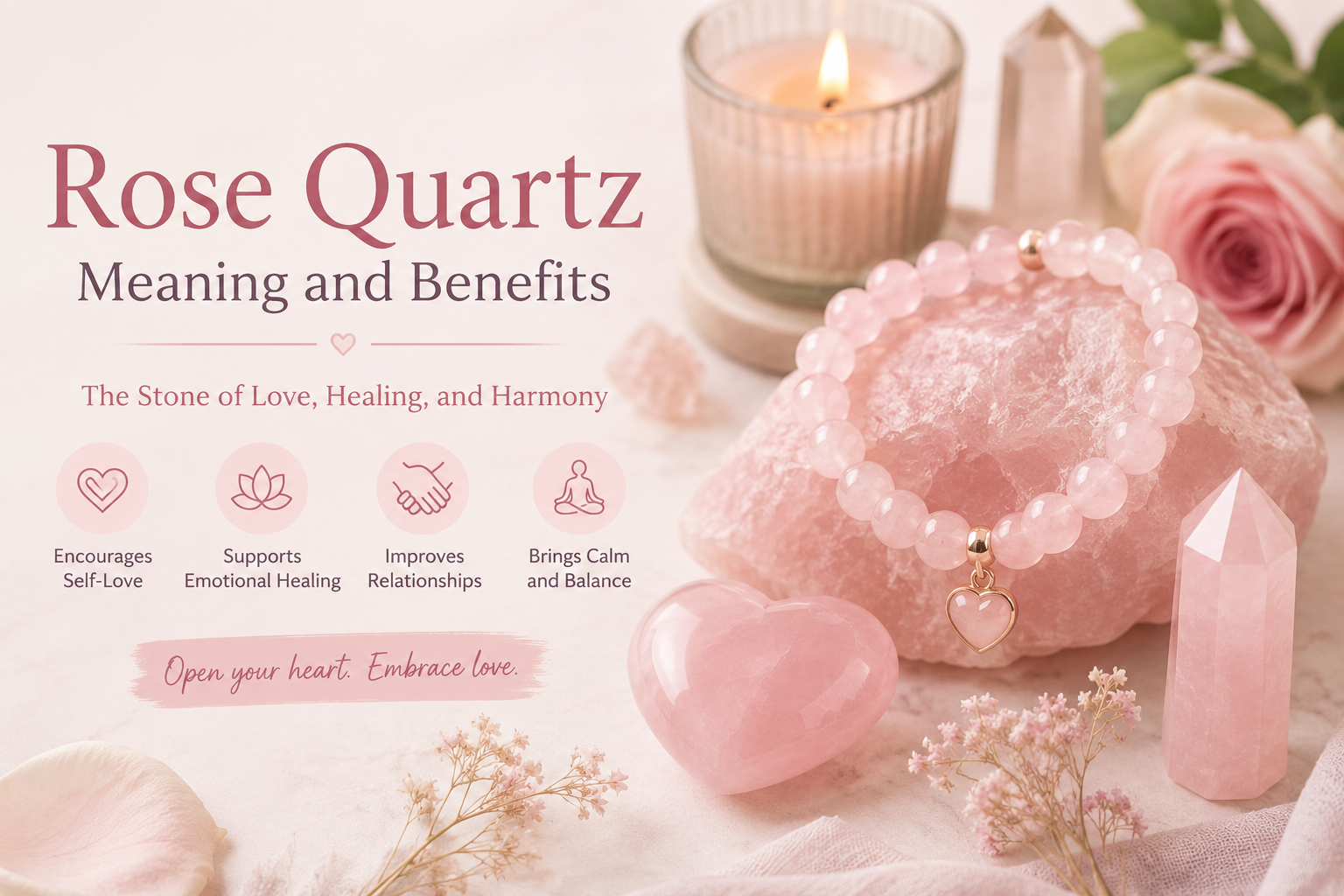
Rose quartz is a useful place to begin if you enjoy pale pink jewelry. Its appeal can be visual, personal, or symbolic: a color that works with your clothes, a gift from someone close, or a private association with kindness. You do not need to choose among those reasons.
Understanding the material makes the choice more satisfying. It also helps distinguish a description of a gemstone from a promise about relationships or emotional recovery.
What makes it rose quartz?
GIA describes rose quartz as a pink variety of quartz, ranging from almost white to deeper pink. Color and appearance vary, so compare the actual beads or finished piece rather than assuming every item with the same name looks alike.
Ask for photographs in ordinary light, dimensions, and a clear material description. A very small bead may give a different impression from a large polished pendant, even when both are correctly identified. Consider how much color you want on the wrist or near the face.
Give meaning a personal sentence
You may see “stone of love” in contemporary jewelry descriptions. Treat it as interpretive language, not a verified feature like bead size. If you want to use that idea, a note such as “I chose pink because it reminds me of our shared garden” makes the message specific.
Rose quartz need not be romantic. It can be a birthday color choice, a friendship gift, or an accessory you buy yourself. The recipient’s own preferences matter more than matching the stone to an assumed emotional need.
If you are choosing a personal reminder for yourself, read our guide to personal meaning and self-kindness for examples of a message you can choose and practical questions to consider before buying.
Choose a form that suits your routine
- For a bracelet, check wrist size, bead diameter, and whether the fastening is manageable.
- For a pendant, consider the whole piece’s weight and the chain length.
- For mixed-material jewelry, ask what the spacers, cord, and metal components contain.
- For a gift, keep the material details and exchange information with the piece.
If you already wear several accessories, compare the design with those rather than viewing it in isolation. A straightforward shape may be easier to combine; a larger carved piece can stand alone.
Care for more than the stone
GIA’s care guidance gives rose quartz Mohs hardness 7 and recommends warm soapy water for the stone, avoiding steam and ultrasonic cleaners. That advice does not automatically cover a bracelet’s elastic, adhesive, wood, or plating.
Follow the maker’s instructions for the complete construction, and ask before soaking an unfamiliar piece. Inspect the fastening as well as the beads.
For practical upkeep, read our bracelet cleaning guide. Explore bracelet gift ideas for the message, and our evidence and culture discussion for broader claims. Rose quartz can be appreciated fully as a material and a chosen symbol.
What can the name tell you about a rose quartz bracelet?
Some people associate pink quartz with affection or use a bracelet as a personal reminder. Such interpretations are not evidence of a medical effect. Choose how to wear it for comfort and personal preference, rather than treating a routine as a required treatment.
GIA describes rose quartz as a pink quartz variety; a pink photograph does not identify a particular bracelet or show whether it was treated. Ask about the seller’s material description, detectable treatments and any report for the specific piece. Do not use scratches, heat or chemicals as an authenticity test.
For a material question that matters to you, GIA describes its colored stone identification report: it assesses the submitted item and addresses natural or laboratory-grown material and detectable treatments. Check the actual report and whether it describes the specific item. A seller photograph or a pink color alone cannot confirm identity.
Fake rose quartz: which claim needs checking?
Material identity
A listing may use “rose quartz” as its material claim, but pink color is not an identification result. Ask the seller to state what the beads are and what supports that description. A wrong material description is a different issue from a disclosed treatment or an uncertain origin.
Natural origin and treatments
The GIA rose-quartz FAQ describes an identification report that addresses whether a material is natural or laboratory-grown and names detectable treatments. Read the result for the submitted item; do not assume a report for a sample establishes every bead in a different bracelet.
A seller’s grade label
GIA says it evaluates rose quartz but does not grade it. If a listing uses “AAA” or another quality label, ask how that seller defines it. Such a label is not a substitute for the stated identification findings, dimensions, photographs and disclosure you need.
A useful buying message is: “For the selected bracelet, please confirm the material claim, known or unknown treatments, bead size and usable wrist circumference, and whether any report describes this actual item.” Keep the answers with the listing. For everyday use, start with fit and the maker’s care guidance for the complete bracelet; a symbolic intention does not identify the material or turn a wearing routine into a treatment.
Comments
Leave a comment
Please note, comments must be approved before they are published.