
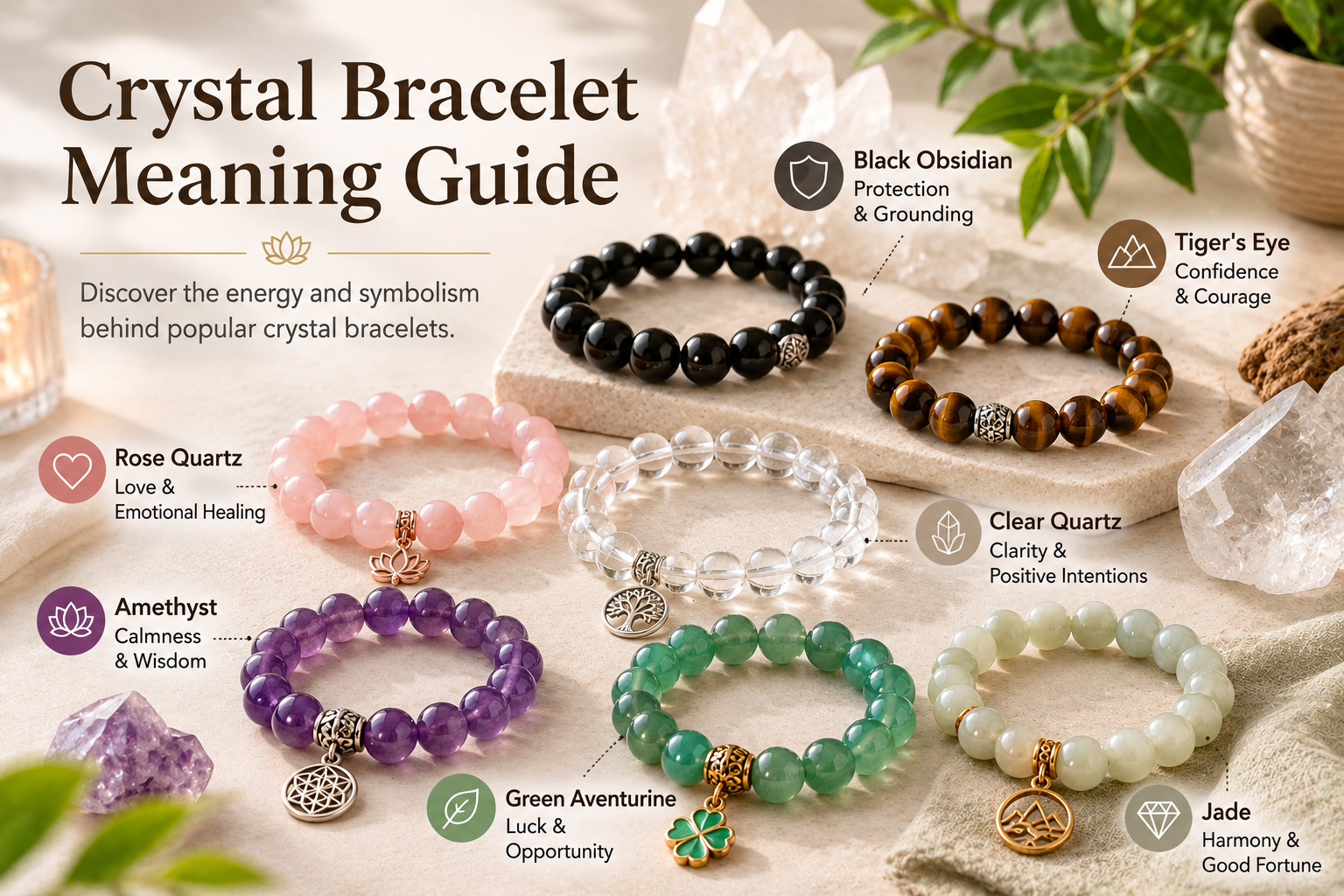
A crystal bracelet can express affection, courage or a personal boundary. Start with the material you enjoy wearing, then choose a meaning you can explain. This guide compares rose quartz, tiger’s eye and obsidian through their appearance and possible personal uses.
The material facts below come from GIA and the National Park Service. The meanings and gift messages are our suggestions, not claims of a universal tradition or proven effects on health, relationships or fortune.
Compare three bracelet materials
- Rose quartz: pink quartz, often with cloudy translucence. A possible personal theme is kindness or affection. Consider it when the wearer likes pink and your message concerns a shared relationship.
- Tiger’s eye: quartz known for a silky, moving reflection. A possible personal theme is courage or attention. Consider it to mark a particular challenge, if the wearer enjoys its appearance.
- Obsidian: volcanic glass rather than a crystalline mineral. A possible personal theme is a boundary or fresh start. Choose it for its appearance and a meaning agreed with the wearer.
These are conversation starters, not rules assigning a stone to each person.
Rose quartz: make affection specific
GIA describes rose quartz as a pink quartz variety, with microscopic inclusions contributing to cloudy translucence. This is a material description to compare with a seller’s listing; a pink bead alone does not establish its identity.
Replace a vague promise of “love” with something you actually want to say. A bracelet for a friend might mark years of support; one for yourself might represent making time for people you care about.
Gift message: “I chose this pink bracelet to thank you for the kindness you have shown me.” Ask whether the recipient likes the color and style before choosing.
Tiger’s eye: connect courage with an action
GIA’s tiger’s-eye exhibit explains its silky optical effect, called chatoyancy, and its use in beads and cabochons. The changing reflection is an appearance to enjoy.
If courage is your theme, name the occasion: a first presentation, a new course or an unfamiliar responsibility. Connect the bracelet with a useful action, such as preparing one question or taking the first small step.
Gift message: “For your new chapter—and a reminder of the preparation you have already done.” This offers encouragement without promising success.
Obsidian: agree on what a boundary means
The National Park Service describes obsidian as glassy rock formed when lava cools rapidly. It is brittle and can chip to sharp edges, so inspect a bracelet for damaged beads rather than choosing by symbolism alone.
A boundary can be a concrete intention: keeping an evening free, declining an extra commitment or pausing before responding. If obsidian represents that intention for you, explain it in your own words.
Gift message: “To mark the time you are making for yourself.” Ask first: an unsolicited suggestion that someone needs protection or stronger boundaries may feel like a judgment.
Choose a meaning the wearer wants
- Start with the person. Ask which colors, patterns and bracelet styles they enjoy. A meaningful gift still needs to be something they want to wear.
- Name one occasion or intention. “Thank you for your support” is clearer than a list of promised benefits.
- Check the object. Read the material description, ask about treatments, and confirm wrist fit and fastening. A symbolic label does not replace product details.
- Write the message. Explain why you chose it in one sentence. Leave the wearer free to give it a different meaning.
If a seller presents an association as an ancient cultural rule, ask which tradition and source supports it. The references here establish material facts, not the suggested gift meanings as historical customs.
Questions to settle before buying
Does a crystal bracelet have one fixed meaning? This guide does not assign one. You can choose an interpretation openly without presenting it as a property of the material.
Can you choose only for appearance? Yes. Liking a color or reflection is a complete reason to enjoy a bracelet; you do not need a spiritual explanation.
What should you read next? Use our daily-wear selection guide for fit and construction, our crystal bracelet care guide for maintenance, and our article on crystal claims and evidence to examine efficacy claims separately.
Comments
Leave a comment
Please note, comments must be approved before they are published.