
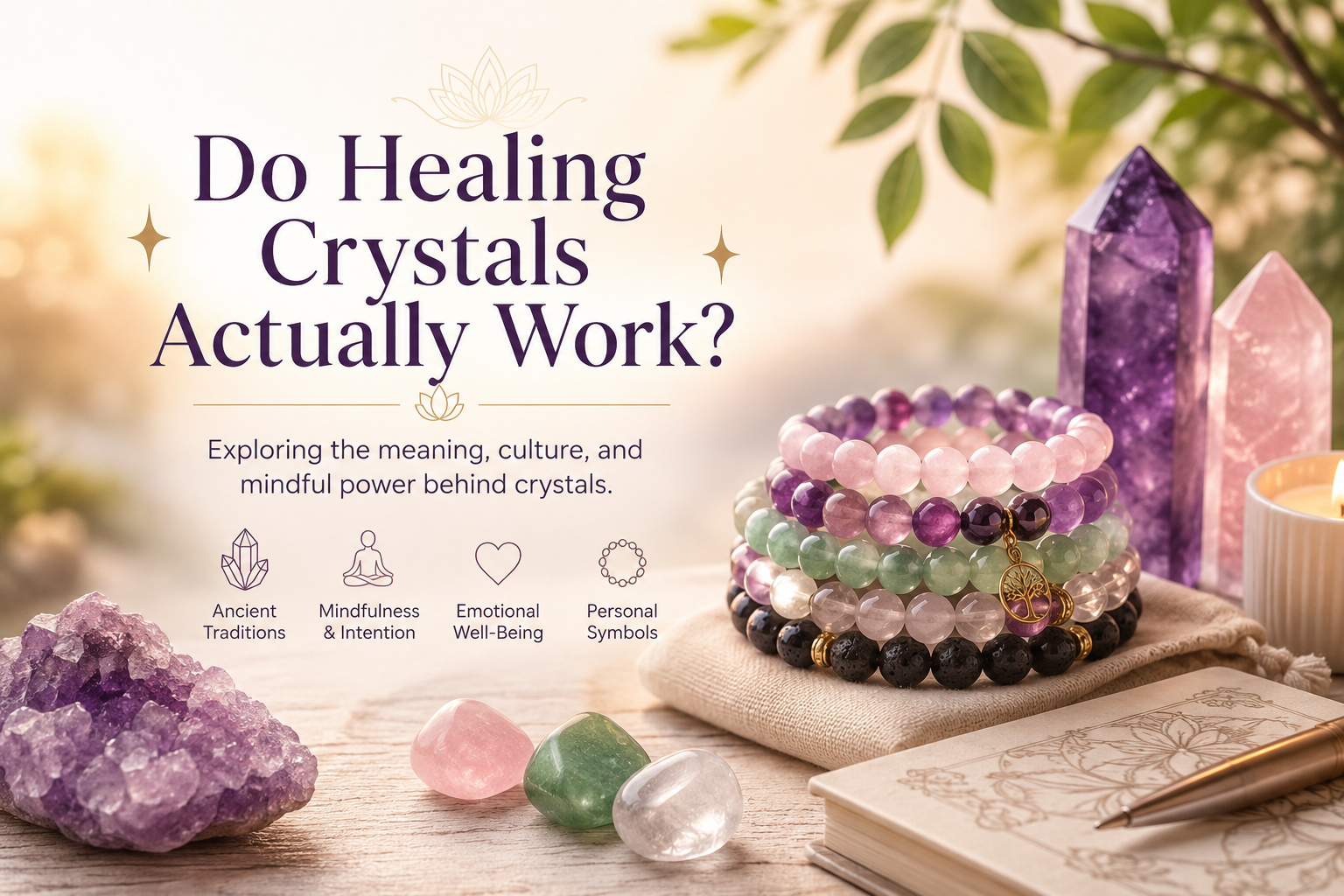
To ask whether healing crystals “work,” first name the proposed result. Looking attractive, marking a memory, reducing anxiety, and treating an illness are different claims. Personal enjoyment needs no clinical trial, but a medical promise requires evidence that tests the actual intervention and outcome.
Calling an object meaningful does not establish that it emits healing energy. Equally, questioning a treatment claim does not prevent someone from appreciating a stone as jewelry or a keepsake.
A relevant controlled study
A 2025 randomized study in CNS Spectrums compared rose quartz with visually matched placebo stones in 138 adults over 14 days. It found no specific anxiety benefit from the real crystal. The sample was nonclinical, so the result should not be presented as a trial of treatment for diagnosed anxiety disorders.
This was one material and protocol, not an experiment on every stone, bracelet, condition, or possible experience. Still, it does not supply evidence for advertising a crystal-specific anxiety treatment. Broader claims require their own appropriate research rather than an appeal to tradition.
Why testimonials are limited
If someone feels better while using a stone, several things may have changed: circumstances, other support, expectations, or the passage of time. A testimonial cannot reliably separate those possibilities or tell another person what effect to expect.
A placebo comparison helps investigate whether the tested object adds something beyond the comparison condition. It should not be turned into advice to self-prescribe a placebo or into a guarantee that belief itself will help everyone.
Cultural meaning answers a different question
The National Palace Museum’s discussion of jade virtues documents a historical ethical interpretation of jade. It is evidence about symbolism, not a clinical demonstration that a mineral treats distress.
Read a cultural account in its named period and setting. Avoid using ancient ornaments as proof of modern health claims, or assuming all minerals and religious communities share one explanation of energy.
A practical way to assess a promise
- Ask exactly what change is claimed and how it was measured.
- Look for a relevant comparison, not only selected testimonials.
- Check whether participants and outcomes match the advertised use.
- Keep ordinary jewelry features separate from health promises.
Persistent symptoms deserve qualified assessment. A bracelet should not replace treatment or lead you to stop prescribed care. You can also choose not to buy: there is no requirement to purchase a mineral to mark an intention or enjoy a quiet moment.
For more context, see our cultural take on bracelet claims. The anxiety bracelet guide discusses health-related limits, and our rose quartz guide introduces a particular material. Enjoyment, belief, and treatment evidence can each be discussed clearly without treating them as interchangeable.
Comments
Leave a comment
Please note, comments must be approved before they are published.