
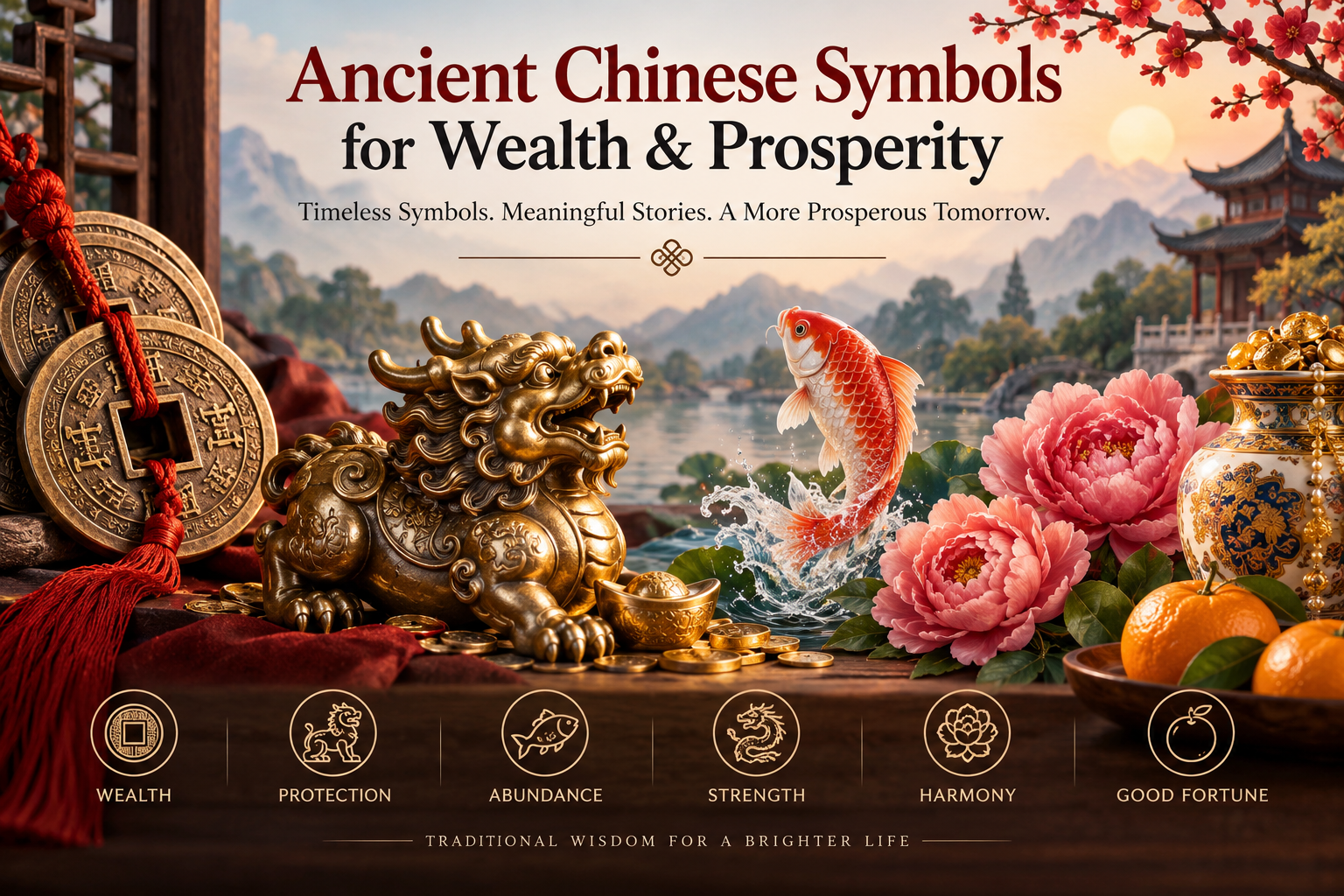
Walk through an old Chinese temple, traditional garden, or antique market, and you may notice the same images appearing again and again: coins, fish, mythical creatures, gourds, and even certain fruits.
They are not simply decorative.
In Chinese culture, symbols have long been used to express wishes that were sometimes difficult to say directly. Wealth was one of them, but traditionally, "prosperity" meant more than becoming rich. It could also mean having enough food, a successful family, good opportunities, and a peaceful life.
Here are some of the most recognizable ancient Chinese symbols connected with wealth and prosperity.
1. Ancient Chinese Coins
Traditional Chinese coins are probably among the easiest wealth symbols to recognize.
Many old coins were round with a square hole in the center. Traditionally, the round shape was associated with heaven, while the square represented earth. Because coins were actual currency, they naturally became symbols of material prosperity as well.
In feng shui traditions, several coins may be tied together with red cord. Many people believe the combination represents prosperity protected or strengthened by auspicious energy.
Today, coin motifs often appear on bracelets, pendants, decorations, and New Year ornaments.
2. Pixiu
Pixiu is one of my favorite Chinese mythical creatures because its story is much more interesting than simply calling it a "wealth animal."
According to traditional legends, Pixiu has an enormous appetite for gold, silver, and treasure. One popular version of the story says that the creature could consume riches but could not release them.
That unusual legend eventually connected Pixiu with the idea of gathering and preserving wealth.
Traditionally, merchants and business owners sometimes kept Pixiu figures nearby. In modern culture, Pixiu is also commonly seen on bracelets.
Many people believe wearing Pixiu represents the intention to attract opportunity and manage wealth carefully. Of course, it should be understood as a cultural symbol rather than a promise of financial success.
3. The Three-Legged Money Frog
Another unusual creature associated with prosperity is the three-legged money frog, often called Jin Chan.
It is commonly shown sitting on coins, sometimes with a coin in its mouth.
One traditional story connects Jin Chan with Liu Hai, a legendary figure who supposedly lured the magical creature from hiding using strings of coins. Over time, the image became associated with wealth arriving at one's home or business.
In feng shui-inspired decoration, the money frog is still popular today.
4. Fish and the Carp
Fish have a clever connection with prosperity because of language.
In Chinese, the word for fish, "yu," sounds like another word meaning "surplus" or "abundance." This is why the expression "nian nian you yu" expresses the wish to have abundance year after year.
Carp have another layer of meaning.
An old Chinese legend tells of carp swimming upstream and attempting to leap over the Dragon Gate. A carp that succeeded could transform into a dragon.
Because of this story, the carp became associated not only with abundance, but also with perseverance, achievement, and rising to a better position in life.
5. The Chinese Dragon
Western stories sometimes portray dragons as dangerous monsters guarding treasure. The traditional Chinese dragon is quite different.
In China, dragons were historically associated with power, rain, vitality, authority, and good fortune.
Rain was especially important in agricultural societies. Good rainfall could mean healthy crops, sufficient food, and prosperity for an entire community.
This helps explain why dragon imagery became connected with abundance as well as power.
6. The Wealth Vase
The wealth vase is another traditional symbol that appears in Chinese and Tibetan cultural traditions.
It is usually represented as a vessel filled with precious objects, coins, grains, gemstones, or other treasures.
Symbolically, the important idea is not simply "getting money." The vessel represents something valuable being accumulated, protected, and preserved.
I think this older interpretation feels surprisingly modern. Earning wealth is one thing; keeping and managing it wisely is another.
7. Peony Flowers
Not every prosperity symbol looks like money.
The peony has traditionally been associated with wealth, honor, beauty, and high social status. In historical Chinese art, particularly paintings and decorative objects, lush peonies often suggested an elegant and prosperous life.
This is why the peony is sometimes called the "king of flowers."
For jewelry and decorative art, peonies offer a softer way to express prosperity than coins or mythical wealth creatures.
8. Mandarin Oranges
During Chinese New Year, oranges and mandarins are everywhere.
Part of their popularity comes from their bright golden color, which naturally recalls gold and abundance. Wordplay and regional pronunciation also contribute to their auspicious associations.
Traditionally, giving oranges during the New Year can express wishes for good fortune and prosperity.
In this case, the symbol is not an ancient mythical creature at all. It is an ordinary fruit carrying generations of cultural meaning.
Wealth Was Never Just About Money
What I find most interesting about traditional Chinese prosperity symbols is how rarely they represent money alone.
A fish can mean abundance. A carp can represent persistence. A dragon can suggest strength and favorable conditions. A peony can represent an abundant, honorable life. Pixiu can symbolize gathering and protecting resources.
Together, these symbols reflect an older idea of prosperity: having enough, making progress, protecting what you have, and hoping that the next generation will live well.
Many people believe these symbols bring good luck. Others simply wear or display them because they appreciate the history, craftsmanship, or story behind them.
Either way, you do not have to believe that a symbol has supernatural power to find meaning in it. Sometimes, an ancient coin, a small Pixiu bracelet, or a carved jade fish is simply a reminder of a wish people have shared for centuries: may life become a little more abundant, secure, and fortunate.
Comments (0)
No comments yet. Be the first to comment!
Leave a Comment
Please note, comments must be approved before they are published.