
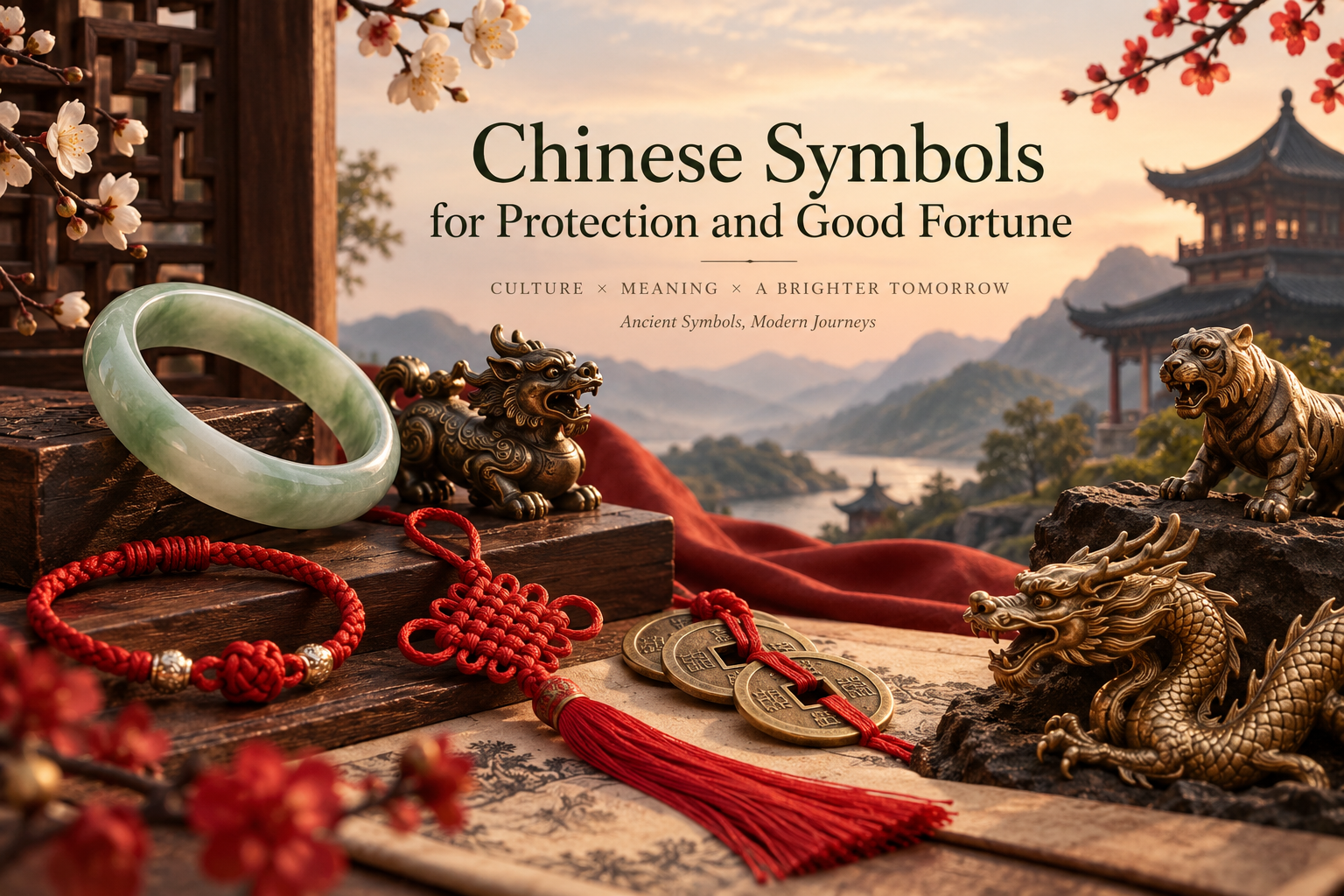
Walk through an old Chinese neighborhood, visit a traditional family home, or browse a small jewelry shop, and you may notice the same symbols appearing again and again: red cords, jade pendants, mythical creatures, coins, knots, and protective animals.
They are not simply decorations.
In Chinese culture, symbols have long been used to express wishes that are difficult to put into words: "Stay safe," "May things go smoothly," "I hope prosperity finds you," or simply, "Take care of yourself."
Of course, wearing a symbol does not guarantee protection or good luck. But many people believe these objects can serve as meaningful reminders of family, hope, balance, and positive intention.
Here are some of the most recognizable Chinese symbols associated with protection and good fortune.
1. Jade: Protection, Virtue, and Peace
Jade is probably one of the most enduring protective symbols in Chinese culture.
For thousands of years, jade has been valued for more than its beauty. Traditionally, it was associated with virtue, purity, longevity, and protection.
There is even an old belief that a jade bracelet or pendant may "protect its wearer" during difficult moments. You may hear stories of a jade bracelet suddenly cracking after an accident or stressful event. Some families interpret this as the jade having "taken the misfortune" for its owner.
Whether you believe that literally or not, the story explains why jade jewelry can feel deeply personal.
In many Chinese families, jade is also given by parents or grandparents to younger family members as a quiet wish for safety and a peaceful life.
2. Red String: A Simple Symbol of Protection
Few things look simpler than a red string tied around the wrist, yet red carries enormous cultural weight in China.
Traditionally, red represents happiness, vitality, celebration, and good fortune. It appears everywhere from weddings and Lunar New Year decorations to red envelopes and protective charms.
Many people believe a red string bracelet can symbolize protection from negative influences while attracting positive energy.
For me, its appeal is partly its simplicity. You do not need a large pendant or complicated design. A thin red cord can carry the message, "May you be safe and fortunate," without saying anything at all.
3. Pixiu: A Guardian of Wealth
Pixiu is a mythical Chinese creature often described as resembling a powerful winged lion or dragon-like beast.
In traditional folklore, Pixiu is known for seeking treasures and guarding wealth. Because of this, it became especially popular in Feng Shui and is commonly seen in bracelets, pendants, statues, and home decorations.
Many people believe Pixiu represents both protection and prosperity: guarding what you already have while symbolically welcoming new opportunities.
That does not mean a Pixiu bracelet magically creates wealth. A more grounded way to understand it is as a cultural symbol of ambition, financial awareness, and the desire to protect one's resources.
4. The Chinese Knot: Good Fortune That Continues
The traditional Chinese knot is one of my favorite symbols because its meaning comes partly from its structure.
A knot is formed from a continuous cord, weaving through itself without easily breaking apart. Traditionally, this continuous form has been associated with connection, harmony, longevity, and lasting good fortune.
Red Chinese knots are often displayed in homes, shops, cars, and during festivals.
They are also incorporated into bracelets and pendants, where the knot can represent a wish for good things to remain connected to the wearer.
5. The Dragon: Strength and Auspicious Power
Western stories often portray dragons as dangerous creatures. In Chinese culture, the image is quite different.
The Chinese dragon is traditionally associated with strength, vitality, rain, authority, and auspicious power.
Historically, dragons were closely connected with imperial symbolism, but they also became broader cultural symbols of confidence and good fortune.
Today, dragon jewelry is sometimes worn as a personal reminder of courage and resilience rather than as a literal protective charm.
6. The Tiger: Courage Against Negative Forces
In traditional Chinese folk culture, the tiger has long been viewed as a powerful guardian.
Its fierce appearance made it a natural symbol for driving away harmful influences. In some regions, children traditionally wore tiger-head hats or tiger-themed shoes. These were not just cute designs; they represented a family's wish that the child would grow up healthy and strong.
This is a good example of how protection symbols often worked in everyday life. They were woven into clothing, gifts, jewelry, and family traditions.
7. Ancient Chinese Coins: Prosperity and Protection
Traditional round coins with square holes frequently appear in Feng Shui decorations and jewelry.
The circular outer shape and square center have been interpreted as representing heaven and earth. Over time, old-style coins also became natural symbols of prosperity because, quite simply, they represented money.
You may see three, six, or more coins tied together with red cord.
Many people believe these combinations symbolize good fortune and financial stability, although their exact meanings can vary between traditions and modern Feng Shui practices.
Why These Symbols Still Matter
What I find interesting about Chinese protective symbols is that their value does not depend entirely on whether you believe in their supernatural power.
A jade bracelet from your grandmother can remind you of home. A red string given by a partner can represent connection. A Pixiu bracelet might remind someone to stay focused on financial goals. A Chinese knot hanging near the door can simply express the hope that life continues smoothly.
In Japan, you can find a somewhat similar relationship with objects such as omamori, small amulets traditionally associated with wishes for safety, health, study, travel, or relationships. The traditions are different, but the human idea behind them feels familiar: sometimes we like carrying a physical reminder of what we hope for.
Choosing a Symbol for Yourself
If you are choosing Chinese symbolic jewelry, I would start with meaning rather than asking, "Which one is the luckiest?"
Choose jade if you appreciate its connection with peace, virtue, and protection. Choose red string if you prefer something simple and understated. Pixiu may appeal to someone focused on prosperity and personal goals, while a Chinese knot can be meaningful for relationships, continuity, and lasting good wishes.
Traditionally, these symbols were never just about decoration. They carried stories from one generation to another.
And perhaps that is why they still feel relevant today.
You do not have to believe that a bracelet can change your destiny. Sometimes wearing a symbol is simply a way of carrying an old idea with you: stay safe, stay hopeful, and welcome good things when they come.
Comments (0)
No comments yet. Be the first to comment!
Leave a Comment
Please note, comments must be approved before they are published.