
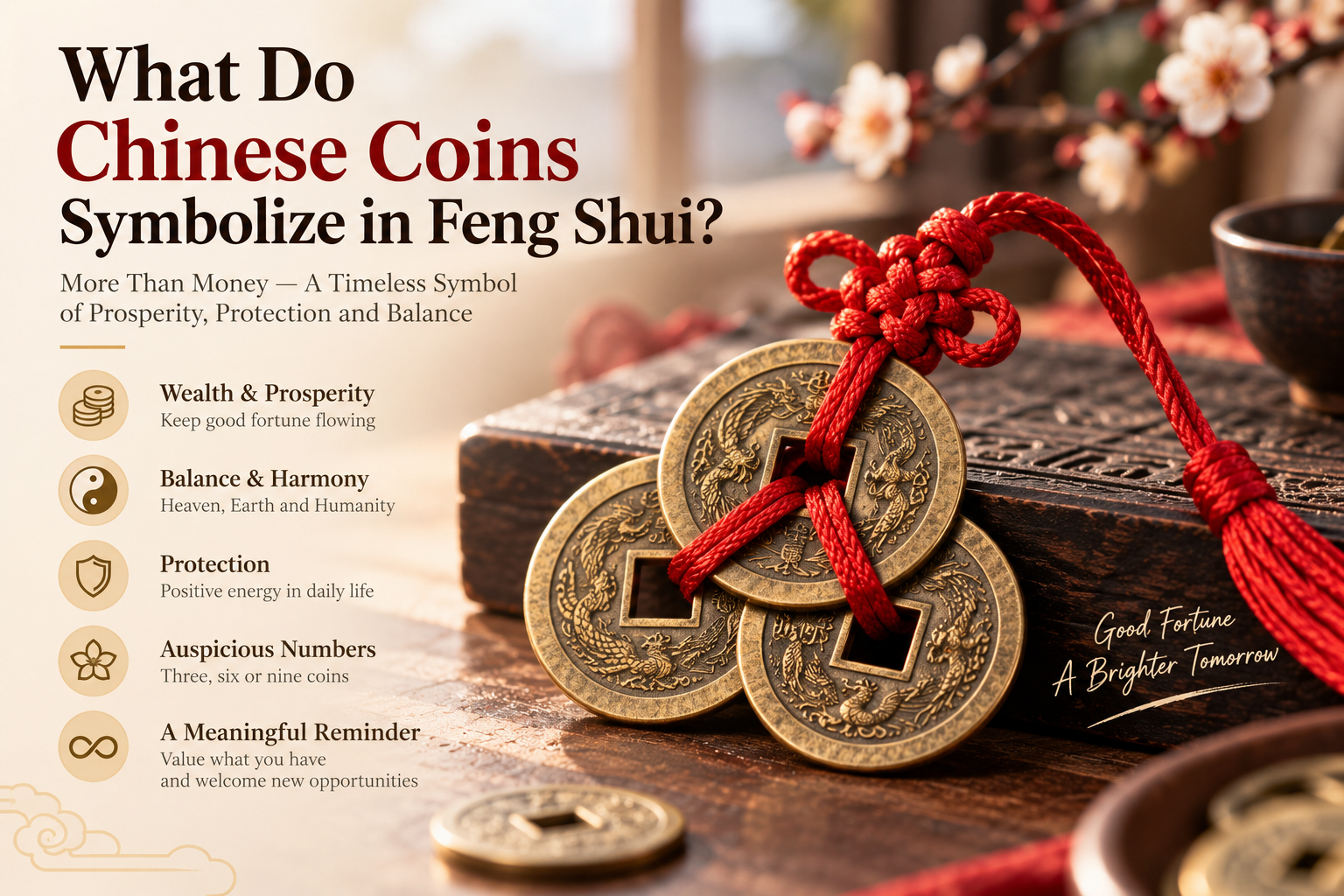
If you have ever looked closely at a Feng Shui bracelet, traditional Chinese decoration, or old-style wealth charm, you may have noticed a small round coin with a square hole in the center.
At first glance, it looks like nothing more than an old coin. But in Chinese culture, this simple shape has carried layers of meaning for centuries.
Traditionally, Chinese coins are associated with wealth, prosperity, protection, and the idea of keeping good fortune in circulation. In Feng Shui, many people believe they can serve as symbolic reminders to welcome opportunity, manage wealth wisely, and create a more balanced environment.
But the story behind them is more interesting than simply "coins equal money."
Why Are Traditional Chinese Coins Round With a Square Hole?
One of the most recognizable features of traditional Chinese cash coins is their shape: a circular outer edge surrounding a square hole.
In traditional Chinese symbolism, the circle was often associated with Heaven, while the square was connected with Earth. Together, the two shapes could represent harmony between Heaven and Earth.
There was also a very practical reason for the hole. Coins could be threaded onto cords, making large quantities easier to carry and count.
Over time, however, the design gained a symbolic life of its own. In Feng Shui traditions, many people see the combination of circle and square as representing balance, order, and the connection between different forces in life.
Why Are Chinese Coins Associated With Wealth?
The simplest explanation is also the most obvious: coins were money.
For centuries, Chinese cash coins circulated through markets, households, and trade routes. A string of coins represented real purchasing power, so it is not surprising that coins gradually became visual symbols of prosperity.
But traditionally, wealth was not always understood as sudden riches.
In Chinese culture, prosperity could also mean having enough food, a stable household, successful work, healthy family relationships, and resources that lasted from one generation to the next.
This is why Chinese coin symbolism often feels less like "get rich quickly" and more like "may prosperity continue to flow."
The Meaning of Three Chinese Coins
You will often see three Chinese-style coins tied together with a red cord.
Why three?
In traditional Chinese thought, the number three can represent the relationship between Heaven, Earth, and Humanity. Because of this, three coins are commonly used in modern Feng Shui practices as a symbol of balanced prosperity.
The red cord adds another layer of meaning. In Chinese culture, red is traditionally associated with celebration, vitality, good fortune, and protection.
So when coins and red cord appear together, the design combines two familiar symbols: prosperity and auspicious energy.
Many people believe this makes the three-coin charm meaningful for a wallet, desk, doorway, or bracelet, although the practice is cultural and symbolic rather than a guarantee of financial results.
What About Six or Nine Coins?
Different numbers may carry different associations in Feng Shui traditions.
Six is often connected with smooth progress and favorable circumstances, while nine has long been regarded as an important and auspicious number in Chinese culture, historically carrying associations with longevity, completeness, and imperial symbolism.
You may therefore find Chinese coin arrangements made with three, six, or nine coins.
There is no single arrangement that everyone follows. Feng Shui customs vary by school, family tradition, region, and modern interpretation.
Chinese Coins as Protective Symbols
Interestingly, old coins were not used only to symbolize money.
In some Chinese folk traditions, coins were incorporated into protective charms. Old coins might be tied together, carried as amulets, or combined with red cord and other auspicious objects.
Part of their symbolic power came from the idea that an object that had passed through many hands carried a history of human activity and "yang" energy.
Today, many people wear Chinese coin bracelets or carry coin charms less as literal protection and more as personal symbols of confidence, stability, and good intentions.
Where Are Chinese Coins Used in Feng Shui?
In modern Feng Shui practice, Chinese-style coins appear almost everywhere: bracelets, necklaces, keychains, wallets, desk decorations, doorway charms, and decorative knots.
Some people place them near a workspace or business area as a reminder of growth and opportunity. Others keep coins inside a wallet to symbolize financial abundance.
You may also see coins combined with Pixiu, jade, red string, or Chinese knots. Each element adds its own cultural meaning. Pixiu, for example, is traditionally associated with attracting and guarding wealth, while jade has long been connected with virtue, protection, and good fortune.
The result is less like a magical formula and more like a small collection of cultural symbols telling the same story: protect what you have, welcome opportunity, and value prosperity.
A Symbol, Not a Promise
This is probably the most important thing to understand about Feng Shui coins.
Carrying three coins in your wallet will not automatically change your bank balance.
For many people, the value is symbolic.
A coin charm might remind someone to save money, pay attention to opportunities, appreciate what they already have, or approach work with a more positive mindset.
In that sense, Feng Shui objects can function a little like meaningful jewelry, family keepsakes, or lucky charms found in cultures around the world.
Their importance comes from the stories and intentions people attach to them.
Final Thoughts
Chinese coins are among the simplest Feng Shui symbols, but they carry a surprisingly rich history.
Their round shape and square center have been associated with Heaven and Earth, while their original role as currency naturally connected them with prosperity and abundance. When paired with red cord, Chinese knots, jade, or Pixiu, their symbolic meaning becomes even richer.
Traditionally, Chinese coins represent more than money alone. They can suggest balance, continuity, protection, opportunity, and the hope that good fortune continues to circulate rather than disappear.
Perhaps that is why the symbol has survived long after the original coins stopped being everyday currency.
For many people today, a Chinese coin charm is not a promise that wealth will suddenly arrive. It is something quieter: a small reminder to respect what you have, stay open to opportunity, and keep good things moving forward.
Comments (0)
No comments yet. Be the first to comment!
Leave a Comment
Please note, comments must be approved before they are published.