
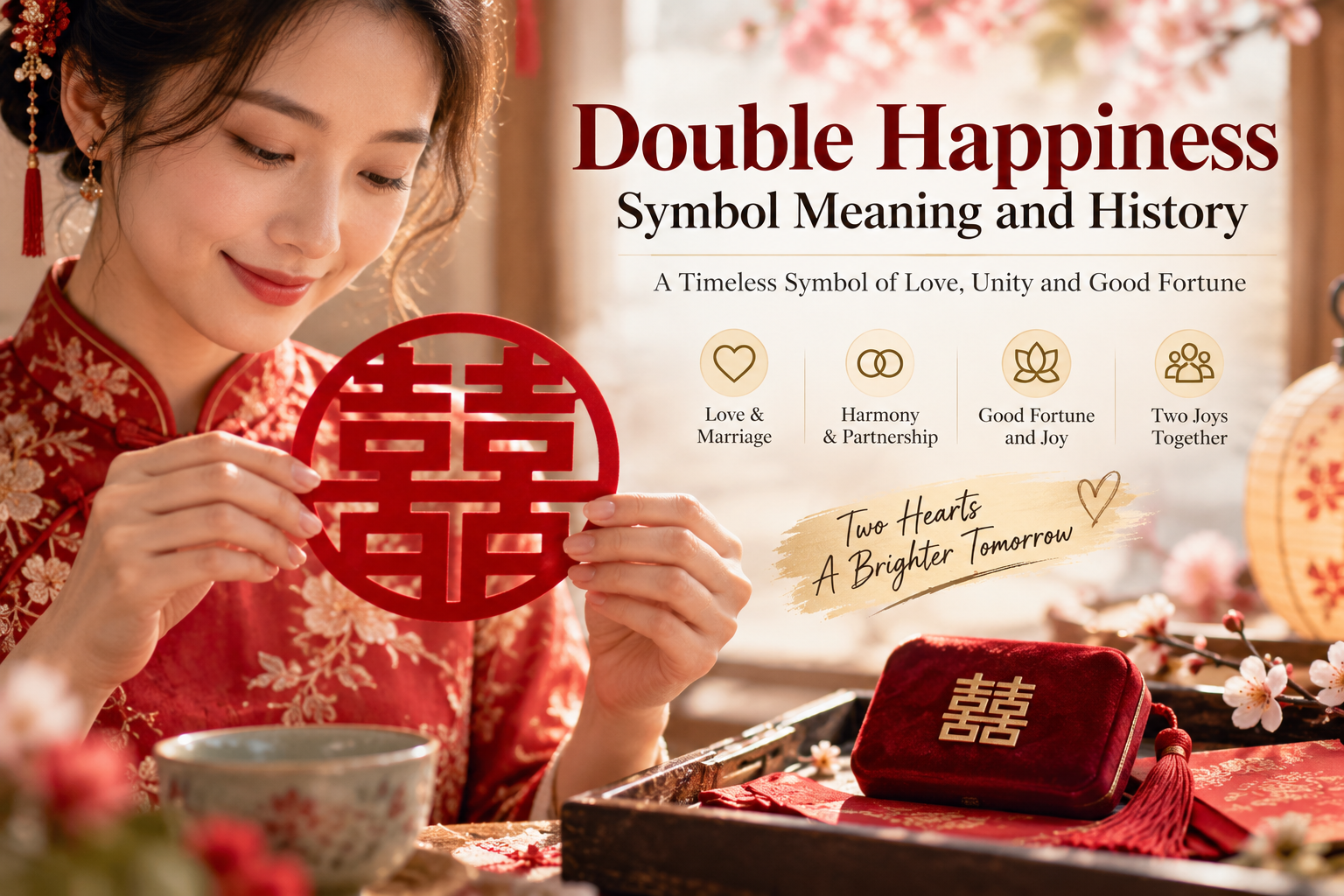
If you have ever attended a traditional Chinese wedding, visited a Chinese wedding shop, or looked closely at Chinese-inspired jewelry, you may have seen a striking red symbol that looks almost symmetrical.
It is called the Double Happiness symbol, written as "囍" and commonly pronounced "shuāng xǐ" in Mandarin.
At first glance, it may look like a complicated Chinese character. But its meaning is surprisingly simple: two joys coming together.
Traditionally, the Double Happiness symbol has been closely associated with marriage, celebration, harmony, and the hope that two people will build a happy life together.
What Does the Double Happiness Symbol Mean?
The symbol "囍" is created by placing two "喜" characters side by side.
"喜" means "joy," "happiness," or "a happy occasion."
Put two together, and the idea becomes "double happiness."
In Chinese culture, this is especially meaningful in marriage. Rather than representing happiness for only one person, the paired characters suggest two people sharing happiness together.
That is why you will often see the symbol on wedding invitations, doors, gift boxes, decorations, jewelry, and red envelopes.
Many people believe the symmetry of the design also makes it especially suitable for weddings. Two nearly identical halves stand beside each other, visually reflecting partnership and togetherness.
The Traditional Story Behind Double Happiness
One popular story about the Double Happiness symbol is connected with Wang Anshi, a famous scholar and statesman of China's Song dynasty.
According to the traditional tale, when Wang Anshi was traveling to take the imperial examination, he encountered a family displaying half of a poetic couplet and looking for someone clever enough to complete it.
Wang continued his journey and eventually reached the examination.
During the test, he was supposedly given another literary challenge that happened to provide the perfect answer to the unfinished couplet he had seen earlier.
He passed the examination and later returned to the family. After successfully completing their couplet, he married their daughter.
Two pieces of good news had arrived together: success in the imperial examination and marriage.
The story says that Wang wrote two "喜" characters together to celebrate his "double happiness."
Whether every detail of this popular legend can be treated as literal history is another question, but the story beautifully explains how Chinese tradition came to associate "囍" with two joyful events arriving together.
Why Is Double Happiness Used at Chinese Weddings?
Walk into a traditional Chinese wedding setting and you may see "囍" almost everywhere.
Traditionally, red paper cutouts of the symbol were placed on doors, windows, walls, mirrors, and furniture. Today, it can also appear on wedding invitations, tea sets, jewelry, gift packaging, and modern reception decorations.
Red matters too.
In Chinese culture, red has long been associated with celebration, vitality, good fortune, and important life events. A red Double Happiness symbol therefore combines two powerful visual traditions: the color of celebration and the character for joy.
But the symbol is not simply saying, "Good luck."
Its deeper message is about shared happiness.
Marriage brings together two people and, traditionally, two families. Many people believe the paired "喜" characters express the hope that happiness will be multiplied rather than divided when two lives come together.
Double Happiness in Jewelry and Gifts
The symbol has gradually moved beyond wedding decorations.
Today, you may find Double Happiness designs on pendants, bracelets, earrings, rings, ornaments, and other culturally inspired objects.
When given as a wedding or engagement gift, the meaning is usually easy to understand: a wish for happiness, harmony, and a lasting partnership.
In jewelry, I think the symbol becomes especially interesting because it can be quite subtle. Someone unfamiliar with Chinese characters might simply see a balanced geometric design, while someone who knows its background sees a centuries-old symbol of marriage and shared joy.
That hidden layer of meaning is part of what makes traditional symbols so appealing in modern design.
Is Double Happiness Only for Marriage?
Traditionally, "囍" is strongly connected with weddings, so marriage remains its most recognizable meaning.
It is different from broader Chinese lucky symbols that can be used almost anywhere.
Still, modern interpretations can be more flexible. Some people see Double Happiness as representing partnership, harmony, two fortunate events, or simply happiness shared between people.
If you are choosing it as a gift, however, understanding its wedding connection is useful. Giving Double Happiness jewelry to newlyweds, an engaged couple, or a partner usually feels much more culturally natural than treating it as a generic good-luck symbol.
A Symbol That Still Feels Modern
What I like about Double Happiness is how little explanation the basic idea really needs.
Two people. Two joys. One shared life.
The symbol comes from Chinese writing and wedding tradition, but the emotion behind it is remarkably universal.
In modern Chinese weddings, you can still see "囍" beside flowers, candles, contemporary dresses, and minimalist decorations. Styles have changed dramatically, yet the old symbol continues to fit.
Perhaps that is why it has lasted.
Traditionally, Double Happiness does not promise that a marriage will always be perfect. Instead, it expresses a hope: that two people entering a new chapter will find happiness together.
And sometimes, a symbol does not need to promise anything more than that.
Comments (0)
No comments yet. Be the first to comment!
Leave a Comment
Please note, comments must be approved before they are published.