
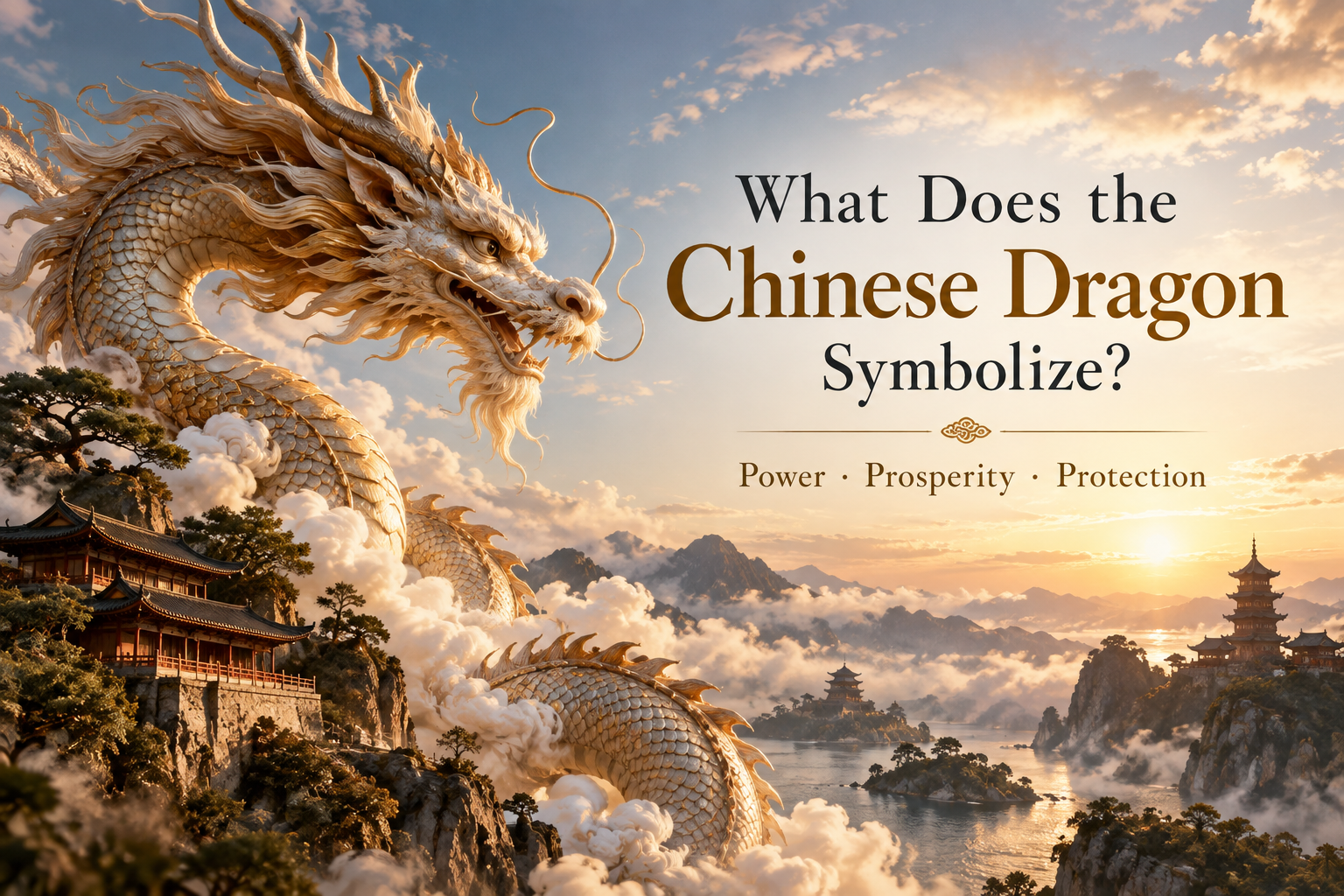
If you grew up with Western fairy tales, the word "dragon" might bring to mind a fire-breathing creature guarding treasure in a dark cave. In Chinese culture, however, the dragon has a very different personality.
The Chinese dragon, or long (龙), has traditionally been associated with power, good fortune, rain, prosperity, and protection. Rather than being a monster that must be defeated, it is often portrayed as an auspicious creature connected with the natural world.
That difference is one reason the dragon can be confusing, and fascinating, to people encountering Chinese symbolism for the first time.
The Dragon as a Symbol of Power
Traditionally, the dragon represented extraordinary power and authority.
This became especially visible in imperial China. Dragons appeared on robes, architecture, furniture, ceramics, and objects associated with the imperial court. The emperor was closely connected with dragon imagery, while specific designs and numbers of claws could carry meanings related to rank and status.
But the dragon's power wasn't simply about ruling over others.
In traditional stories, dragons could command clouds, wind, and water. Their strength came from their connection with forces larger than human beings. In that sense, the dragon represented a kind of natural authority: powerful, unpredictable, but also capable of bringing life.
Why Are Chinese Dragons Connected With Water?
One of the most interesting differences between Chinese and Western dragons is their relationship with water.
In Chinese folklore, dragons are closely associated with rivers, lakes, seas, clouds, and rainfall. Stories of Dragon Kings, known as Longwang, describe powerful beings who ruled over bodies of water and influenced the weather.
For farming communities, rain could mean the difference between a good harvest and a difficult year. It isn't surprising, then, that dragons became associated with abundance and prosperity.
Traditionally, people sometimes prayed to dragon deities for rain during periods of drought.
This is also why you often see Chinese dragons surrounded by swirling clouds or waves. These details aren't merely decorative. They reflect an older relationship between the dragon, water, weather, and agricultural life.
A Symbol of Good Fortune and Prosperity
Many people believe the dragon is an auspicious symbol that can represent good fortune, success, and prosperity.
You'll often see dragon imagery during celebrations, especially around Chinese New Year. The famous dragon dance is probably the clearest example.
A long dragon figure is carried by a team of performers who make it twist, rise, and flow through the street. Traditionally, performances like these are associated with welcoming good fortune and creating an energetic atmosphere for the new year.
The dragon's connection with prosperity also explains why it frequently appears alongside other auspicious symbols in jewelry, carvings, paintings, and decorative objects.
The Dragon and Protection
The Chinese dragon can also symbolize protection.
Unlike the terrifying dragons of some European legends, Chinese dragons were often imagined as powerful guardians or spiritual beings. Their strength made them natural symbols for keeping harmful influences at a distance.
This doesn't mean that every dragon object was historically treated as a magical protective charm. Context matters.
Still, in modern jewelry and decorative art, many people choose dragon designs because they personally associate them with courage, protection, and inner strength.
Sometimes the meaning is cultural. Sometimes it's spiritual. And sometimes someone simply likes what the dragon represents.
The Dragon and the Pearl
If you look closely at traditional Chinese dragon art, you may notice something interesting: a dragon chasing or holding a glowing pearl.
This "dragon pearl" has several interpretations.
Traditionally, it has been associated with wisdom, spiritual energy, perfection, or something precious that is worth pursuing. In some artworks, two dragons appear facing a single pearl, creating the famous "two dragons playing with a pearl" motif.
There isn't one universal explanation for every version of the image. Still, I like the idea of the dragon pursuing something valuable that isn't simply material wealth.
It gives the symbol another layer: strength guided by purpose.
Is the Chinese Dragon the Same as the Japanese Dragon?
Chinese and Japanese dragon traditions are closely connected, but they aren't identical.
Dragon imagery reached Japan through centuries of cultural exchange with China and developed its own local forms. In Japanese tradition, dragons, or ryū, are also strongly associated with water, rainfall, oceans, and spiritual power.
You can find dragons in Japanese temples, paintings, legends, and traditional art.
Visually, one commonly mentioned difference is that Chinese imperial dragons are often depicted with five claws, while many Japanese dragons are shown with three. However, historical artwork varies, so this shouldn't be treated as an absolute rule.
In both cultures, the dragon is far more complex than the "evil monster" image familiar from many Western stories.
What Does a Dragon Mean in Jewelry Today?
Today, dragon jewelry can carry several meanings at once.
For one person, a dragon bracelet or pendant may represent strength and confidence. For another, it may symbolize protection, prosperity, ambition, or a connection with Chinese culture.
Many people believe wearing meaningful symbols can serve as a personal reminder of the qualities they want to cultivate. A dragon doesn't have to promise wealth or supernatural protection to have value.
It might simply remind someone to stay resilient during a difficult period, pursue a goal with confidence, or respect the traditions behind the symbol.
That personal interpretation is part of what keeps ancient symbols relevant.
More Than a Mythical Creature
The Chinese dragon has survived for thousands of years because its meaning has never been limited to one idea.
It can represent power without necessarily representing aggression, prosperity without being only about money, and protection without being simply a lucky charm.
Traditionally, the dragon connected people with rain, rivers, emperors, legends, and the mysterious forces of nature. Today, it continues to appear everywhere from festivals and architecture to fashion and jewelry.
Perhaps that's the most interesting thing about the Chinese dragon.
It is an ancient symbol that continues to change with the people who carry it, while still keeping a connection to the stories that came before.
Comments (0)
No comments yet. Be the first to comment!
Leave a Comment
Please note, comments must be approved before they are published.