
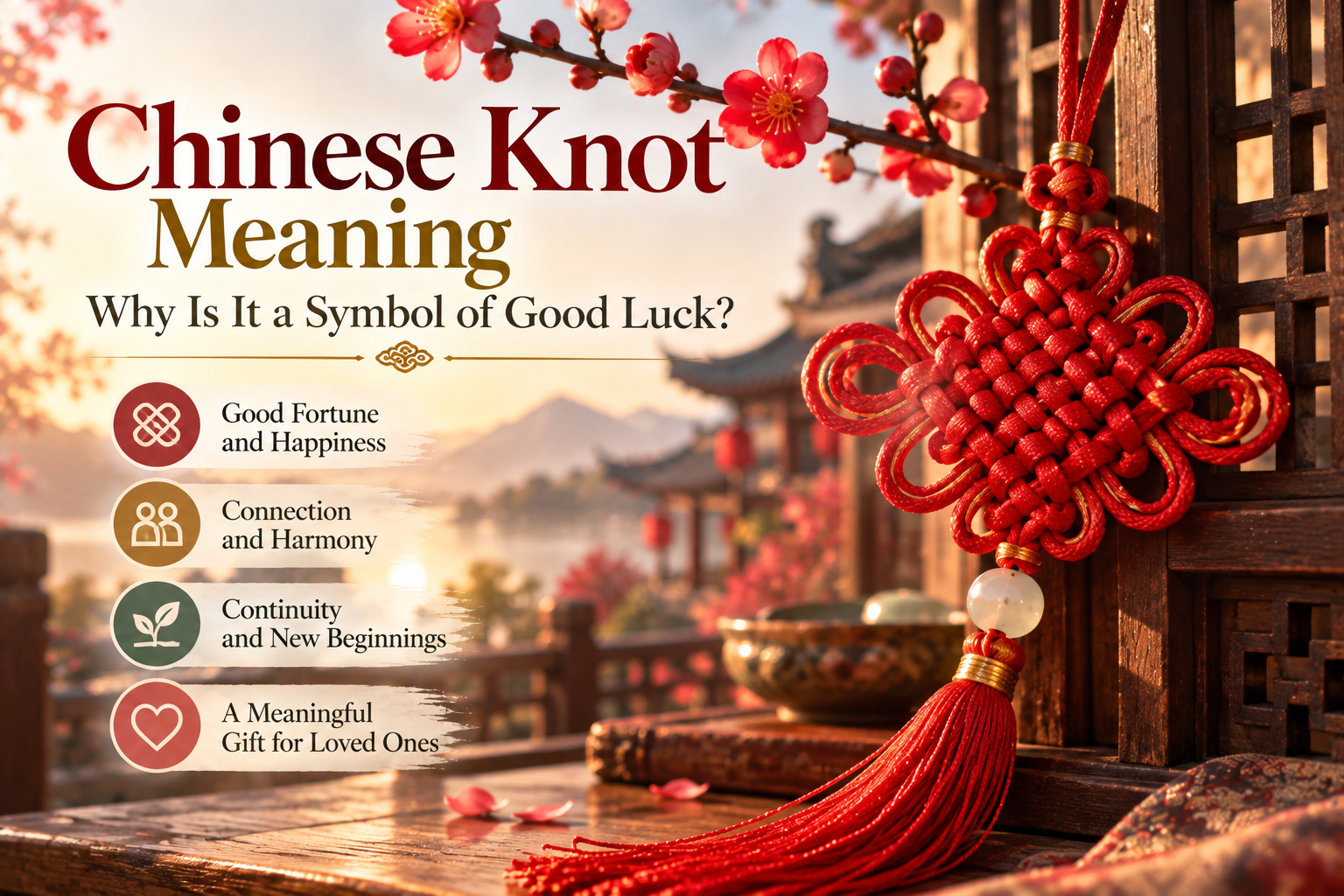
Walk into a traditional Chinese home, especially around Lunar New Year, and there is a good chance you will notice something red hanging near a doorway, window, or piece of furniture.
At first glance, it may look like a decorative tassel. Look closer, though, and you will see that the design is made from carefully woven cord, often forming an intricate, symmetrical pattern.
This is the Chinese knot, or "中国结" (zhōngguó jié).
Today, Chinese knots appear on everything from home decorations and festival ornaments to bracelets, jade pendants, bags, and gifts. But traditionally, a knot was more than something beautiful. Many people believe it represents connection, continuity, harmony, and good fortune.
So why did a simple piece of cord become such a recognizable symbol of luck?
The Meaning Behind the Chinese Knot
One of the most interesting things about Chinese knotting is that a complex design can often be created from a single continuous cord.
The cord bends, crosses, loops, and returns to itself without appearing to have a clear beginning or end.
That visual continuity is part of its symbolism.
Traditionally, an unbroken cord could suggest long-lasting relationships, family unity, continuity, and a life that moves forward without unnecessary interruption.
This is also why Chinese knots are often associated with wishes rather than guarantees. A knot does not "promise" that something good will happen. Instead, it can represent what someone hopes to carry into the future: peace, love, prosperity, health, or happiness.
I think this is one reason the symbol still feels surprisingly modern. You do not have to believe in luck literally to appreciate the idea of tying a meaningful wish into something you can keep.
Why Are Chinese Knots Usually Red?
If you have seen Chinese knots before, you have probably noticed one color appearing again and again: red.
That is not accidental.
In Chinese culture, red has traditionally been associated with happiness, celebration, vitality, and good fortune. It appears prominently during weddings, Lunar New Year celebrations, birthdays, and other important occasions.
There is also an old connection between red and protection.
In traditional stories surrounding the Lunar New Year, the mythical beast Nian was said to fear loud noises, fire, and the color red. Families used red decorations and firecrackers to drive it away. Over time, red became deeply connected with the idea of welcoming an auspicious new beginning.
Combine that symbolism with a carefully tied knot, and the meaning becomes even richer.
Red represents the wish for good fortune, while the knot represents connection and continuity.
A Knot Can Carry Different Wishes
There is no single meaning for every Chinese knot.
Different knotting patterns developed over time, and many were associated with particular wishes or occasions.
For example, the Double Coin Knot resembles two overlapping ancient Chinese coins and is traditionally connected with prosperity. The Double Happiness Knot is associated with marriage and joyful relationships. The Pan Chang Knot, sometimes called the Endless Knot, features an interconnected pattern without an obvious beginning or end.
In Buddhist traditions, the Endless Knot can represent interconnectedness and the continuous nature of existence.
Many people believe these designs are meaningful not because the shape itself magically changes someone's life, but because the knot acts as a visible reminder of a particular intention.
That distinction matters, especially when wearing Chinese knot jewelry today.
Chinese Knots in Everyday Life
Chinese knots are not limited to temples or traditional ceremonies.
In China, you may see them hanging from doors, cars, bags, jade ornaments, and even mobile accessories. Smaller knots are commonly incorporated into bracelets and necklaces.
They are also frequently paired with other traditional materials and symbols.
A red knot with jade, for example, combines two familiar cultural ideas. Jade has traditionally been associated with virtue, beauty, protection, and well-being, while the red cord can represent good fortune and connection.
You may also see knots paired with Pixiu, coins, lotus motifs, or zodiac symbols.
For me, these combinations are interesting because they show how traditional symbolism continues to evolve. Something with centuries of cultural history can become a small bracelet that someone wears with jeans and a T-shirt.
Chinese Knots as Gifts
A Chinese knot can also make a thoughtful gift because its meaning depends partly on the intention behind giving it.
Traditionally, giving someone a knot could express a wish for happiness, peace, prosperity, or a lasting relationship.
A red knot given to a friend might simply mean, "I wish you good luck."
A knot incorporated into a couple's bracelet can symbolize connection.
A decorative knot given around Lunar New Year may represent hopes for a smooth and fortunate year ahead.
And when combined with jade or another meaningful material, the gift can become even more personal.
Many people believe the emotional value comes from this intention rather than from treating the object as a guaranteed lucky charm.
A Small Symbol With a Long History
What I like most about Chinese knots is their simplicity.
They begin with something ordinary: a piece of cord.
Through patience and repetition, that cord becomes something structured, balanced, and surprisingly beautiful. Perhaps that is part of the reason the tradition has survived for so long.
In Chinese culture, knots can represent connection between people, continuity between generations, and hopes carried from one stage of life into another.
You do not need to believe that a Chinese knot will literally bring good luck to appreciate what it represents.
Sometimes a symbol is valuable simply because it reminds us of something worth wishing for.
Good fortune. Strong relationships. Peace at home. A new beginning.
And perhaps that is the real beauty of the Chinese knot: one continuous thread, carefully tied, carrying a simple wish forward.
Comments (0)
No comments yet. Be the first to comment!
Leave a Comment
Please note, comments must be approved before they are published.