
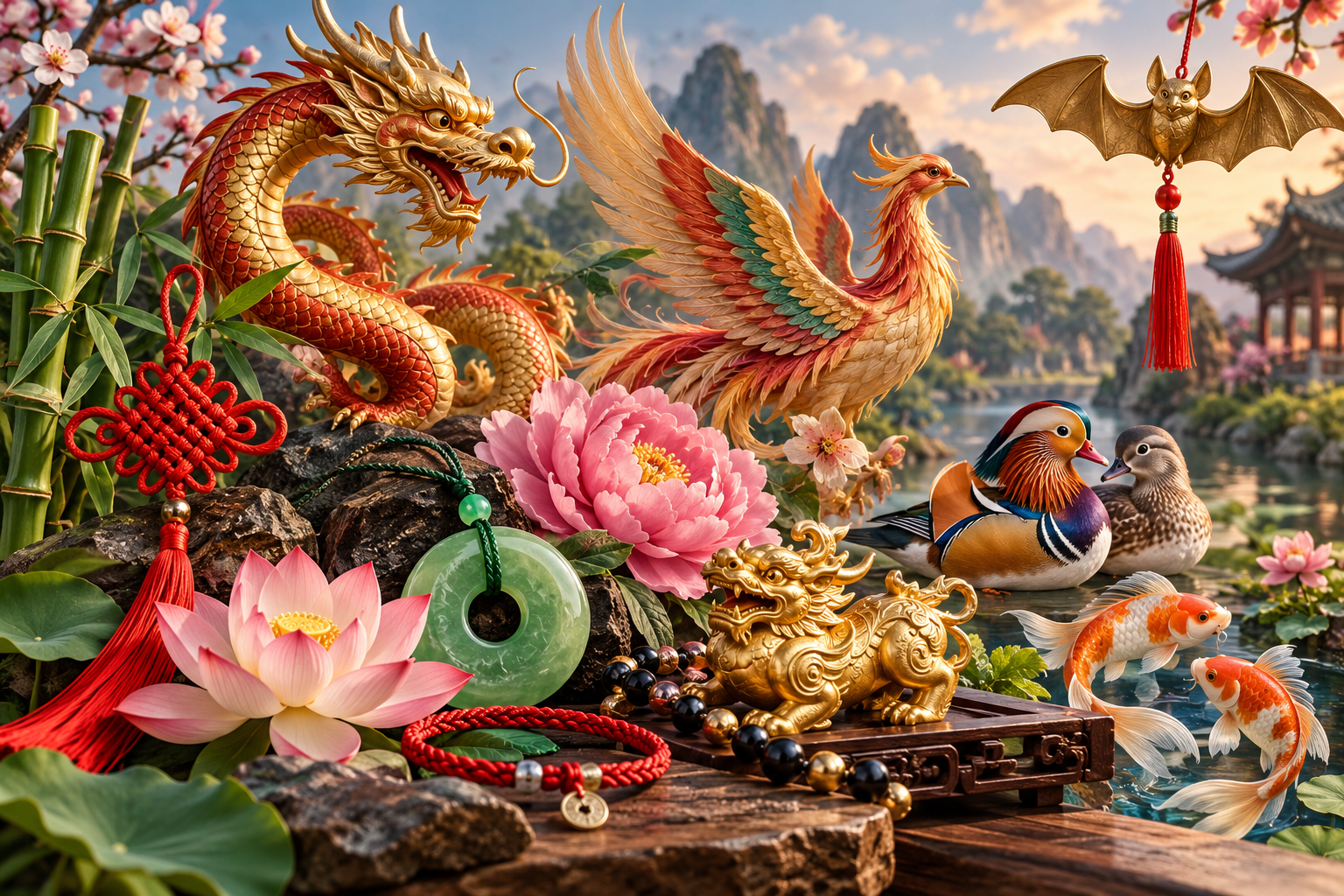
Walk through a traditional Chinese market, visit an old temple, or simply look closely at a piece of Chinese-inspired jewelry, and you may notice the same symbols appearing again and again: a dragon curling around a pendant, a lotus carved into jade, a red knot hanging near a doorway, or a small Pixiu resting on a bracelet.
These designs are rarely chosen only because they look beautiful. In Chinese culture, many objects, animals, plants, and even colors carry meanings that have developed over hundreds, sometimes thousands, of years.
Traditionally, people used these symbols to express hopes for good fortune, protection, health, harmony, and prosperity. Today, many people still wear or display them as cultural symbols, personal reminders, or meaningful gifts.
Here are 12 of the most recognizable Chinese lucky symbols and the stories behind them.
1. Dragon — Strength and Good Fortune
The Chinese dragon is very different from the fire-breathing monster often found in Western stories.
In Chinese tradition, the dragon is usually associated with strength, vitality, authority, and auspicious energy. It was historically connected with emperors, but its symbolism goes far beyond imperial power.
Many people believe the dragon represents the ability to move forward with confidence and overcome difficulties. This is one reason dragon motifs remain popular in jewelry, artwork, and decorations.
2. Phoenix — Renewal and Harmony
The Chinese phoenix, or Fenghuang, is traditionally associated with virtue, harmony, beauty, and renewal.
In older Chinese culture, the dragon and phoenix were sometimes shown together. The pairing could represent balance and a harmonious marriage, making it especially meaningful in wedding decorations.
Rather than simply meaning "luck," the phoenix often carries the idea of becoming stronger and more graceful through change.
3. Pixiu — Wealth and Protection
Pixiu is a mythical creature that looks a little like a winged lion or dragon.
According to traditional stories, Pixiu has an enormous appetite for gold, silver, and treasure but does not let wealth escape. Because of this unusual legend, it gradually became associated with attracting and preserving prosperity.
Today, Pixiu bracelets are especially popular. Many people believe wearing Pixiu is a symbolic way of expressing their hopes for financial stability and protection.
Of course, a bracelet cannot guarantee wealth, but the story behind Pixiu makes it an interesting cultural symbol of abundance.
4. Jade — Protection, Virtue, and Good Fortune
Jade has held a special place in Chinese culture for thousands of years.
Traditionally, jade was valued not only for its beauty but also for qualities it came to represent, including purity, wisdom, kindness, and moral character.
There is also an old belief that jade can protect its wearer. Some families even tell stories of jade bracelets cracking after an accident, believing the jade "took the misfortune" for the person wearing it.
Whether taken literally or simply appreciated as family folklore, these stories help explain why jade jewelry is often given to children, partners, and loved ones.
5. Red String — Protection and Connection
Red is one of the most auspicious colors in Chinese culture.
It appears everywhere during weddings, Lunar New Year celebrations, and other joyful occasions. Traditionally, red represents happiness, vitality, celebration, and good fortune.
A simple red string bracelet can therefore carry more meaning than its minimalist appearance suggests.
In Chinese folklore, red thread is also connected with fate and relationships. The famous "red thread of fate" is said to connect people who are destined to meet, regardless of distance or circumstance.
6. Chinese Knot — Good Luck and Continuity
Traditional Chinese knotting turns a single cord into surprisingly complex decorative patterns.
Because many knots are created from one continuous piece of cord, they can symbolize continuity, connection, and lasting relationships.
The endless-looking structure is part of the charm. Traditionally, Chinese knots were used as decorations and gifts, especially during festivals and important family occasions.
Red knots are particularly common because they combine the symbolism of the knot with the auspicious meaning of the color red.
7. Lotus — Purity and Inner Growth
The lotus grows from muddy water yet rises above the surface with a clean, beautiful flower.
That natural transformation gave the lotus powerful symbolism across Chinese and Buddhist culture.
Traditionally, it represents purity, spiritual growth, and the ability to remain true to yourself even when circumstances are difficult.
In jewelry, lotus designs are often chosen by people who appreciate the idea of personal growth rather than simply "good luck."
8. Bamboo — Resilience and Integrity
Bamboo bends dramatically in the wind without breaking easily.
For centuries, Chinese artists and scholars admired this quality and used bamboo as a symbol of resilience, humility, and integrity.
Its hollow center was also associated with openness and modesty.
In traditional Chinese painting, bamboo frequently appears alongside plum blossoms, orchids, and chrysanthemums, known collectively as the "Four Gentlemen."
For modern wearers, bamboo-inspired designs can be a quiet reminder to stay flexible without losing your principles.
9. Peony — Prosperity and Beauty
The peony has sometimes been called the "king of flowers" in China.
In traditional art, it became closely associated with prosperity, beauty, honor, and high social status. Peonies frequently appeared in paintings, embroidery, porcelain, and decorative objects.
Today, many people still consider the peony an auspicious flower, especially when it appears in gifts or home decorations.
Its symbolism feels less like sudden financial luck and more like a wish for a rich, flourishing life.
10. Mandarin Ducks — Love and Partnership
Mandarin ducks are traditionally associated with romantic love and faithful partnership.
In Chinese art, they are often shown as a pair swimming together among lotus flowers.
Because of this symbolism, images of mandarin ducks have long been used in wedding-related objects and gifts.
Many people believe the pair represents companionship, affection, and harmony between partners. Even today, it can be a sweet symbol for couples without needing to take the old beliefs literally.
11. Goldfish — Abundance and Prosperity
Goldfish are another classic symbol of abundance.
Part of the association comes from language. In Chinese, the word for fish, "yu," sounds similar to the word associated with surplus or abundance.
This connection appears in the traditional New Year expression "nian nian you yu," which expresses the hope of having abundance year after year.
That is why fish frequently appear in Lunar New Year decorations, paintings, ceramics, and jewelry.
12. Bat — Happiness and Good Fortune
This one often surprises Western visitors.
In many Western traditions, bats can feel dark or spooky. In traditional Chinese decorative art, however, bats are highly auspicious.
The reason again comes from language. The Chinese word for bat, "fu," sounds like another "fu" meaning good fortune or blessing.
Five bats shown together traditionally represent the "Five Blessings," commonly connected with ideas such as longevity, prosperity, health, virtue, and a peaceful life.
Once you know this, those tiny bats carved into old Chinese furniture, jade, or porcelain suddenly look very different.
Lucky Symbols Are Really About Wishes
One thing I find interesting about Chinese lucky symbols is that they are rarely just about "getting lucky."
Look more closely and they usually represent something people have always wanted: a peaceful family, good health, meaningful relationships, enough money to live comfortably, protection for loved ones, or the strength to handle difficult times.
That is probably why these symbols have survived for so long.
A jade bracelet does not need to magically change someone's future to be meaningful. A red string can simply remind someone of a person they love. A lotus pendant can represent a difficult period they managed to grow through.
Traditionally, these objects carried stories. Today, we can still appreciate those stories while giving the symbols our own personal meaning.
And perhaps that is the most interesting kind of "luck" they offer: a small connection between everyday life and a culture that has been telling these stories for generations.
Comments (0)
No comments yet. Be the first to comment!
Leave a Comment
Please note, comments must be approved before they are published.