
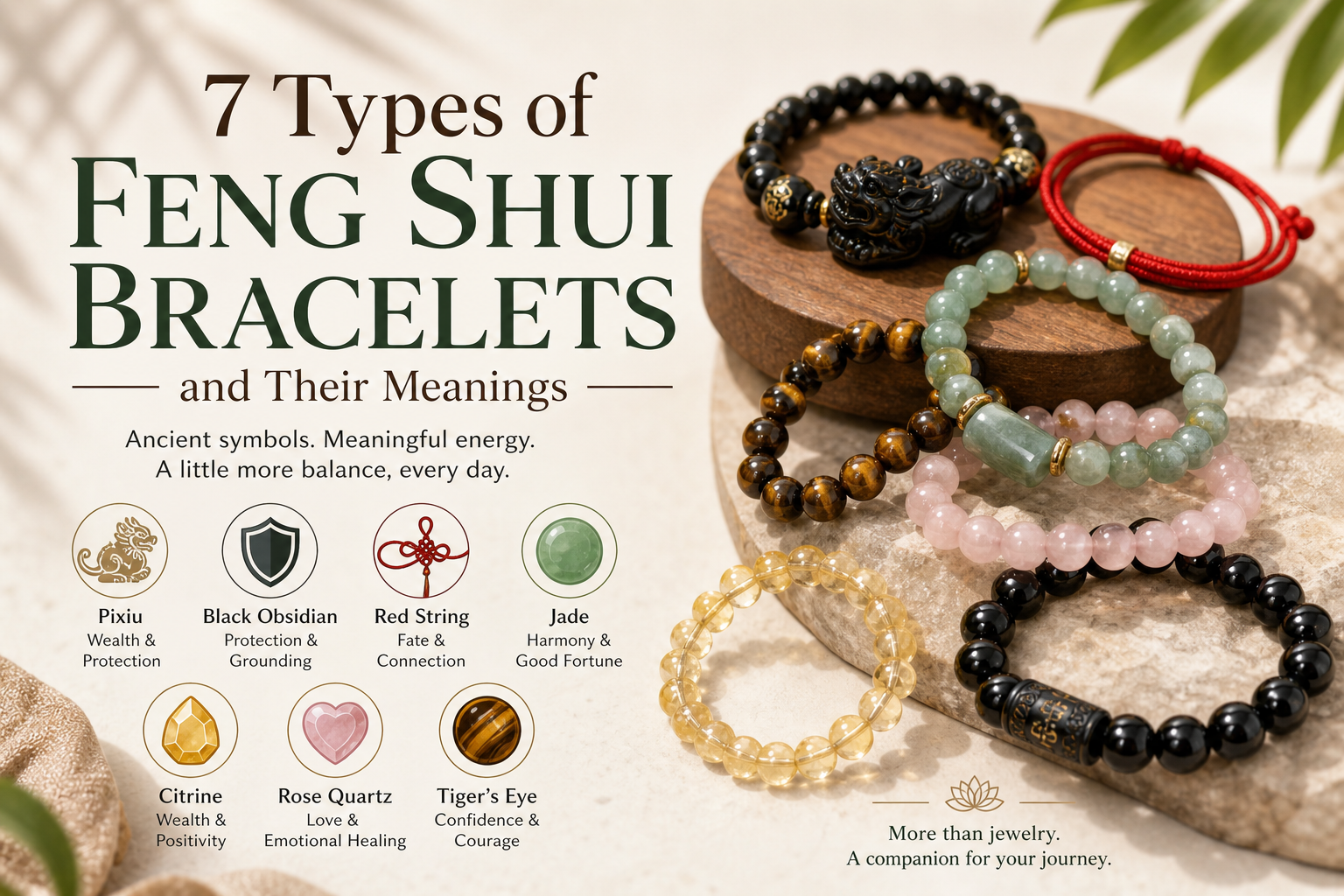
A Pixiu charm, a red cord, and a strand of quartz may all be sold as Feng Shui bracelets, but they are different kinds of objects with different stories. Some draw on Chinese auspicious imagery; others are grouped under modern crystal symbolism.
This guide compares seven familiar types without treating every association as an ancient rule or a physical effect. For the practical next step, our guide to choosing a Feng Shui bracelet covers fit, materials, and daily use.
1. Pixiu: An Auspicious Mythical Motif
Pixiu is a creature rather than a gemstone, so its charm can appear with many bead materials. The National Palace Museum's Southern Branch describes folklore linking it with accumulating wealth.
That makes it a symbol of an auspicious wish, not evidence that the wearer will earn or retain more money. Our Pixiu bracelet guide explains the story and different wearing choices.
2. Black Obsidian: Dark Color and Modern Grounding Symbolism
Obsidian is volcanic glass, as the U.S. Geological Survey explains. Its often dark, glossy surface gives a bracelet a very different look from translucent quartz.
Contemporary crystal descriptions often use words such as “protection” and “grounding.” These are symbolic interpretations; the geological source does not show that obsidian absorbs emotions or negative energy. Choose it if you enjoy the material and design, without needing that promise.
3. Red String: Connection and a Story of Marriage
Red string can evoke connection. In San Qing Gong's telling of the Yue Lao legend, red strings join the feet of future spouses. A modern bracelet can borrow that image as a personal reminder.
The story does not establish one origin or ritual for every red cord. Our introduction to red string bracelet meanings explores the different layers behind the design.
4. Jade: A Material with a Long Cultural History
Jade carries associations that extend beyond contemporary bracelet trends. The National Palace Museum discusses how Confucian thinkers connected jade with virtues including benevolence, wisdom, courage, and integrity.
A jade piece can express admiration, affection, or a connection with family. It does not need a claim that a broken bead has absorbed a disaster. Learn about Hetian jade, and ask about material identity and treatments when comparing pieces.
5. Citrine: Yellow-to-Orange Quartz
GIA identifies citrine as a yellow-to-orange variety of quartz and notes that most citrine on the market results from heat treatment of amethyst. Treatment information helps explain what you are buying; a warm color alone does not establish an untreated origin.
In modern crystal symbolism, citrine is often associated with abundance and confidence. You can choose those as personal meanings without treating the stone as a financial tool or calling that association a universal ancient Feng Shui prescription.
6. Rose Quartz: Pink Color and Personal Affection
GIA describes rose quartz as the pink variety of quartz. Love and compassion are familiar modern symbolic associations, but material identification does not establish emotional-healing effects.
A rose quartz bracelet can be an affectionate gift because someone likes its color or the message you attach to it. Our rose quartz guide offers more background. Avoid promising that a bracelet will resolve heartbreak or attract a partner.
7. Tiger's Eye: A Moving Band of Light
Tiger's eye is known for a silky, often golden-brown appearance. GIA's guide to gemstone phenomena describes its chatoyancy: a light effect that seems to move as a stone is turned.
Confidence and courage can be personal associations with this striking look. The optical explanation does not prove effects on decision-making, and this guide does not repeat an unsupported claim that warriors universally wore it for strength.
Choose the Story and the Object Together
Compare what the bracelet is made from, what its symbolism means to you, and how it fits your routine. A motif and a material can be combined in one piece without multiplying promised benefits.
There is no need to collect all seven types or match each one to a problem. One comfortable bracelet, chosen with clear information and a story you enjoy, can be enough.
Comments
Leave a comment
Please note, comments must be approved before they are published.