
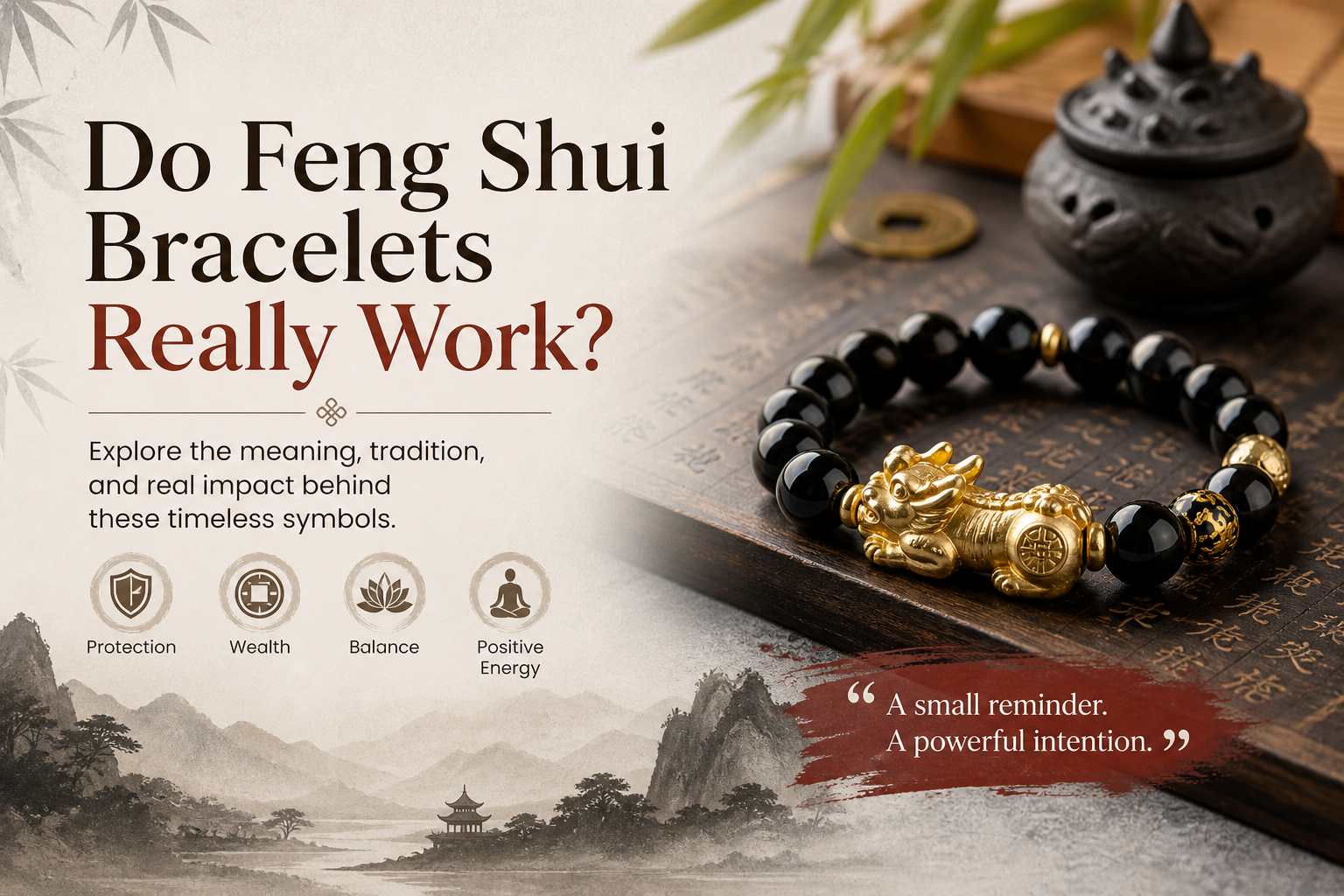
A Feng Shui bracelet can carry meaning as jewelry or a keepsake. That is different from demonstrating that it changes health, luck, or financial outcomes. A cultural story and a pleased wearer's experience do not, on their own, establish those effects.
When asking whether a bracelet “works,” begin by naming the result you mean. Enjoying a design, remembering a gift, and treating anxiety are different questions that require different kinds of answers.
What Does the Cultural Background Establish?
The Science Museum Group's geomantic compass record discusses feng shui in relation to placing houses. It provides historical context for a practice; it is not a study of jewelry.
Our introduction to what a Feng Shui bracelet means explains how the term is used in contemporary descriptions. A label that invokes tradition should not be mistaken for evidence that a particular piece produces a measurable result.
Why a Personal Story Is Not a Test
Someone may feel encouraged after receiving a meaningful gift. They may also change routines, receive support, or experience unrelated improvements at the same time. Their experience can matter to them without showing which factor caused the change.
A testimonial saying “I felt better” does not demonstrate that the beads reduced anxiety. Likewise, a successful month after buying a charm does not show that the charm brought income. The sequence of two events is not enough to establish a causal link.
What Does “Placebo” Actually Explain?
The NIH's National Center for Complementary and Integrative Health explains placebo effects as health responses influenced by expectations. It also explains why researchers compare a treatment with a matching inactive alternative.
This general concept is not evidence that Feng Shui bracelets are an effective treatment. It does not justify promising that belief in a piece will improve someone's well-being or finances. Calling a product a placebo is not a substitute for testing the particular claim.
For a study directly involving a stone, our discussion of crystal bracelets and research describes a rose-quartz experiment and its limits. Findings about one intervention should not be silently extended to every material or bracelet.
Can a Bracelet Still Be a Reminder?
You may decide to use an ordinary object as a cue for something you already want to do: review a plan, write a note, or pause before a purchase. That is a chosen use, not a demonstrated power of the object.
If you enjoy doing this, keep the action explicit. “When I notice the bracelet, I will check my list” is a personal plan. “These beads will make me disciplined” is a claim the plan does not establish.
What About Pixiu and Prosperity?
Wealth symbolism deserves the same distinction. Our article on Pixiu bracelets and expectations separates a wish for prosperity from a promise of financial results.
A charm should not guide consequential money decisions, and jewelry should not replace care for persistent health concerns. The most reasonable purchase is one you can value for its design and meaning without depending on a promised outcome.
You can appreciate tradition and remain precise about evidence. A bracelet does not need a therapeutic claim to be a cherished object.
Comments
Leave a comment
Please note, comments must be approved before they are published.