
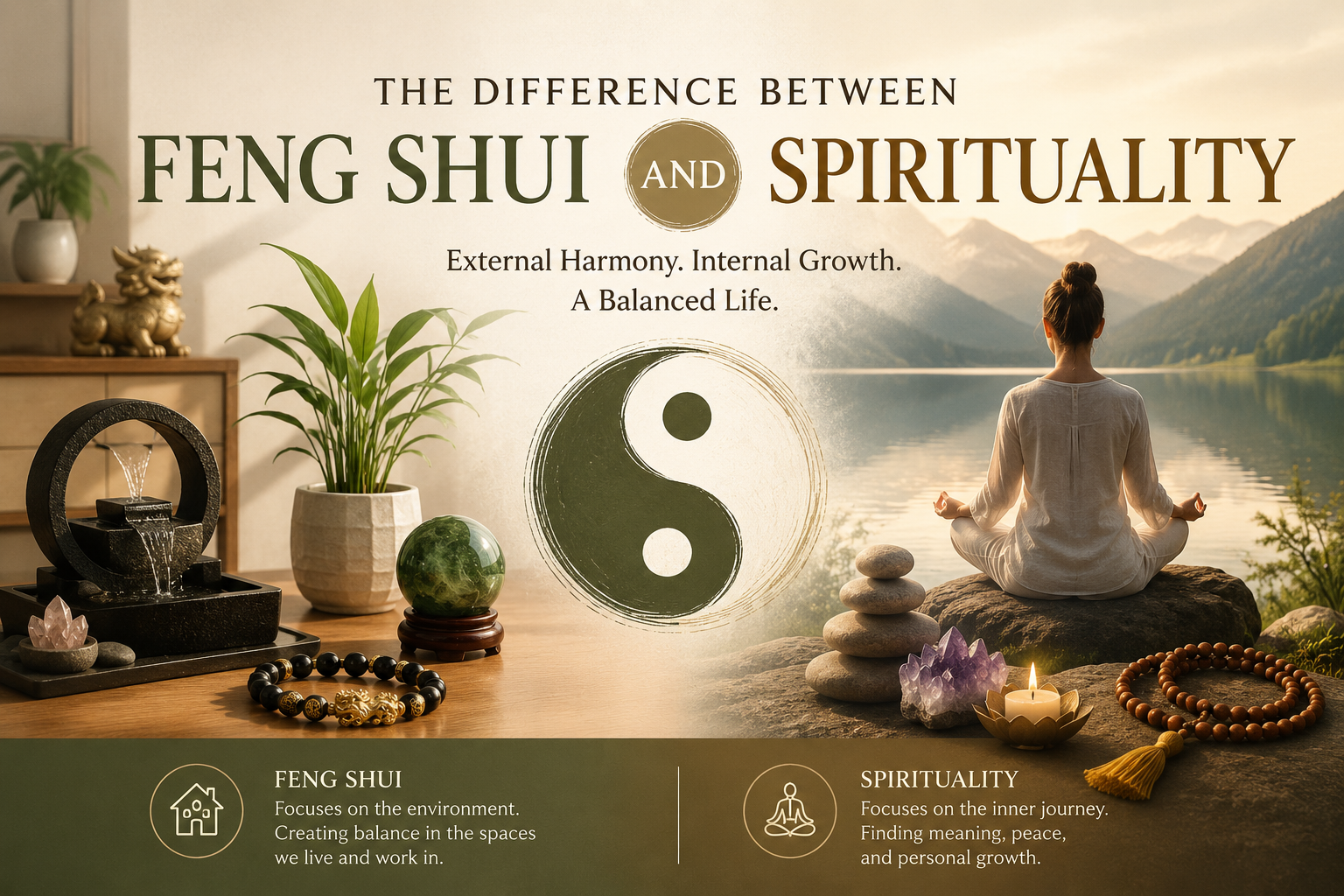
Feng shui and spirituality are not interchangeable labels. Feng shui names a Chinese practice with particular methods and histories. “Spirituality” is a broad word whose meaning depends on the person using it. The clearest comparison begins by asking which practice, object or belief is actually being discussed.
Give feng shui a specific context
The Hearst Museum describes feng shui as divination and the arrangement of space, illustrated by a Chinese luopan. This provides a concrete subject: how practitioners interpret a place and relate a building to its surroundings.
That description includes divination, so reducing the practice to ordinary furniture placement is incomplete. It also does not justify treating every prayer bead, crystal or charm as an example of feng shui. Similar marketing language does not establish a shared origin.
Ask what someone means by spirituality
A person may use the word for religious commitments, a private understanding of meaning or another aspect of life. Ask them rather than supplying a universal definition. Their practice may involve community, particular teachings or material places as well as inward reflection.
The contrast “feng shui is outside, spirituality is inside” is therefore too rigid. It overlooks the way religious practices can involve buildings and objects, while interpretations of place can also carry beliefs.
Keep Buddhist objects in their own context
The Metropolitan Museum of Art describes a tenth-century stele showing the Buddha’s enlightenment under the Bodhi tree. This is specific Buddhist imagery. It should not be relabeled feng shui merely because both subjects appear in a modern jewelry shop.
Likewise, an article about Hetian jade concerns a material with many possible uses. The substance alone cannot tell you the religious or personal commitments of the owner.
Read a product description in layers
A bracelet listing may name a stone, depict a creature and suggest a spiritual effect. Examine each layer separately. Our Pixiu introduction discusses one motif; it does not make every bracelet part of a single religious system.
Ask which source supports the symbolism and whether an interpretation is historical, contemporary or personal. Then ask separately whether any claim about protection, health or wealth has evidence. A meaningful association is not the same as a demonstrated result.
Choose your level of involvement
You may want cultural background, an attractive accessory or guidance within a specific tradition. Those are different goals. Our bracelet selection guide can help with a purchase, while tradition-specific questions deserve sources and teachers from the relevant community. Curiosity is a good reason to learn, without flattening distinct practices into one.
Comments
Leave a comment
Please note, comments must be approved before they are published.