
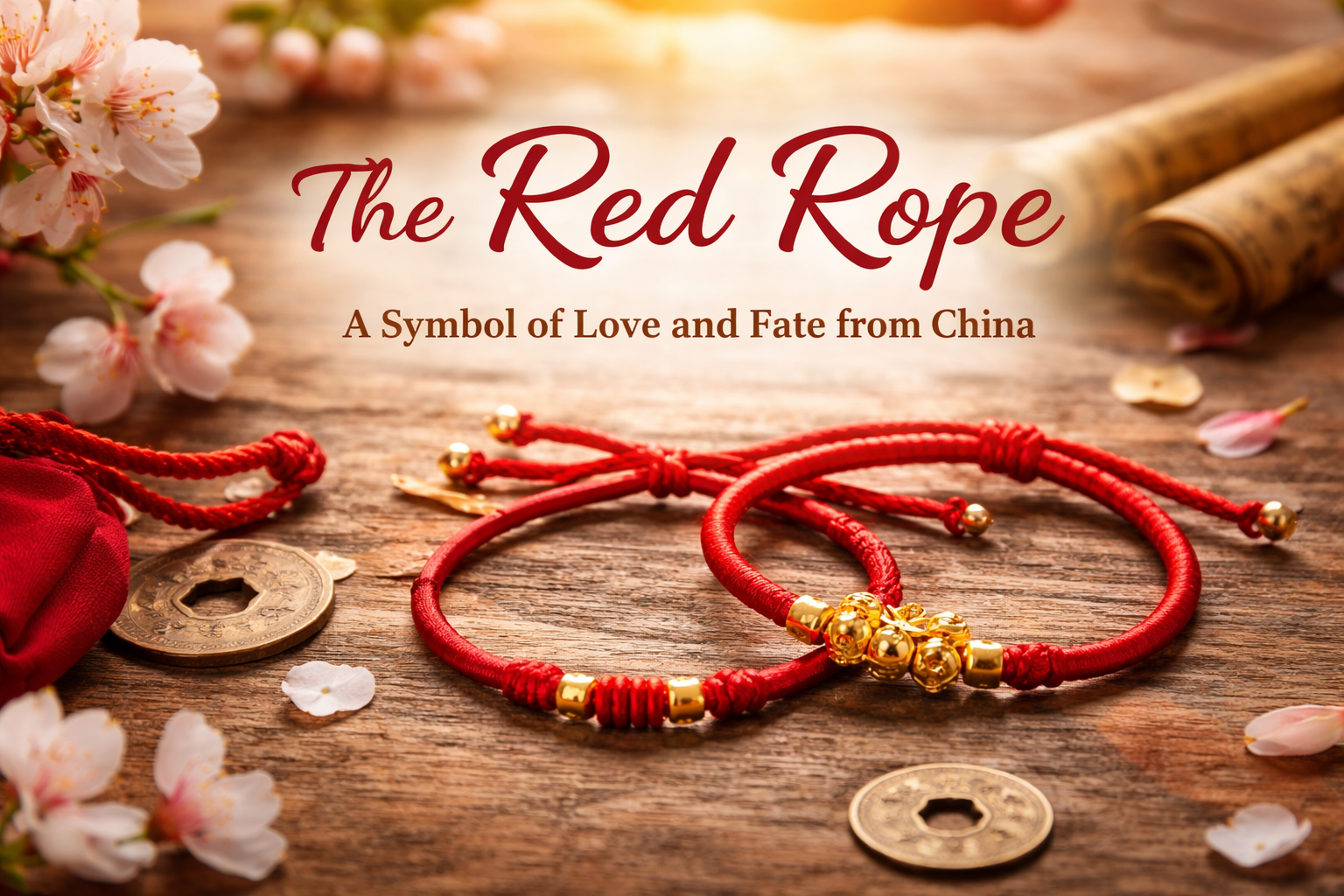
If you ever visit China, you might notice a simple red rope tied around someone’s wrist, hanging from a bag, or woven into jewelry. It may look like a small, decorative detail—but behind it lies a story that has traveled through centuries, carrying wishes of love, protection, and destiny.
In Chinese culture, the red rope is much more than an accessory. It is a symbol deeply rooted in tradition, belief, and storytelling. And like many meaningful objects in China, its beauty comes not just from how it looks, but from what it represents.
The Legend Behind the Red Rope
One of the most famous stories connected to the red rope is the ancient legend often translated as the “Red Rope of Fate.”
According to folklore, an invisible red rope ties together people who are destined to meet. This rope is said to be tied by a matchmaker deity, often imagined as an old man living under the moon. The rope connects two people—no matter how far apart they are, no matter how different their lives may be.
The rope can stretch. It can tangle. It can even appear fragile. But it will never break.
In many versions of the story, two strangers go through life unaware of each other, only to eventually meet in a way that feels almost impossible to explain. When they do, it is believed that the red rope has quietly guided them all along.
This idea resonates strongly in Chinese culture, where fate and relationships are often seen as something both mysterious and meaningful. The red rope becomes a poetic way to explain connections that feel “meant to be.”
Why Red?
In China, the color red has always held special significance. It represents happiness, celebration, luck, and life itself.
You’ll see red everywhere during festivals—especially during the Lunar New Year. Red lanterns, red envelopes, red decorations—all meant to bring good fortune and ward off negative energy.
So when the red rope became part of cultural tradition, it naturally carried these meanings with it. Wearing a red rope is believed to protect the wearer, bring good luck, and attract positive energy.
It’s simple, but powerful.
From Tradition to Everyday Life
Today, the red rope is no longer just a myth or symbol—it’s something people actively wear and share.
You’ll find it in many forms:
- A thin bracelet tied by a friend or loved one
- A woven charm with small beads or pendants
- A minimal piece of jewelry paired with gold or jade
Some people wear it for protection, especially during important life moments—like exams, travel, or big career changes. Others wear it as a quiet reminder of someone they care about.
In recent years, it has also become popular among younger generations—not just in China, but globally. Its meaning adapts easily: love, connection, luck, or even just a sense of grounding in a fast-moving world.
A Gift with Meaning
One of the most touching aspects of the red rope is how it’s given.
Traditionally, it’s more meaningful when tied by someone else rather than by yourself. A friend, a partner, a family member—when they tie the rope around your wrist, it becomes a small but sincere gesture of care.
It says: I wish you well.
I hope you’re protected.
I believe good things will come to you.
That’s why the red rope has become a popular choice in cultural and creative products. It’s light, simple, and affordable—but it carries emotional weight that many larger gifts cannot match.
A Modern Symbol with Ancient Roots
In today’s world, where trends change quickly and meanings often get lost, the red rope stands out for its quiet consistency.
It doesn’t try to impress. It doesn’t need to.
Instead, it tells a story—one that connects the past with the present, and tradition with personal meaning.
For someone discovering it for the first time, the red rope may just look like a piece of string. But once you know the story, it becomes something more: a symbol of unseen connections, of hope, and of the belief that certain things in life are meant to find their way to you.
And maybe, somewhere out there, a rope is already tying you to something—or someone—you haven’t met yet.
Comments (0)
No comments yet. Be the first to comment!
Leave a Comment
Please note, comments must be approved before they are published.