
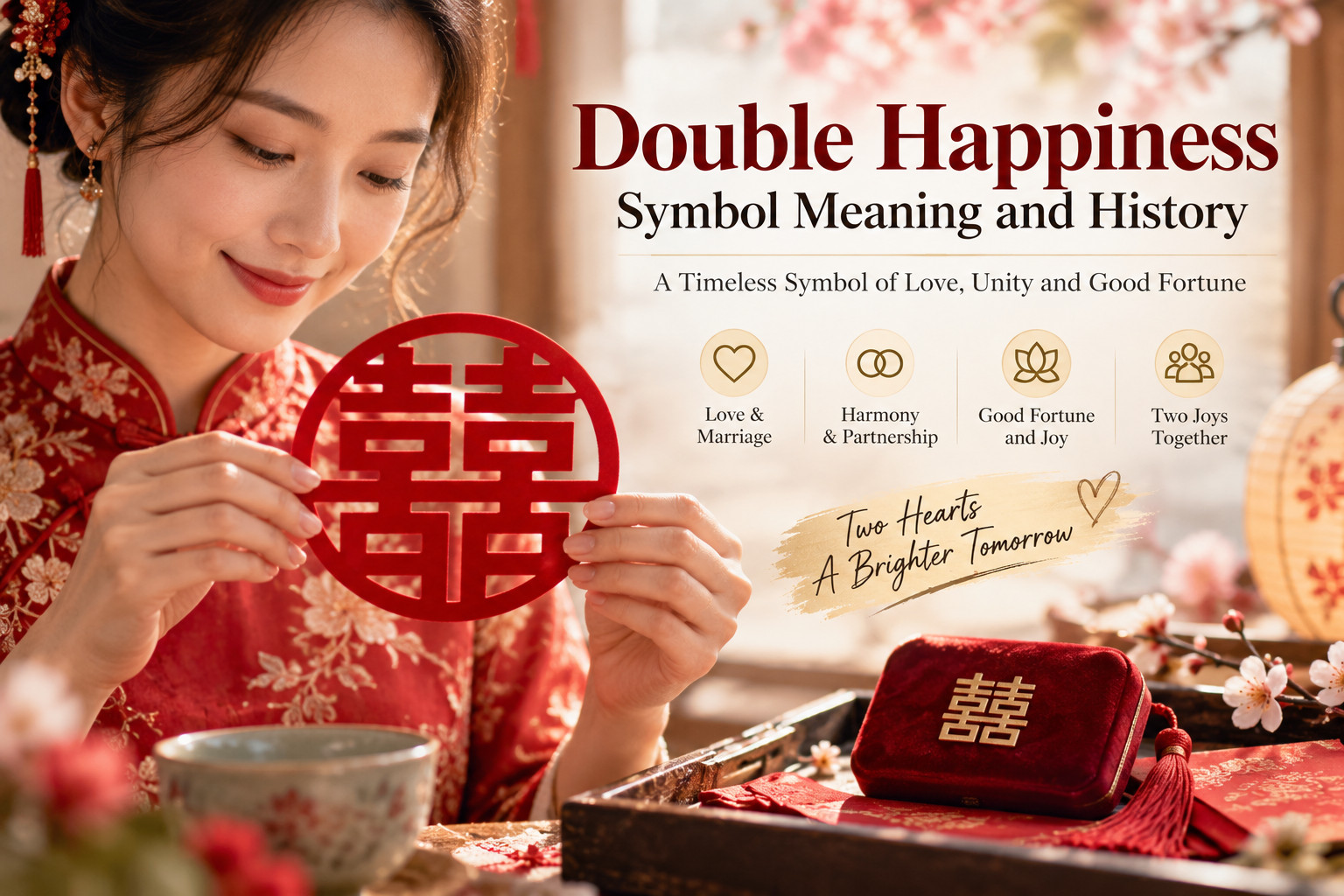
Double Happiness, 囍, brings two 喜 forms together in one compact design. In wedding imagery, that visible pairing makes an immediately fitting greeting for shared joy. A group of coins decorated with paper and an enamelled porcelain vase show how the same written wish can enter very different objects.
A greeting attached to a gift
Powerhouse records two silver coins in an envelope labelled as a Chinese wedding present. Red-paper Double Happiness characters were attached to their faces. The coins, paper and envelope belong together in the museum’s collection of objects relating to Chinese customs.
The paper is a particularly revealing detail. The wedding greeting was added to an existing object instead of being built into its original metal form. Looking at the layers, we can distinguish what was given from the way the gift was addressed to an occasion.
That makes the envelope more than background packaging. Its label helps connect the decorated coins with a wedding exchange. Our article on red in Chinese celebrations explores how color can make such a message more visible.
A present can therefore acquire an occasion-specific meaning through a small addition. A written sign, placed with care, may do as much communicative work as a more elaborate object. This is a useful comparison when thinking about a handwritten note accompanying a gift today.
The same wish within a larger design
The Met’s Daoguang-period Jingdezhen vase, dated 1820–50, combines Double Happiness with bats, peaches and scrolling floral vines. Its label links 囍 with marital harmony and the accompanying imagery with happiness and longevity.
The character participates in a decorative conversation. It gives a written focus to a surface also occupied by animals and plants. Instead of asking each element to repeat the same message, a viewer can read how their different wishes sit together.
The contrast with the coins is instructive: the greeting can be attached as paper or incorporated into a durable decorated surface. The recognizable written form travels between materials while its surrounding design changes. That is a history of use we can see in objects, without assigning an unsupported inventor to the character.
Celebration gathers images together
Peabody Essex Museum’s Double Happiness exhibition framed Chinese celebratory art through ceremonies, seasonal occasions and layered symbols. Its featured late-1880s bowl brings dragons, phoenixes, gourds and happiness characters into one composition.
This is another invitation to read beyond a single emblem. Our fenghuang guide introduces one of those companion images, while the Chinese knot article considers how a separate pattern can contribute when it is added to a design. Recognizable elements can work together without becoming interchangeable.
Use the greeting where it is welcome
For a wedding or anniversary gift, check whether the couple likes the design and its explicit association. A short wish for happiness together can be sincere without predicting a perfect relationship. The pleasure of 囍 lies partly in that simple, shareable message.
Comments
Leave a comment
Please note, comments must be approved before they are published.