
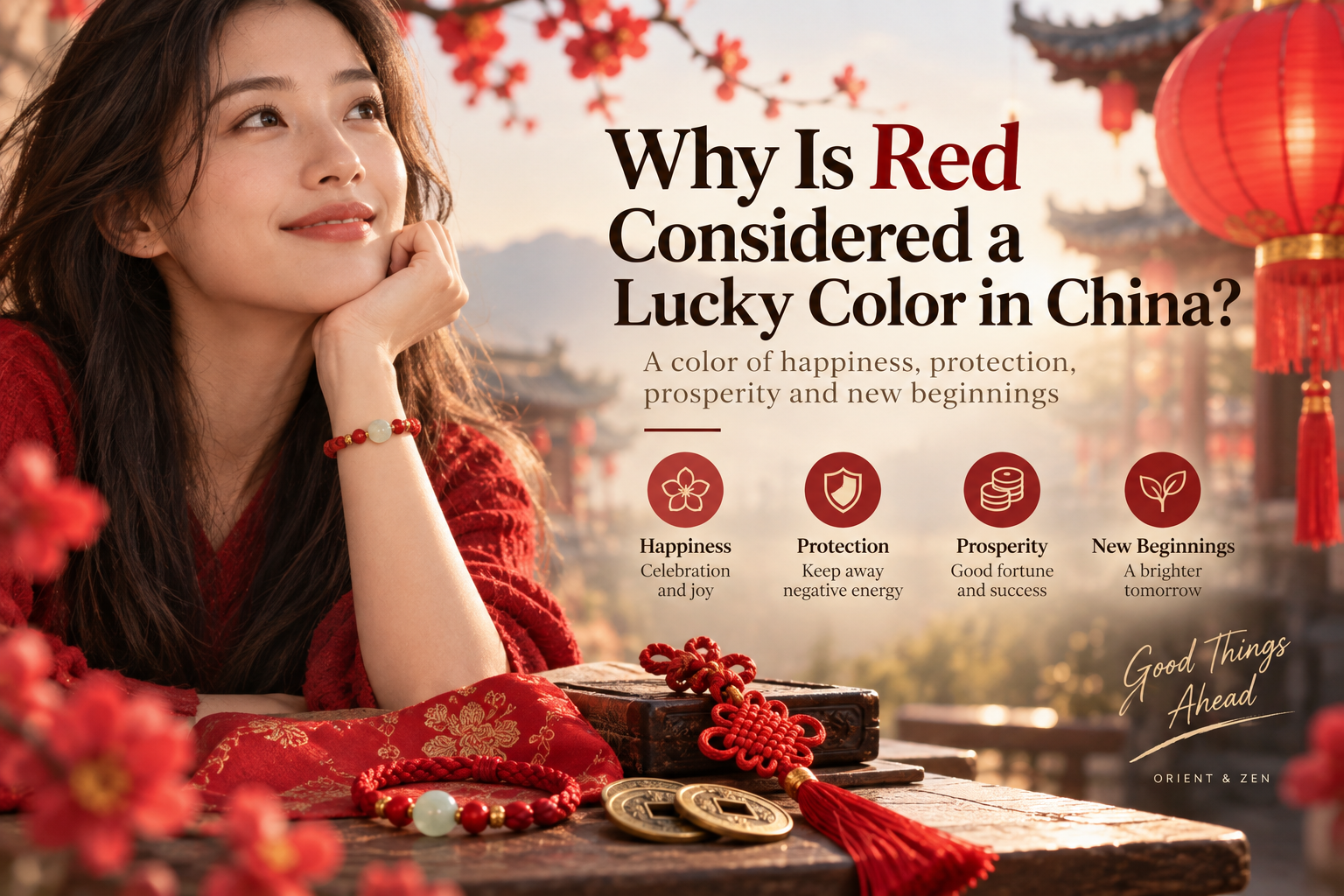
Walk through a traditional Chinese wedding, visit a temple fair during Lunar New Year, or simply look at the decorations hanging outside homes during a festival, and one color is almost impossible to miss: red.
Red lanterns, red envelopes, red knots, red clothing, and red decorations appear everywhere.
But why is red considered such a lucky color in China?
The answer is not simply "because red means good luck." Its meaning comes from centuries of stories, celebrations, beliefs, and everyday traditions. Over time, red became connected with happiness, protection, prosperity, and important new beginnings.
Red and the Legend of Nian
One of the most famous stories connected with the color red comes from the legend of Nian.
In traditional folklore, Nian was a frightening creature said to appear around the beginning of the new year. Villagers eventually discovered that the creature feared loud noises, bright lights, and the color red.
So people decorated their doors with red paper, lit firecrackers, and created as much noise as possible to drive Nian away.
Whether taken literally or simply enjoyed as an old folk tale, the story helps explain why red became so closely associated with Lunar New Year.
Even today, streets and homes are often filled with red decorations during the festival. Many people believe these traditions represent leaving behind misfortune and welcoming a more hopeful year.
Red Represents Happiness and Celebration
In Chinese culture, red is strongly associated with joyful occasions.
Traditionally, Chinese weddings featured large amounts of red. Brides often wore red clothing, rooms were decorated with red fabrics and paper cuttings, and the "Double Happiness" symbol was commonly displayed in red.
This is very different from the way some Western cultures traditionally associate white with weddings.
In China, red communicates something warmer and more energetic. It suggests celebration, happiness, vitality, and a promising beginning.
That is why red still appears frequently at weddings, birthdays, business openings, and major festivals.
Why Are Chinese Red Envelopes Red?
Another familiar tradition is the red envelope, or "hongbao."
During Lunar New Year, weddings, birthdays, and other important occasions, money may be placed inside a red envelope and given as a gift.
The money is useful, of course, but traditionally, the color of the envelope carries meaning too.
Many people believe the red wrapping represents good wishes, happiness, and good fortune for the person receiving it.
In other words, a red envelope is not only about giving money. It is also a small ritual of passing along positive wishes.
Red as a Color of Protection
Red is also connected with protection in Chinese folk traditions.
This is one reason you may see red strings tied around the wrist, red cords attached to jade pendants, or red tassels hanging from traditional ornaments.
Traditionally, many people believe red can help symbolically keep negative influences away and invite more positive energy into everyday life.
This belief becomes especially noticeable during one's Chinese zodiac year, known as "benmingnian."
Some people wear red underwear, socks, belts, or bracelets during that year. A red string bracelet is particularly popular because it is simple enough to wear every day.
Of course, wearing red does not guarantee protection or good fortune. For many people today, these traditions are better understood as cultural rituals, personal reminders, or meaningful connections to family and heritage.
Why Red Appears With Jade, Gold, and Lucky Symbols
Red is rarely used alone.
In traditional jewelry and decorative objects, it is often combined with materials and symbols that have their own cultural meanings.
A red cord may hold a jade pendant. A red bracelet may include a Pixiu charm. Chinese knots may be paired with coins, tassels, or other auspicious symbols.
The combinations are intentional.
Traditionally, jade has been associated with virtues such as purity, harmony, and moral character. Gold naturally suggests wealth and prosperity, while red brings the visual language of happiness, vitality, and good fortune.
Together, these materials create objects that are not only decorative but also rich in cultural symbolism.
Red in Everyday Chinese Life
What makes red especially interesting is that it has never remained only inside temples or ancient stories.
It is still very much alive.
You can see red decorations during Lunar New Year, red envelopes exchanged through modern apps, red wedding details, red strings worn as bracelets, and small red charms attached to bags or accessories.
Some people follow these customs seriously. Others simply enjoy them because they remind them of childhood, family, or home.
And many people fall somewhere in between.
That is probably why red has remained so powerful. Traditions survive more easily when they can change with everyday life.
Is Red Always Lucky in China?
Not necessarily.
Cultural symbolism is rarely that simple.
Context matters, and certain uses of red can carry different meanings depending on the situation, region, or tradition. So it is better to think of red as a strongly auspicious color rather than a magical color that is always appropriate.
In celebrations, however, its positive associations are especially strong.
For Lunar New Year, weddings, gifts, jewelry, and festive decorations, red usually communicates something close to: "I wish good things for you."
A Color That Carries a Wish
Perhaps this is the easiest way to understand the meaning of red in Chinese culture.
Red is not lucky because the color itself promises that something wonderful will happen.
Instead, it has become a visual language for hope.
A red envelope can carry a wish for prosperity. A red string can represent protection and connection. A red wedding decoration can celebrate love and a new beginning. A red lantern at Lunar New Year can welcome another year with optimism.
After centuries of tradition, these meanings have become woven into everyday Chinese culture.
So when you see a red bracelet, knot, envelope, or lantern, you are looking at more than a bright color.
You are looking at a small cultural message that has been passed from one generation to another:
May happiness come your way, and may the road ahead bring good fortune.
Comments (0)
No comments yet. Be the first to comment!
Leave a Comment
Please note, comments must be approved before they are published.