
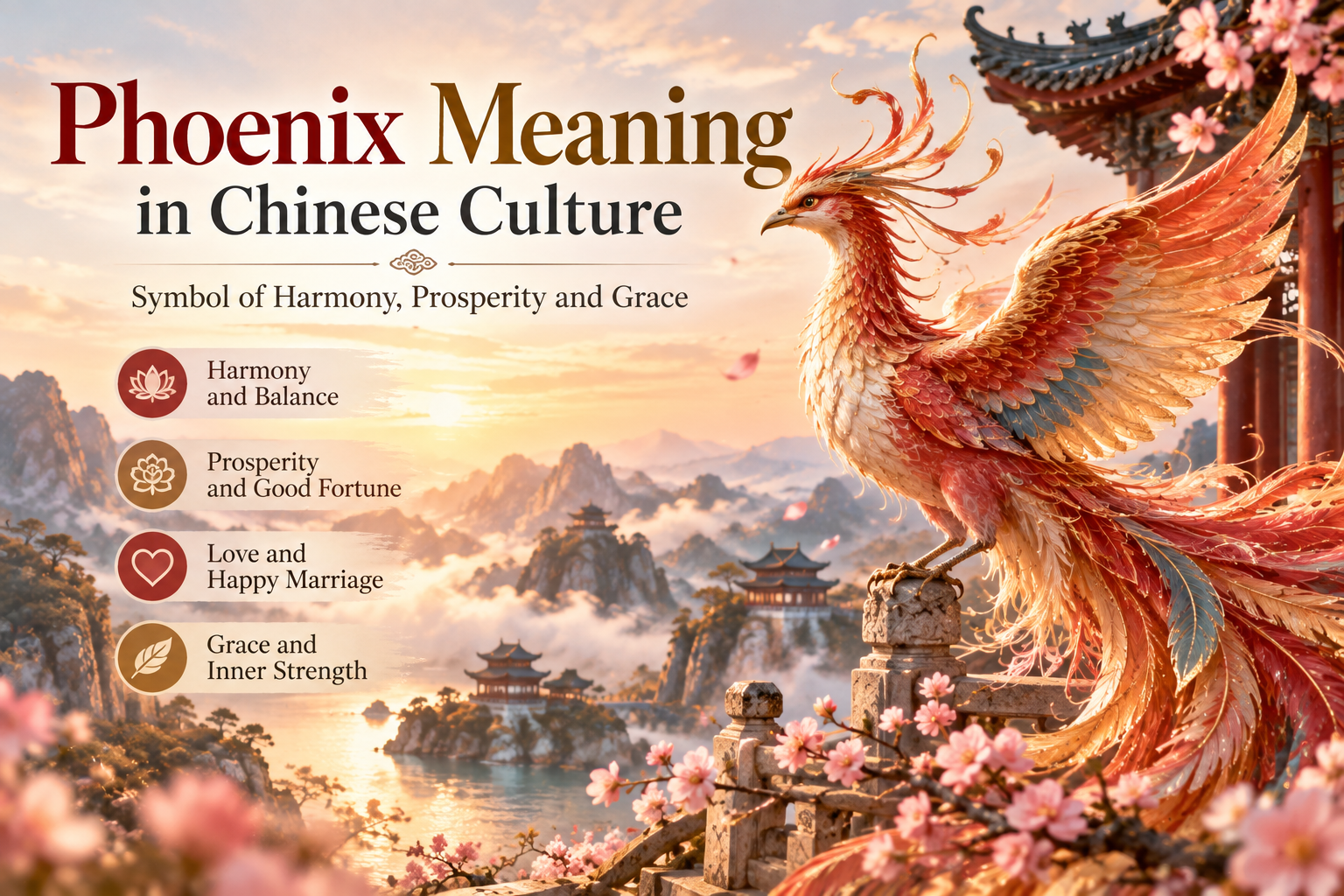
When people in the West hear the word "phoenix," they often imagine a fiery bird that dies and rises again from its ashes. In Chinese culture, however, the story is a little different.
The Chinese phoenix is usually called the fenghuang (凤凰). Traditionally, it is not mainly a symbol of resurrection. Instead, it represents harmony, virtue, prosperity, grace, and the hope for a peaceful life.
You can find the fenghuang almost everywhere in traditional Chinese art: on ancient paintings, palace decorations, wedding textiles, jewelry, ceramics, and carved jade. Even today, phoenix-inspired designs remain popular because they feel both elegant and deeply symbolic.
The Fenghuang Is Not Exactly the Western Phoenix
Although "phoenix" is the common English translation, the fenghuang has its own cultural history.
In early Chinese traditions, "feng" and "huang" were sometimes described separately, with associations that later developed and changed over time. Eventually, the two became understood as one magnificent mythical bird.
Traditionally, the fenghuang was imagined as a creature of extraordinary beauty. Ancient descriptions sometimes combined features of different birds and animals, creating something that did not belong to the ordinary natural world.
Many people believe this was intentional. The fenghuang was less about representing a real bird and more about bringing together different qualities into a single image of balance and harmony.
A Symbol of Virtue and Peace
One of my favorite things about the fenghuang is that it was traditionally connected with good government and peaceful times.
In old stories, the appearance of a fenghuang could be interpreted as an auspicious sign. It was said to appear when the world was harmonious or when a virtuous ruler governed the land.
This gives the Chinese phoenix a slightly different personality from its Western counterpart. It does not need to burst dramatically into flames. Its power is quieter.
In traditional culture, the fenghuang can represent qualities such as kindness, integrity, wisdom, grace, and harmony.
That is why phoenix imagery often feels refined rather than aggressive. It represents strength, but strength expressed through balance.
The Phoenix and the Dragon
If you have ever looked at traditional Chinese wedding decorations, you may have noticed a dragon and phoenix appearing together.
This pairing is especially meaningful.
Traditionally, the dragon became closely associated with the emperor, while the phoenix became associated with the empress. Over time, "dragon and phoenix" also developed into a popular symbol of a harmonious couple.
You may still see this combination at Chinese weddings today.
Many people believe the dragon represents active strength and authority, while the phoenix represents grace, harmony, and beauty. Together, they suggest two different energies complementing each other.
This is one reason phoenix jewelry can make a thoughtful romantic or wedding gift. Rather than simply meaning "good luck," it can carry a more personal message about harmony and a life built together.
A Traditional Story of the Fenghuang
Chinese legends about the fenghuang vary from period to period, but one recurring idea is that this extraordinary bird does not appear casually.
According to traditional stories, the fenghuang arrives during times of peace and prosperity and disappears when disorder takes over.
There is something beautiful about that idea.
Instead of defeating enemies or showing its power through force, the fenghuang becomes a sign that things are finally in balance.
For me, that makes it one of the more interesting Chinese cultural symbols. It suggests that true prosperity is not simply having more wealth. It can also mean living in a world where relationships, nature, and society exist in harmony.
Phoenix Meaning in Jewelry
In jewelry, the phoenix can carry several meanings depending on the design and the person wearing it.
Many people believe phoenix jewelry symbolizes:
- Harmony and balance
- Grace and inner strength
- Prosperity and good fortune
- Love and a happy marriage
- Virtue and personal growth
- New beginnings
The last meaning is especially interesting. Modern phoenix jewelry sometimes borrows the Western idea of rebirth and combines it with traditional Chinese symbolism.
There is nothing necessarily wrong with that. Cultural symbols continue to evolve, especially when they travel between different countries.
A jade phoenix, for example, may combine the traditional symbolism of the fenghuang with jade's long-standing associations with virtue, beauty, and auspiciousness in Chinese culture.
The Phoenix in Chinese and Japanese Culture
Phoenix-like imagery also traveled throughout East Asia.
In Japan, the mythical bird is known as the hō-ō, and its imagery was strongly influenced by Chinese traditions. It appears in Buddhist art, architecture, textiles, and decorative objects.
One famous example is the Phoenix Hall at Byōdō-in in Uji, Japan, where phoenix figures stand on the roof.
Although Chinese and Japanese traditions developed their own interpretations, both cultures often connect the mythical bird with dignity, beauty, and an ideal world of peace.
What Does the Phoenix Mean Today?
Today, someone might wear a phoenix pendant simply because the design is beautiful. Another person may choose it because of family traditions, marriage symbolism, or an interest in Chinese culture.
And that is perfectly natural.
Traditional symbols do not need to have exactly one meaning for everyone.
For some people, the fenghuang represents harmony. For others, it represents feminine elegance, inner strength, prosperity, or starting a new chapter in life.
Many people believe the most meaningful symbols are the ones that become connected to our own experiences.
Final Thoughts
The phoenix in Chinese culture is more accurately understood as the fenghuang, a mythical bird associated with harmony, virtue, prosperity, and grace.
Unlike the Western phoenix, its traditional story is not primarily about dying and rising from ashes. Instead, it represents something quieter: the possibility of balance in a complicated world.
Perhaps that is why the fenghuang has survived for thousands of years in Chinese art and culture.
Whether it appears beside a dragon on a wedding decoration, carved into jade, or shaped into a modern bracelet or pendant, the phoenix continues to carry an old but surprisingly timeless idea: strength does not always have to be loud. Sometimes, it looks like grace, harmony, and the ability to begin a new chapter with dignity.
Comments (0)
No comments yet. Be the first to comment!
Leave a Comment
Please note, comments must be approved before they are published.