
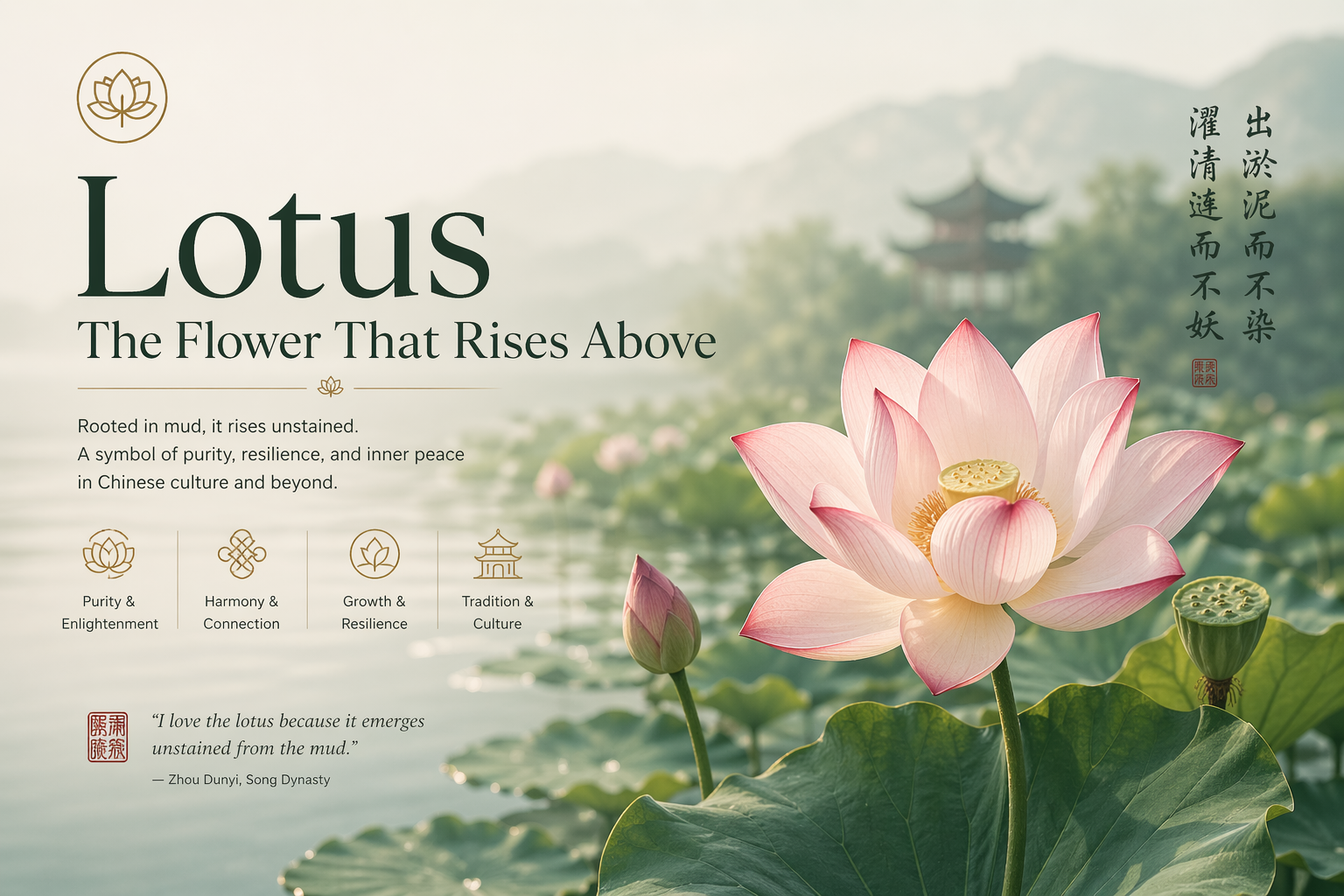
A lotus motif can be as small as a carved petal or as expansive as a pond across a painted screen. Its recognizable form gives artists a way to suggest growth, clarity, and the possibility of remaining true to one's values in difficult surroundings.
Those meanings become richer when the living plant, Chinese literary imagery, and Buddhist art are considered in their own contexts. They overlap, but each brings something different to the flower's story.
The Living Plant Behind the Image
Kew's profile of the sacred lotus, Nelumbo nucifera, describes an aquatic perennial whose rhizomes grow in mud and whose leaves rise above the water. The leaves have a highly water-repellent surface.
That botanical detail is part of the plant's interest. It should be kept separate from the moral meanings people have given the flower. A plant's way of growing can inspire an image without being evidence that wearing its likeness changes a person's health or character.
Purity in Chinese Literary and Visual Culture
The National Palace Museum's Silk Tapestry (Kesi) of Lotuses offers a specific example. Its account explains how Chinese literary writers admired the lotus flowering above muddy water as an image of purity and the cultivated gentleman.
The Song-dynasty tapestry turns that idea into woven blossoms and leaves. It is a reminder that symbolism travels through materials and skilled work, as well as through words.
Another material with a moral vocabulary is jade. Our article on Hetian jade and its cultural meaning explores that separate tradition. In a jade lotus carving, the flower motif and the stone can contribute different layers of interpretation.
A Lotus in Buddhist Art
The Metropolitan Museum of Art's Two Lotuses, from the Bharhut Stupa records an Indian sandstone relief from around the first century BCE. The museum explains the lotus there as an auspicious reference to the Buddha's enlightenment.
This example also helps place the flower beyond a single national tradition. Its religious use deserves attention on its own terms, rather than being reduced to a general promise of “positive energy.”
Choosing a Lotus Motif for Everyday Wear
A small flower can be a reminder to pause or to keep a value in view. That is a personal use of the image, not a universal ritual or an effect produced by the jewelry.
If you prefer a more abstract shape, the peace buckle's circular form offers a different way to express a wish for well-being. Comparing the two can help you decide whether you want a recognizable flower or a quieter geometric detail.
A cord can add another aspect to the design. Our guide to red string and good wishes explores its symbolism separately, so the meanings do not blur into a single invented rule.
Letting the Flower Remain Personal
A lotus gift might accompany a new beginning or acknowledge someone's persistence. It is kindest to let the recipient decide what that image means in their own life, rather than assigning a lesson to their circumstances.
The flower offers a familiar outline and a history of thoughtful interpretation. You can appreciate that history, enjoy the craftsmanship, and still leave space for a meaning that belongs to you.
Comments
Leave a comment
Please note, comments must be approved before they are published.