
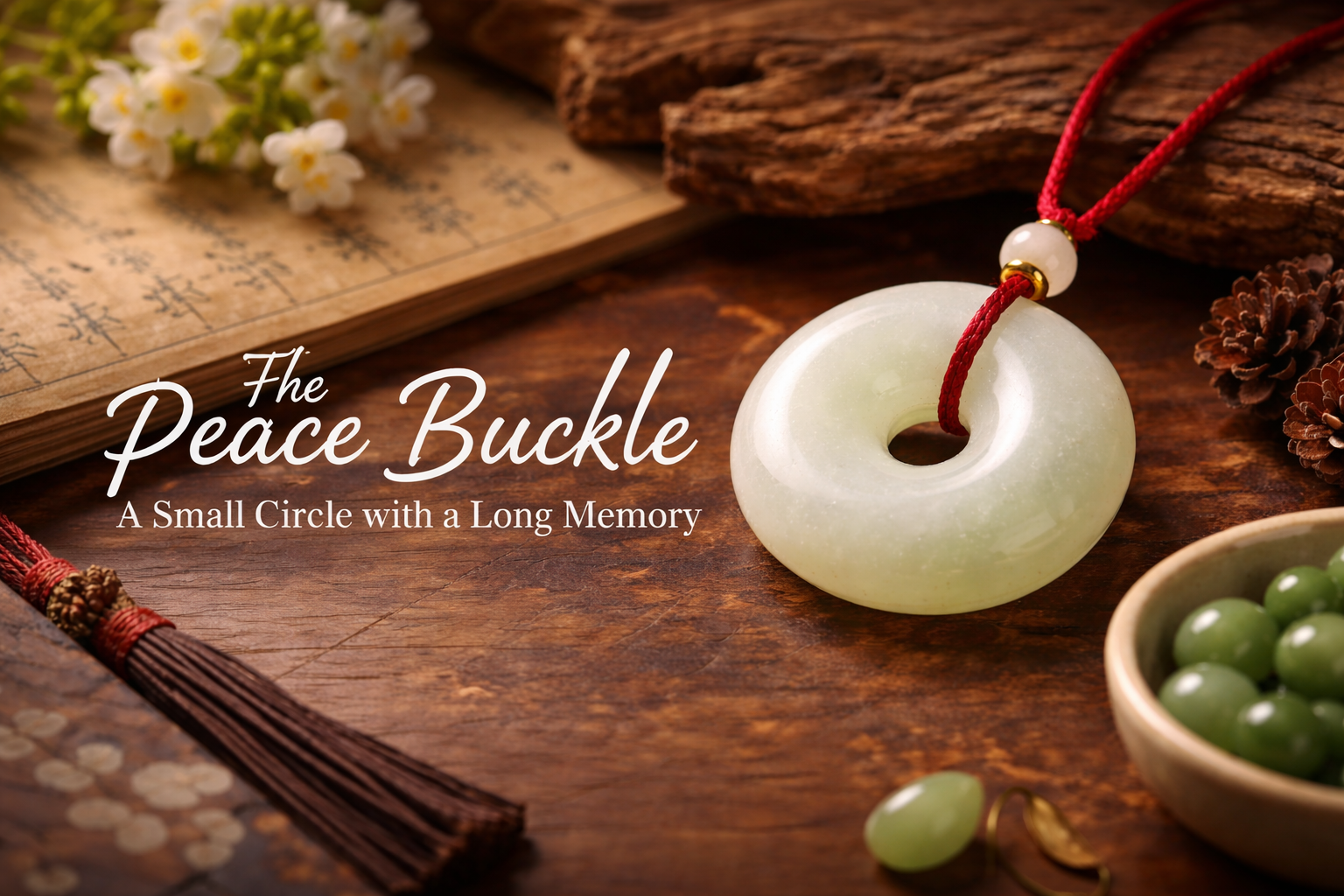
If you spend enough time around traditional Chinese jewelry, you’ll start noticing a simple shape that keeps coming back—a smooth, round disc with a hole in the center. It doesn’t glitter like diamonds or shout for attention. In fact, it’s almost quiet. This is the Ping An Kou, often translated as the “Peace Buckle,” and for many people in China, it’s more than just an ornament. It’s something you carry, almost like a wish you can touch.
At first glance, the design feels almost too simple. A perfect circle, with another smaller circle cut out from its center. But in Chinese culture, simplicity often hides depth. The outer ring represents the vastness of heaven, while the inner hole symbolizes the grounded world we live in. Together, they reflect harmony—between sky and earth, and between a person and their surroundings. It’s a philosophy you can wear.
The story of the Peace Buckle goes back further than you might expect. Its shape is believed to be inspired by ancient jade discs known as bi, which date as far back as the Neolithic period. These discs were used in rituals, often placed in tombs or offered to the heavens. Over time, as society evolved, the meaning softened and became more personal. What was once ceremonial became intimate—a token for everyday protection and peace.
There’s an old saying in China: “Gold has value, but jade is priceless.” Jade, especially, carries a kind of quiet prestige. It’s not just about wealth; it’s about character. Confucian scholars once compared jade to virtue—gentle, resilient, and warm. That’s why many Peace Buckles are made of jade, particularly soft white or green varieties. When worn close to the skin, people say jade “breathes” with you, gradually becoming smoother and more luminous over time. Whether or not you believe that, there’s something undeniably comforting about an object that seems to age alongside you.
Growing up, it wasn’t unusual for children to receive a Peace Buckle from their parents or grandparents. Sometimes it would be tied with a simple red cord and worn around the neck, tucked under a shirt. The message was clear, even if it wasn’t spoken aloud: Stay safe. Stay whole. Unlike flashy gifts, this one carried a quiet kind of love.
There’s also a practical elegance to its design. The round shape has no sharp edges, making it comfortable to wear every day. It sits lightly, whether as a pendant, bracelet centerpiece, or even a small charm attached to a bag. In a world where accessories often chase trends, the Peace Buckle feels timeless. It doesn’t need reinvention—it already knows what it is.
Today, the Peace Buckle has found new life beyond tradition. Designers are experimenting with different materials—agate, sandalwood, even modern ceramics—while keeping the original form intact. You’ll see it styled with minimalist outfits, layered with other pieces, or worn alone as a quiet statement. It fits just as naturally into a contemporary wardrobe as it did centuries ago in a scholar’s study.
But what really makes the Peace Buckle endure isn’t just its history or design. It’s the feeling it carries. In a fast-moving world, there’s something grounding about wearing a symbol that stands for peace, protection, and balance. It doesn’t promise to change your life overnight. It simply reminds you—gently, constantly—of what matters.
And maybe that’s why it has lasted so long.
Not because it tries to be extraordinary, but because it holds onto something very human: the hope that wherever we go, we can carry a little peace with us.
Comments (0)
No comments yet. Be the first to comment!
Leave a Comment
Please note, comments must be approved before they are published.