
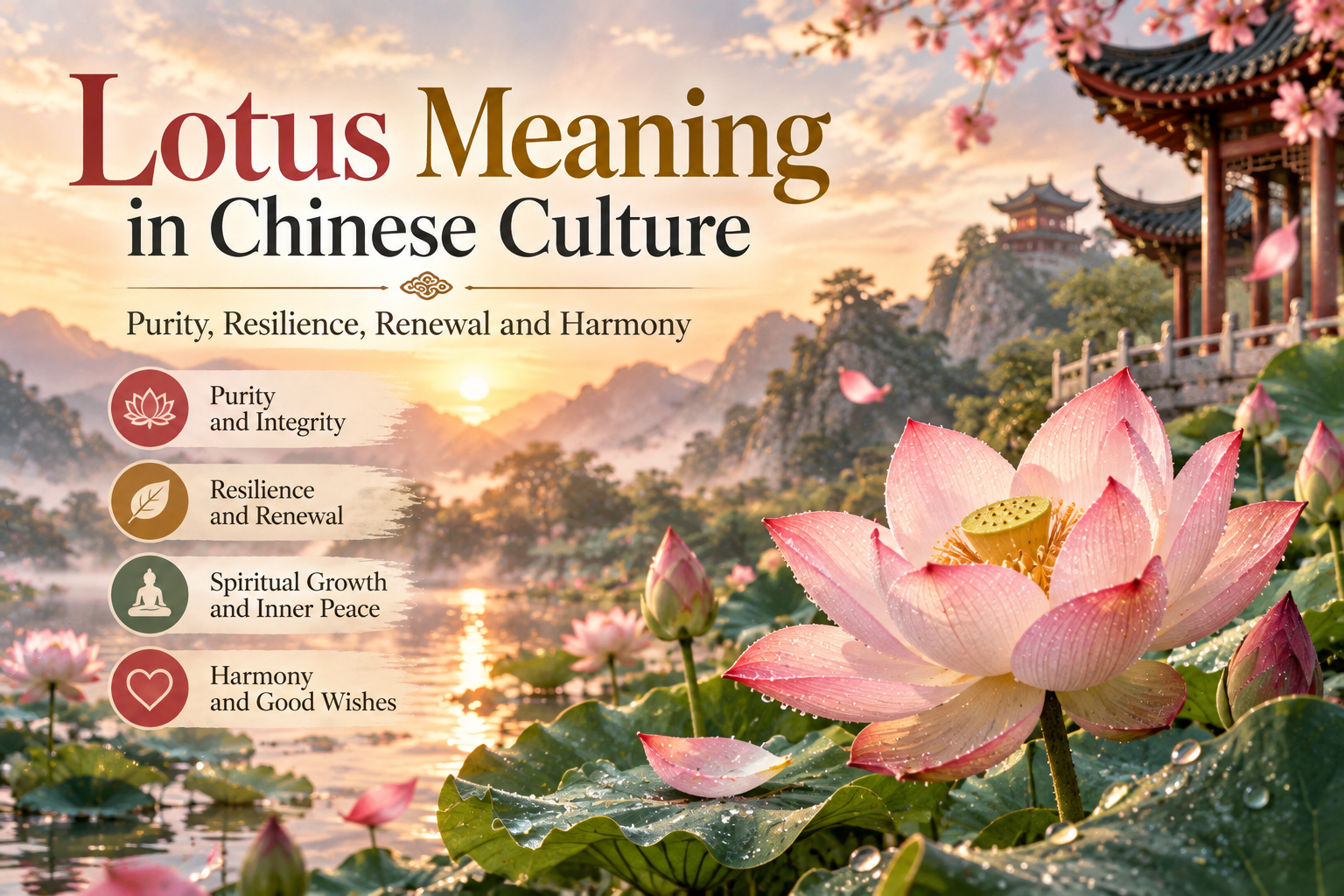
If you have ever visited a traditional Chinese garden in summer, you may have noticed lotus flowers rising above the water. Their pale pink or white petals look almost too delicate for the muddy ponds they grow in.
That contrast is exactly why the lotus has meant so much in Chinese culture for centuries.
Traditionally, the lotus is associated with purity, integrity, harmony, and spiritual growth. Many people believe its deeper meaning comes from something very simple: it grows from mud, yet its flower opens clean and beautiful above the water.
It is a symbol that does not pretend life is always perfect. Instead, it suggests that beauty and character can grow through difficult surroundings.
Why Does the Lotus Symbolize Purity?
In Chinese, the lotus is commonly called "莲花" (liánhuā) or "荷花" (héhuā).
One of its most famous cultural associations comes from the Song Dynasty scholar Zhou Dunyi. In his well-known essay, On the Love of the Lotus, he admired the flower because it emerged from mud without becoming stained by it.
Over time, this image became closely connected with personal integrity.
Traditionally, a person compared to a lotus was someone who could live in a complicated world without easily losing their principles.
That is probably my favorite way to understand the lotus. Its symbolism is not really about avoiding the "mud" of life. It is about what you become while growing through it.
The Lotus in Buddhism
The lotus also has an important place in Chinese Buddhist culture.
In Buddhist art, Buddhas and bodhisattvas are often shown sitting or standing on lotus flowers. The flower can represent awakening, wisdom, and the possibility of spiritual development.
Again, the way the plant grows helps explain the symbolism.
Its roots are hidden in muddy water, while the flower reaches toward light. Many people believe this reflects the idea that a person can move from confusion toward greater awareness.
This does not mean that wearing a lotus pendant or bracelet automatically creates spiritual change. For many people today, it is simply a personal reminder to stay calm, thoughtful, and grounded.
Lotus, Harmony, and Good Wishes
The lotus has another interesting layer of meaning because Chinese symbolism often plays with similar-sounding words.
The character "莲" (lián), meaning lotus, sounds like "连," which can suggest continuity or connection. Because of this, lotus imagery traditionally appears in art connected with wishes for harmony, family continuity, and abundance.
You may also see lotus flowers together with fish in Chinese paintings and decorative objects. Fish are associated with abundance, while the lotus can suggest continuity, creating a visual wish for prosperity year after year.
This is one reason traditional Chinese art can feel almost like a visual language. A flower is rarely just a flower.
The Lotus and Resilience
For modern life, I think resilience may be one of the easiest lotus meanings to connect with.
The lotus does not grow in perfectly clear water. It grows in an environment that looks unlikely to produce something so elegant.
Because of that, many people believe the lotus can represent the ability to move through difficult periods without allowing those experiences to define everything that comes afterward.
A lotus bracelet, necklace, carving, or small decorative object may therefore become a quiet reminder of renewal.
Not magic. Not a promise that everything will suddenly become easy.
Just a symbol that says difficult beginnings do not necessarily determine the ending.
Lotus Meaning in Love and Relationships
Lotus imagery can also carry meanings of harmony and affection.
In traditional Chinese decorative art, paired lotus flowers sometimes suggest a harmonious relationship. Because lotus plants produce flowers and seeds together, they have also historically been connected with family blessings and continuity.
Today, lotus jewelry can make a thoughtful gift for a partner, family member, or close friend, especially when the message is about growing together, starting again, or wishing someone peace.
The meaning does not have to be strictly romantic.
Sometimes "I hope you continue to grow beautifully" is enough.
Lotus Symbolism in Japan
The lotus is also important in Japanese culture, particularly through Buddhism.
In Japan, lotus flowers are commonly associated with Buddhist temples, spiritual awakening, and the idea of beauty emerging from imperfect circumstances.
Chinese and Japanese traditions are not identical, of course, but both cultures have been influenced by Buddhist lotus symbolism over many centuries.
This shared imagery helps explain why lotus motifs appear so often in East Asian art, sculpture, temples, jewelry, and decorative objects.
What Does Lotus Jewelry Mean Today?
Today, lotus jewelry is often worn simply because the flower is beautiful. But for people who care about symbolism, it can carry a more personal message.
A lotus pendant or bracelet may represent purity, resilience, renewal, inner peace, spiritual growth, or the decision to remain true to yourself during difficult times.
Traditionally, symbols gained meaning through stories, language, religion, and generations of cultural association. You do not have to believe that an object has supernatural power to appreciate that history.
Sometimes a meaningful symbol works because it reminds us of something we already know but easily forget.
Final Thoughts
The lotus has remained meaningful in Chinese culture because its story is surprisingly human.
It begins in mud.
It grows through dark water.
And eventually, it reaches the surface and opens toward the light.
For centuries, Chinese poets, scholars, artists, and Buddhist traditions have found meaning in that journey. Many people believe the lotus represents purity, but I think its deeper message is also about resilience.
You do not need perfect circumstances to grow into something beautiful.
Perhaps that is why, after hundreds of years, the lotus still feels relevant today.
Comments (0)
No comments yet. Be the first to comment!
Leave a Comment
Please note, comments must be approved before they are published.