
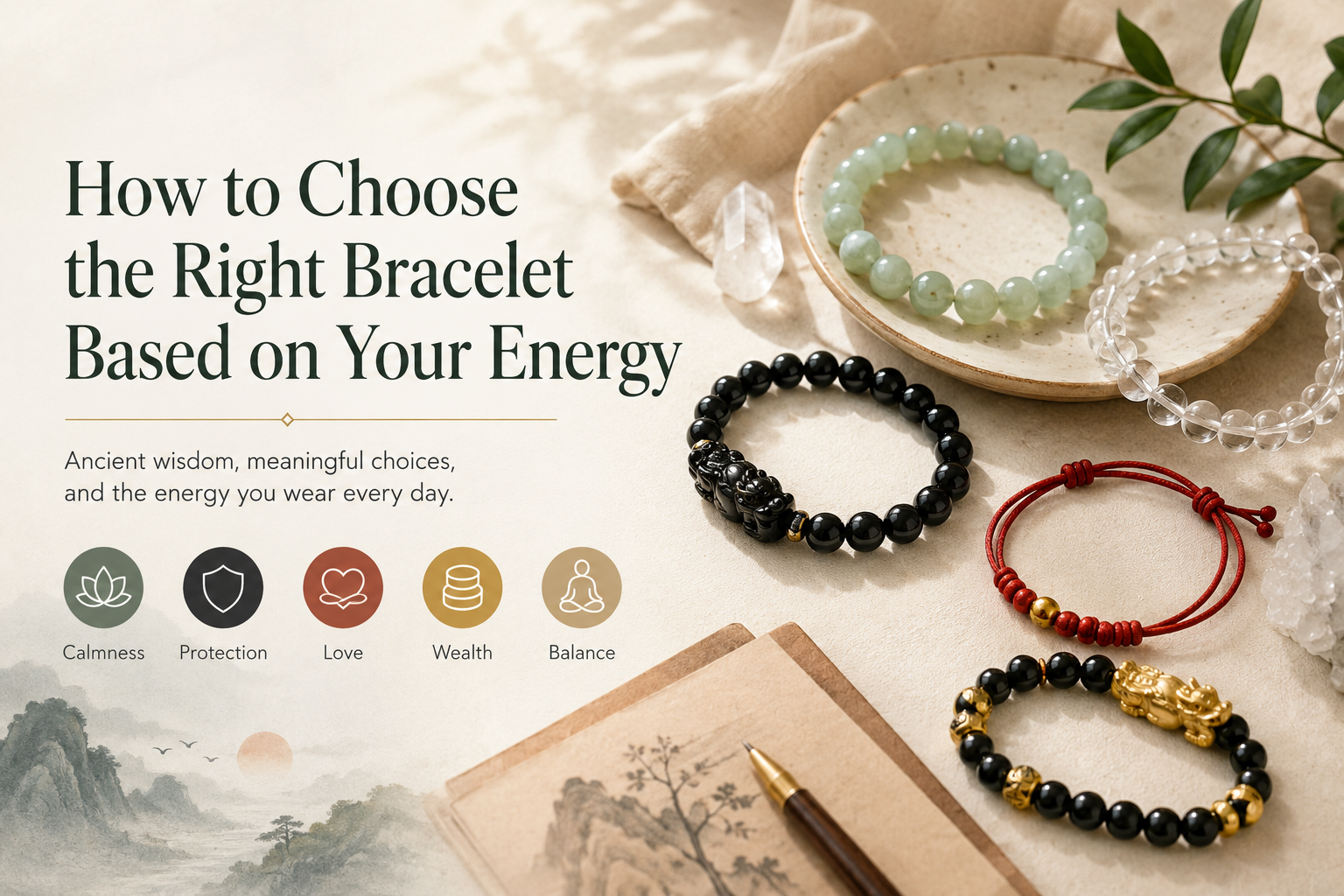
When a bracelet description asks you to choose “based on your energy,” a useful interpretation is personal preference: what you like looking at, how you want to dress, and what meaning you want to carry. Your attraction to a color does not diagnose an energy deficiency or reveal a mineral your body needs.
You can enjoy symbolic jewelry without treating the selection process as a test you might fail. There is no need to identify the strongest stone or buy several pieces to correct an invisible imbalance.
Turn a vague feeling into a clear brief
Instead of asking which stone will change your mood, ask questions you can actually answer:
- Do I want a subtle accessory or a bright point of color?
- Will I wear it while working at a desk or mainly on special occasions?
- Do I prefer smooth beads, a fine cord, or a single carved detail?
- Is there a person, value, or occasion I want it to represent?
For a quiet look, compare smaller beads and colors close to your usual wardrobe. For a visible accent, consider contrast and proportion. Neither choice implies a particular personality or mental state.
Choose meanings with a named context
Jade offers a good example of why specificity matters. The National Palace Museum’s account of jade describes how Eastern Zhou Confucians associated its qualities with moral virtues. That historical interpretation gives a wearer something concrete to reflect on; it does not prove that jade creates peace or protects its owner.
If that context interests you, begin with our Hetian jade introduction, then check the seller’s actual material identification rather than relying on a poetic name.
A red cord can also carry an explicit story. Singapore’s San Qing Gong Taoist Cultural Centre recounts the Yue Lao legend in which red strings connect the feet of future spouses. That is a marriage narrative, not evidence that every friendship or modern red bracelet has the same historical origin. Our red string of fate article explores the story separately.
Check the object as carefully as the symbolism
Ask for wrist sizing, bead dimensions, the cord or elastic type, metal composition, and any disclosed stone treatments. A color you love is still a poor everyday choice if its bracelet catches on clothing or feels heavy against your desk.
Also ask how to clean it. GIA explains that amethyst can be damaged by abrupt temperature changes and may fade under prolonged intense light. That is a reason to plan storage and wear, not to interpret a color change as an energy message.
Give yourself permission to choose simply
You may attach a private intention to a bracelet, but a purchase does not guarantee focus, confidence, love, or financial success. A reasonable budget and a clear return policy matter more than pressure to find a destined object.
For related symbolism, read our feng shui bracelet guide; for the boundary between interpretation and evidence, see whether crystal bracelets work. The choice can remain as straightforward as liking the piece and knowing how it fits your life.
Comments
Leave a comment
Comments are reviewed before publication.