
For the complete topic overview, start with our guide to meaning, materials and everyday use. This article addresses the specific question below.
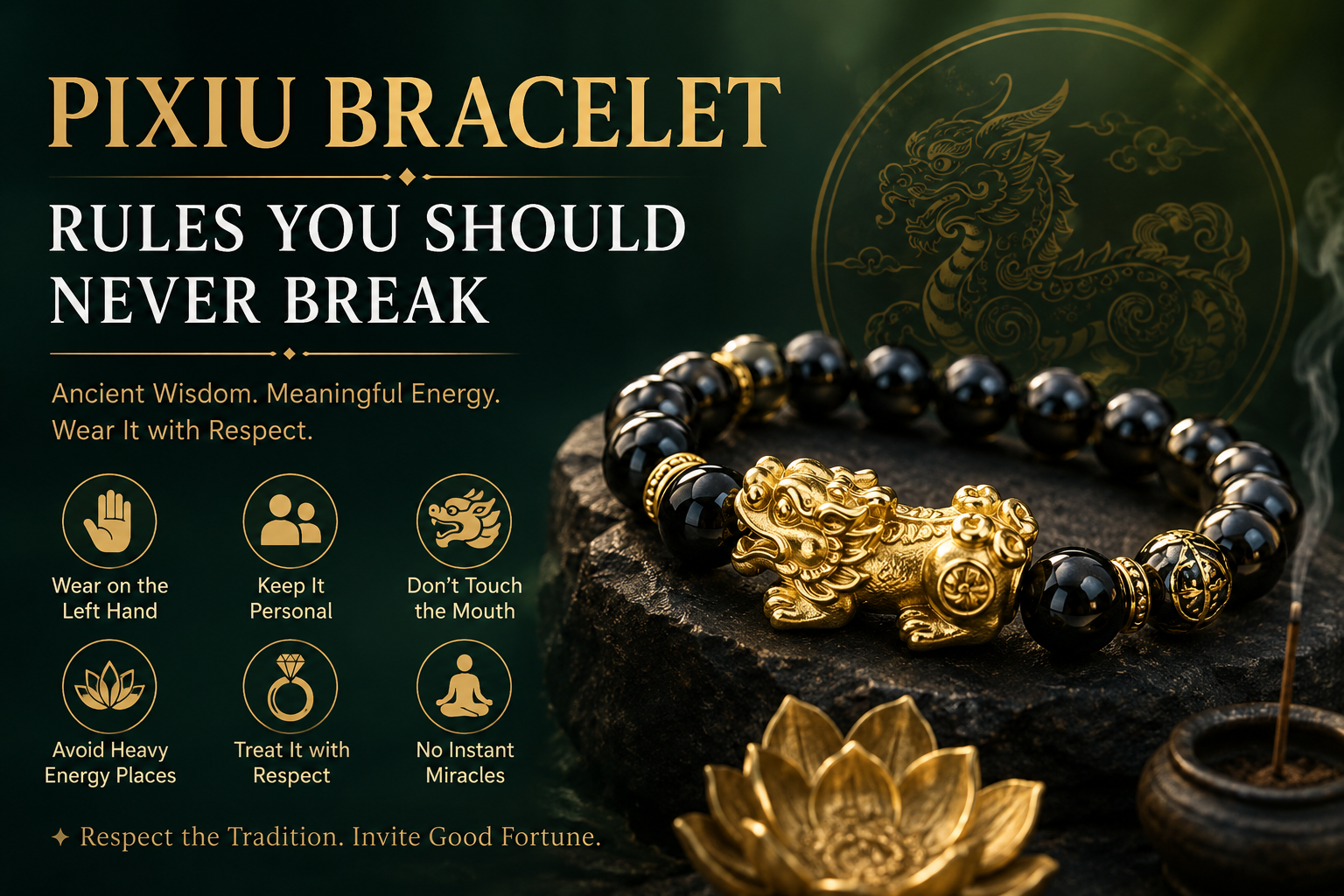
Pixiu bracelet advice often arrives as a list of things you must never do. A more useful approach is to ask what each instruction addresses: a symbolic preference, a particular community’s practice, or the physical needs of the jewelry. Those categories call for different decisions, and none requires treating an ordinary mistake as a prediction of bad luck.
Start with symbolism, not threats
The National Palace Museum’s Southern Branch describes Pixiu’s wealth association as a development of folklore. That explains why the motif appeals to people hoping for prosperity; it does not establish rules about every wearer’s wrist, visitors or daily schedule. Our introduction to Pixiu bracelets explains the symbol before the etiquette.
When someone presents a prohibition, ask which source or community it comes from. A family preference can matter deeply to that family without becoming an obligation for everyone else. Be especially cautious when a frightening claim is followed by an offer to sell a corrective ceremony.
Which wrist should you choose?
Choose a fit that does not pinch, catch or interfere with your normal activities. If you have received a bracelet with specific family instructions, you can decide whether following them feels meaningful to you. There is no reason to judge another wearer’s sincerity from their wrist alone.
For a fuller discussion, see left-hand and right-hand Pixiu wearing choices. If you move it to the other side because of a watch or a sore wrist, you do not need to interpret the change as losing wealth.
What if someone touches the charm?
You can ask people not to handle your jewelry, just as you would with any personal possession. An accidental touch does not demonstrate contamination of luck, ownership or a spiritual bond. Nor does brushing the carved mouth establish that your financial prospects have changed.
If the bracelet becomes physically dirty, address the dirt using care appropriate to its materials. A personal preference about handling does not need a supernatural explanation. A polite boundary is enough: “I prefer to keep it on, but you’re welcome to look.”
Hospitals, funerals and grief
Do not treat patients, mourners or places of care as sources of spiritual danger to your bracelet. If a hospital asks you to remove jewelry, follow its instructions. At a funeral, consider the family’s wishes and the tone of the occasion rather than assuming one rule covers every community.
The National Museum of Natural Science documents guardian-beast imagery in historical burial contexts. That historical use does not determine modern bracelet etiquette, but it cautions against flattening the tradition into a blanket fear of death. Removing or wearing a personal accessory is not a measure of respect or compassion by itself.
The practical rules worth keeping
- Check for worn cord and loose fittings before wearing the bracelet.
- Remove it when it could catch on equipment or when an activity requires jewelry removal.
- Keep it somewhere it will not be knocked onto the floor when you take it off.
GIA advises protecting jewelry from chemicals and selecting cleaning methods for the actual materials and treatments. For the difference between cleaning and symbolic cleansing, use our crystal-bracelet care guide.
A bracelet can carry a personal meaning without controlling your movements or relationships. Keep the customs you understand and value, care for the object, and leave frightening predictions out of everyday decisions.
Who might prefer not to wear one?
If fit, personal preference or activity requirements make the bracelet unsuitable, choose another piece or take it off. See who might prefer not to wear a Pixiu bracelet for that specific question. The motif is not a basis for assigning forbidden ages, identities or circumstances to every wearer.
Comments
Leave a comment
Please note, comments must be approved before they are published.