
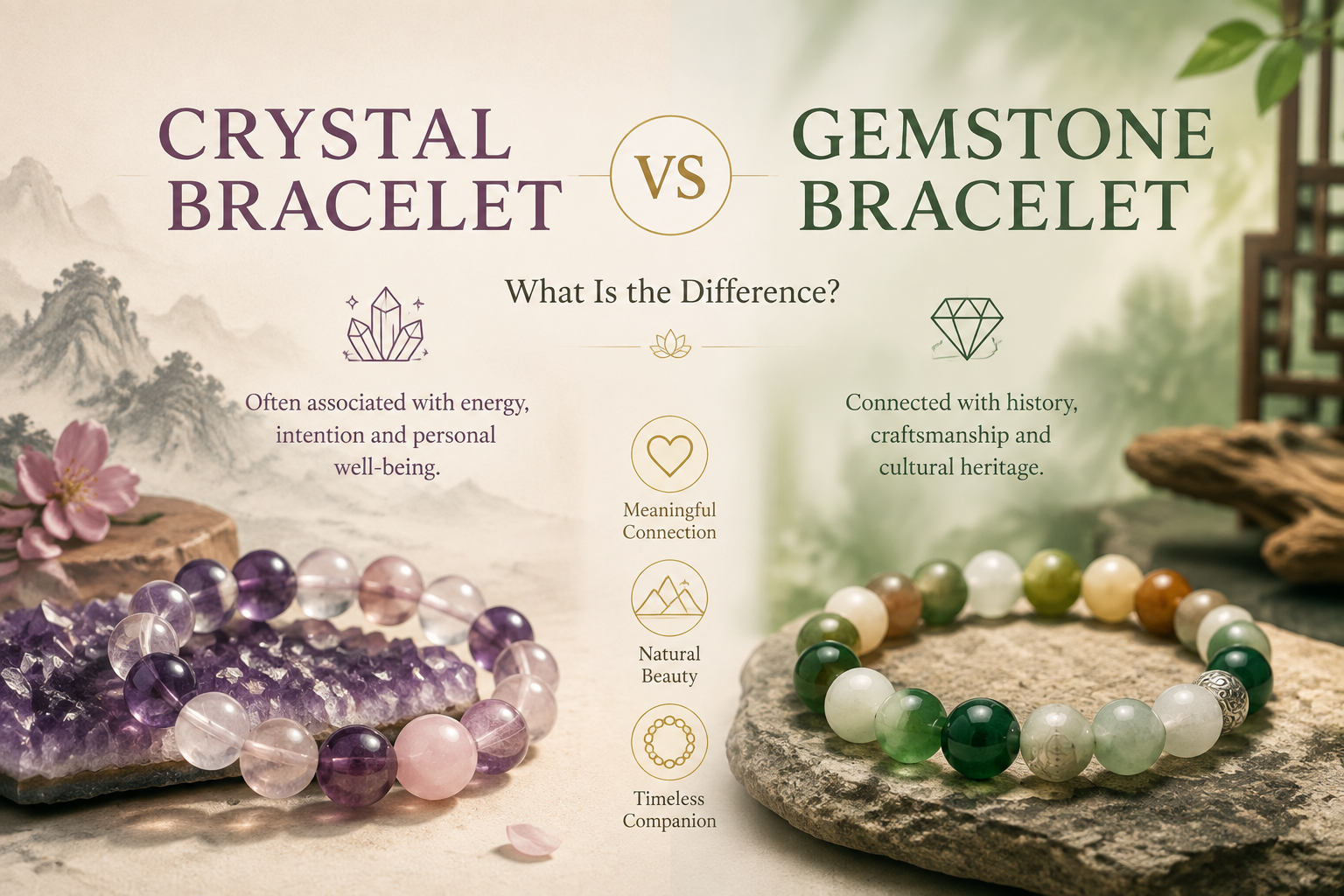
“Crystal bracelet” and “gemstone bracelet” are overlapping shopping descriptions, not reliable labels for two separate kinds of wearer. An amethyst design can appear under either heading. The words do not tell you that one piece is more spiritual, more valuable, or necessarily natural.
The most useful next question is specific: what are these beads actually made from?
Why the categories overlap
In everyday jewelry listings, “crystal” can refer to named mineral beads, while other products use the word for decorative glass. Do not infer composition from the category alone. Look for the material name and an explanation of how the seller uses the term.
A familiar exception helps make the point. The USGS identifies obsidian as volcanic glass, even though it is frequently grouped with crystals in retail language. A shopping category is broader than that geological identity.
Gem materials are not all crystalline minerals
GIA identifies amber as fossilized resin, an organic gem rather than a mineral. This is another reason not to build a rigid crystal-versus-gemstone rule from a product heading.
Instead, compare named examples. Rose quartz, amber, and obsidian have different identities and care needs. None becomes interchangeable simply because it has been drilled into round beads.
Natural, laboratory-created, and imitation answer another question
The FTC’s gemstone buying guidance distinguishes those descriptions. They concern origin and composition, rather than whether the piece appears in a crystal or gemstone collection.
Ask the seller to clarify an ambiguous listing in writing. A clear answer is more useful than a photograph alone, particularly if a material claim is an important part of the price.
A concise written description is useful to keep with the item, especially when a gift recipient will be responsible for its care.
Compare the finished bracelets on the same terms
- Which materials are present, including cord and metal?
- Are treatments or coatings disclosed?
- What are the bead dimensions and actual fit?
- How is the piece fastened and maintained?
- What return or adjustment options are available?
Personal meaning can come afterward. You might choose a piece because it recalls a person or because you like the color. That association does not need to follow a retail category, and neither label establishes a health benefit.
For a named material, explore our rose quartz introduction. If you are comparing designs, the daily-wear guide covers fit and routine. The care guide explains why identifying the complete bracelet matters before cleaning it. Buy the description you can understand and verify, rather than expecting a broad label to answer every question.
Comments
Leave a comment
Please note, comments must be approved before they are published.