
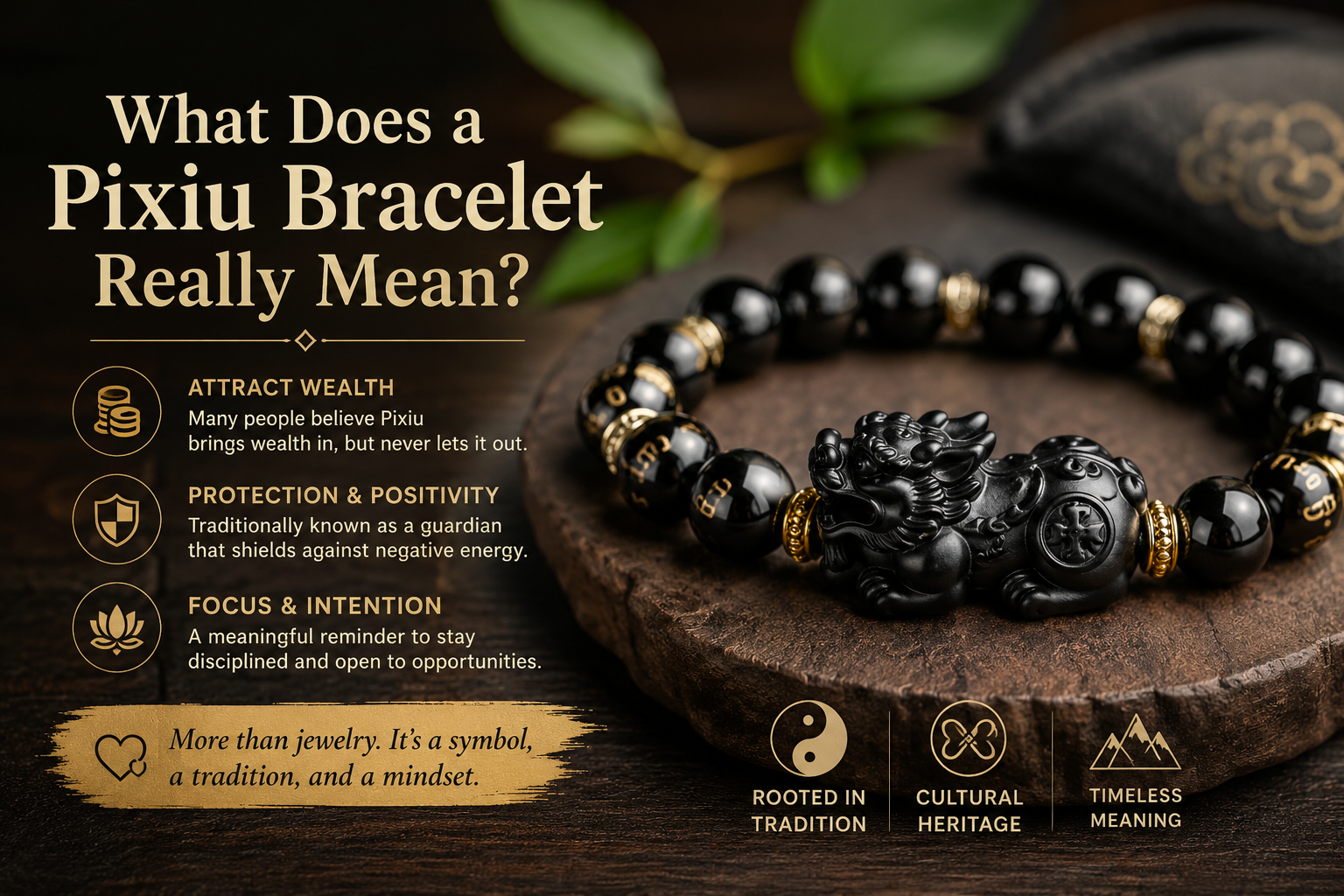
For the complete topic overview, start with our guide to meaning, materials and everyday use. This article addresses the specific question below.
This article examines the guardian interpretation of Pixiu. A guardian image can express a wish for safety without establishing that the object prevents harm. For the separate prosperity story, see Pixiu’s wealth-retention folklore.
A guardian image with a longer history
The National Museum of History’s record for a Western Han bronze bixie connects Pixiu with guardian-beast names and protective imagery. The National Museum of Natural Science also discusses related composite beasts in burial settings. These objects help place the motif in a wider history of imagined guardians.
That context matters because a modern bracelet is not interchangeable with an ancient tomb sculpture. A museum object can document an image and its interpretation without proving that a contemporary bead arrangement carries an unbroken set of ancient wearing instructions. Names and forms also deserve attention to their specific source and period.
What protection means in this context
A protective motif expresses a wish for safety or reassurance. It should not be read as evidence that jewelry blocks accidents, illness or harmful forces. You can appreciate the guardian story while continuing to make ordinary practical decisions about your surroundings.
Similarly, a dark stone does not establish that a bracelet absorbs “negative energy.” Material descriptions, cultural stories and claims about effects are different kinds of information. A careful product description should make clear which one it is offering.
Does wearing it require a religious commitment?
The carving alone does not tell you a wearer’s beliefs. Someone may approach it through family custom, a spiritual practice, design, or a gift relationship. If a bracelet comes from a particular religious community, ask about that context rather than assigning the same meaning to every Pixiu object.
Respect begins with curiosity: learn the name, avoid presenting a sales story as the voice of an entire culture, and listen when a person explains their own practice. You do not need to claim supernatural powers to value the craftsmanship or the symbolism.
Give a personal interpretation its own name
A wearer may connect the image with a family memory, a milestone or a wish to look after something valued. Presenting that as a personal interpretation leaves room for another wearer to understand the same design differently. It does not require turning one person’s explanation into a universal cultural rule.
A giver can say “I chose this guardian motif as a wish for your well-being.” That communicates an intention without promising safety or demanding a ritual. The object’s historical references, the maker’s product description and the recipient’s beliefs remain separate sources of meaning.
Questions about wrist, charm direction or handling belong to Pixiu wearing customs. For the jewelry’s components rather than its interpretation, return to the charm-and-beads introduction.
Comments
Leave a comment
Comments are reviewed before publication.