
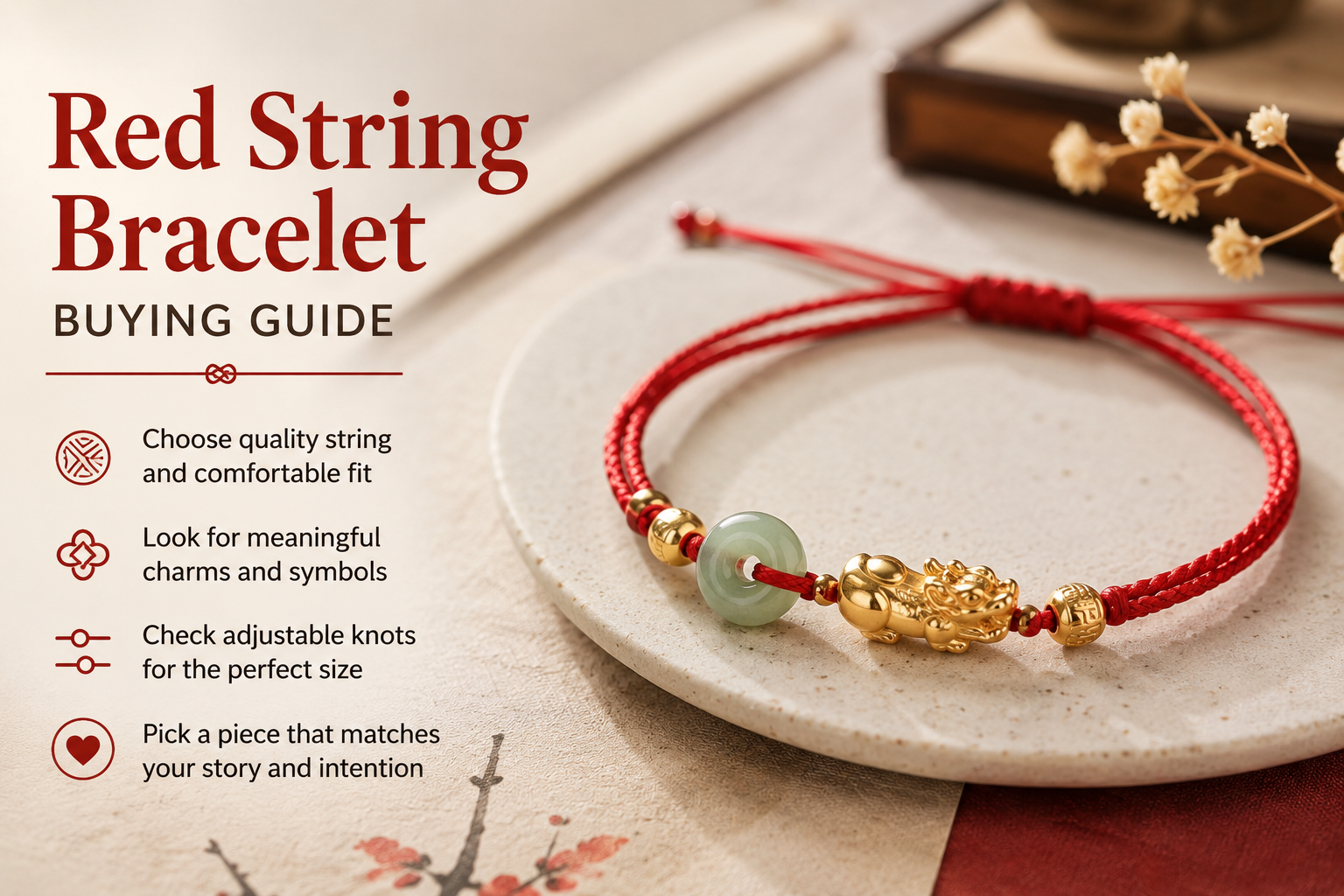
A red string bracelet is probably one of the simplest pieces of jewelry you can buy. A piece of red cord, perhaps a small bead or charm, and a knot around the wrist. Nothing complicated.
And yet, in many cultures, that little red thread carries much more meaning than its appearance suggests.
In China, red has traditionally been associated with happiness, good fortune, celebration, and protection. You see it during Lunar New Year, at weddings, on lucky envelopes, and tied around meaningful gifts. In Japan, red threads also appear in folklore, especially in stories about fate and human connection.
Today, people wear red string bracelets for all kinds of reasons. Some are interested in tradition. Some like the symbolism. Others simply love how a thin red bracelet looks next to a watch or everyday jewelry.
If you're thinking about buying one, here's what I would actually pay attention to.
1. Start With the String Itself
This sounds obvious, but the cord matters more than the charm.
A bracelet that looks beautiful online isn't very useful if the string feels scratchy, fades quickly, or becomes uncomfortable after a few days.
For everyday wear, I usually prefer a cord that feels soft but tightly woven. It should have enough strength to handle normal movement without feeling like a shoelace around your wrist.
Traditional-looking bracelets often use a thinner red cord, while modern versions may use braided or woven strings.
Neither is necessarily "better." It depends on whether you want something subtle or something that feels more like a piece of jewelry.
2. Choose the Right Shade of Red
Not every red string bracelet is bright scarlet.
You'll find deep crimson, burgundy, vermilion, and softer muted reds. Traditionally, bright red is strongly connected with auspicious occasions in Chinese culture, which is why classic red remains the most recognizable choice.
But you don't need to treat the color like a strict rule.
A darker red can feel more understated and easier to wear with neutral clothing, while a vivid red makes the bracelet more noticeable.
Personally, I think the best shade is the one you'll actually enjoy wearing.
3. Decide Whether You Want a Simple String or a Charm
This is where red string bracelets become interesting.
Some are nothing more than a red cord with carefully tied knots. Others include jade, Pixiu, gold-colored beads, zodiac symbols, obsidian, or small decorative charms.
A simple red string tends to feel more traditional and minimal.
A charm bracelet can carry additional symbolism. For example, jade has long been valued in Chinese culture and is often associated with virtue, harmony, and protection. Pixiu, meanwhile, is traditionally connected with wealth and good fortune.
Many people believe combining these symbols with a red string adds another layer of meaning.
I prefer thinking of these meanings as cultural stories rather than promises. A bracelet shouldn't have to "guarantee" anything to be meaningful.
4. Check How the Bracelet Adjusts
This is one detail people often forget when buying online.
Look carefully at the wrist-size information.
Adjustable sliding knots are especially convenient if you're buying the bracelet as a gift because you don't need to know the recipient's exact wrist measurement.
For fixed-size bracelets, measure your wrist first and leave a little room for comfort.
A red string bracelet usually looks best when it sits naturally against the wrist rather than hanging extremely loose.
5. Handmade or Machine-Made?
There's nothing automatically wrong with a machine-made bracelet.
But handmade red string bracelets often have small differences in knot placement, cord tension, and finishing. Personally, I like those tiny imperfections. They make the bracelet feel less like something that came straight from a factory mold.
Traditionally, knots themselves can carry symbolic meaning in Chinese decorative culture. Chinese knotting, for example, has a long history of using cords and interconnected patterns to represent ideas such as continuity, harmony, and good wishes.
If craftsmanship matters to you, look closely at product photos, especially the knots and finishing points.
6. Think About Why You're Buying It
This may be the most useful question.
Are you buying it for yourself?
As a couple's bracelet?
As a birthday gift?
For Lunar New Year?
As a small reminder of someone or something important?
In Chinese culture, red is often used during moments of celebration and transition. That's one reason a red string bracelet can make a surprisingly thoughtful gift. It doesn't need to be expensive to carry a personal message.
In Japanese folklore, there is also the famous idea of the "red thread of fate," an invisible red thread believed to connect people who are destined to meet.
Many people today interpret that story more loosely. The red thread can represent love, friendship, family, or simply a connection worth remembering.
7. Be Careful With Big Spiritual Claims
When shopping online, you may see bracelets promising instant wealth, guaranteed protection, perfect relationships, or dramatic changes in your life.
I'd be cautious with those.
Red string bracelets have genuine cultural and symbolic traditions behind them, but that doesn't mean a bracelet should be treated as a guaranteed solution to life's problems.
Traditionally, symbolic objects often worked alongside personal intention, ritual, family customs, and belief.
For me, that's actually more interesting.
The bracelet can be a reminder of what you value rather than something you expect to magically do the work for you.
So, What Makes a Good Red String Bracelet?
A good red string bracelet doesn't need to be complicated.
Look for comfortable cord, secure knots, an appropriate size, and thoughtful craftsmanship. If it includes jade, Pixiu, obsidian, or another symbol, learn a little about what that symbol traditionally represents before choosing it.
Most importantly, choose something whose story makes sense to you.
Maybe you wear it because you grew up around Chinese traditions. Maybe someone you love gave it to you. Maybe you're fascinated by the red thread of fate. Or maybe you simply like that tiny flash of red on your wrist.
All of those reasons are valid.
After all, the most interesting jewelry isn't always the most expensive.
Sometimes, it's just a small red thread with a story attached to it.
Comments
Leave a comment
Please note, comments must be approved before they are published.