
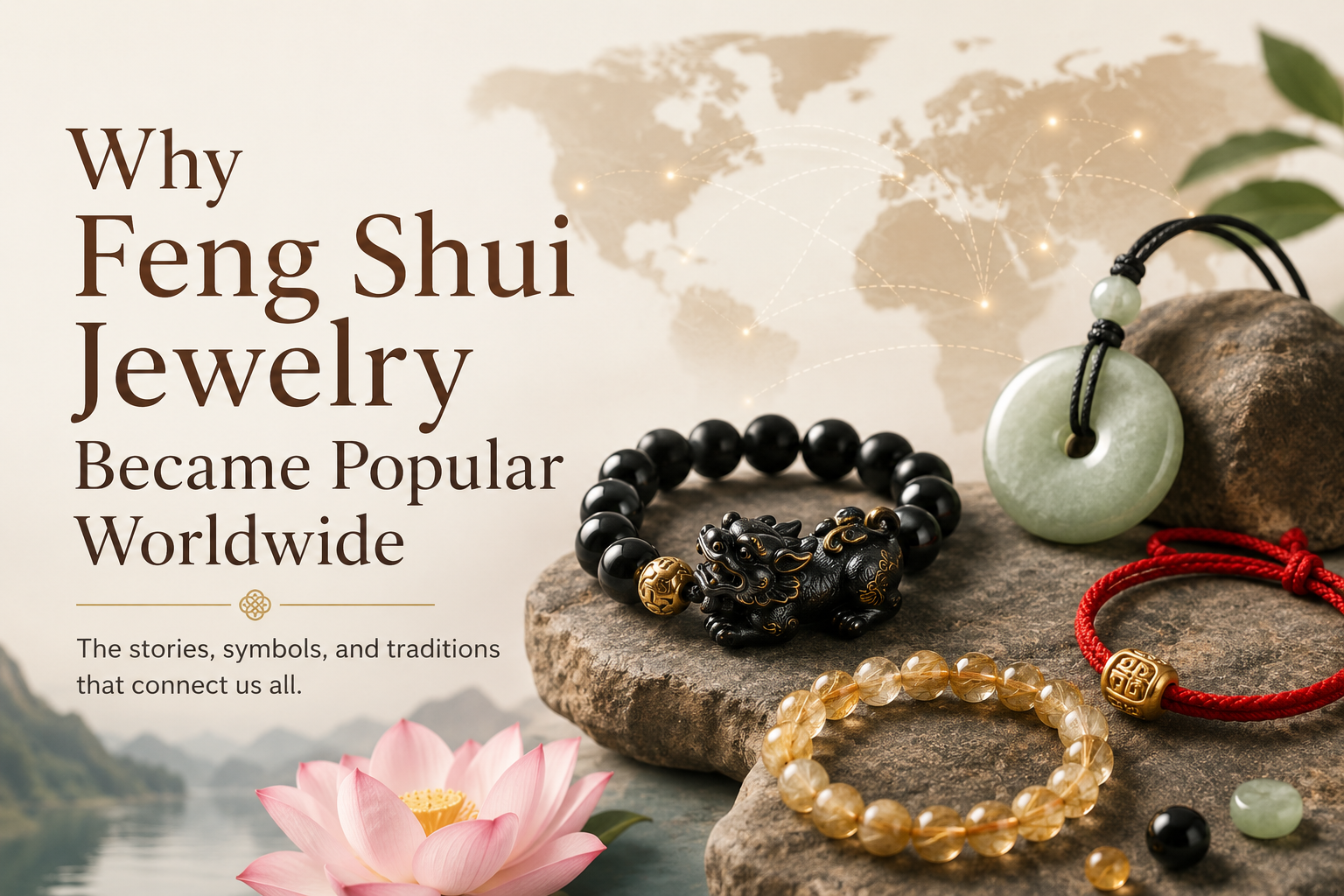
“Feng shui jewelry became popular worldwide” is a larger claim than a few familiar designs can support. Establishing that trend would require reliable sales or audience data, a defined period and a clear product category. Without those, it is more useful to explore why a symbolic bracelet might appeal to people in different settings.
A broad retail label can hide different histories
Feng shui has a documented relationship with interpreting places: the Hearst Museum explains it through spatial arrangement and a divination compass. A modern jewelry category can bring together motifs and materials whose histories should be studied separately.
A jade pendant, cord bracelet and carved creature are not interchangeable evidence of one continuous jewelry tradition. Our Pixiu article provides an introduction to one motif. Start with the individual object rather than assuming its marketing category tells the whole story.
Design provides an accessible starting point
A buyer may like a bracelet’s proportions, color or texture before learning anything about its symbolism. Another might recognize a motif from family objects. These are possible reasons for interest, not survey findings about what most buyers believe.
The same piece may be worn as decoration by one person and as a personal reminder by another. Neither choice requires a claim that the material transmits a force or that wearing it delivers the outcome associated with a symbol.
Stories can invite learning
Symbolic imagery has rich, specific contexts. Kyoto National Museum’s account of a Qing dragon robe shows auspicious motifs combined with distinctions of rank. It illustrates why an object’s setting matters: a court robe is not a modern bracelet, even when both invite discussion of meaning.
For another focused subject, our Hetian jade article introduces a material associated with Chinese objects. A thoughtful description makes those connections visible without inventing a family history or claiming every design has been worn unchanged for centuries.
Sharing a design calls for clear explanations
When jewelry is offered to an unfamiliar audience, plain descriptions help. Name the motif, explain the source of a claimed association and identify contemporary interpretation as such. Give the bead material and dimensions the same attention as the story.
Do not treat celebrity photographs, short videos or personal travel anecdotes as proof of a global market trend. Nor does an online listing establish how an entire culture understands a symbol.
Choose a piece for reasons you can explain
Our selection guide can help turn curiosity into a considered choice. You might choose an attractive design, a gift with a clear intention or a starting point for learning. Those are sufficient reasons to enjoy symbolic jewelry without overstating its popularity or promising supernatural results.
Comments
Leave a comment
Comments are reviewed before publication.