
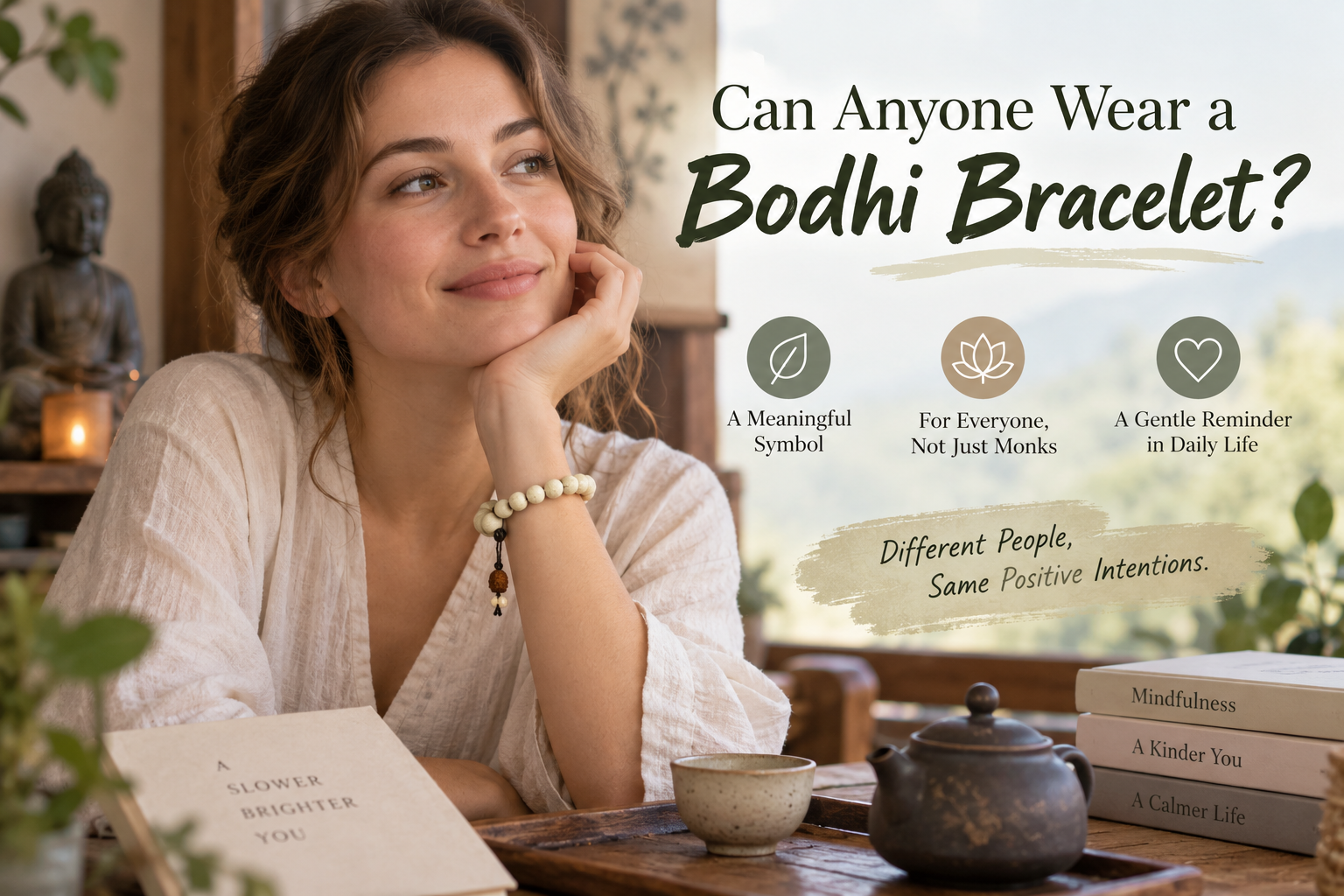
Bodhi bracelets are often photographed beside incense, tea, or meditation cushions, so it is easy to assume that they belong only to monks, Buddhists, or people who practice meditation.
But in everyday life, the answer is much simpler: yes, almost anyone can wear a Bodhi bracelet.
You do not have to follow a particular religion, understand every Buddhist teaching, or meditate every morning. For many people, a Bodhi bracelet is simply a meaningful object — something that reminds them to slow down, stay grounded, or carry a little intention into an ordinary day.
The more important question is not "Am I allowed to wear one?" but rather, "What does wearing one mean to me?"
What Does "Bodhi" Actually Mean?
The word "Bodhi" is commonly associated with awakening or enlightenment in Buddhist tradition. The best-known story is, of course, that Siddhartha Gautama attained enlightenment while meditating beneath the Bodhi tree.
Because of this connection, Bodhi has gradually become associated with wisdom, awareness, patience, and spiritual growth.
In China, strings of beads have long appeared in Buddhist practice and later became part of everyday cultural life. Traditionally, some beads were used for counting prayers or mantras, while others were carried or worn as reminders of Buddhist teachings.
Over time, however, Bodhi beads also moved beyond strictly religious settings.
Today, you may see someone wearing a Bodhi bracelet while meditating, drinking coffee, working at a laptop, or simply walking through the city.
Do You Have to Be Buddhist?
No.
This is probably the most common misunderstanding around Bodhi bracelets.
Traditionally, Bodhi beads have strong connections with Buddhism, but wearing them does not automatically mean that you are Buddhist. In modern China and other parts of Asia, people may wear Bodhi beads for many different reasons.
Some appreciate the spiritual symbolism. Some enjoy the natural texture of the beads. Others like watching the beads slowly change in color and character through years of handling.
Many people believe that the most respectful approach is simply to understand what you are wearing.
You do not need to pretend that a Bodhi bracelet has a religious meaning for you if it does not. At the same time, knowing a little about its cultural background makes the bracelet feel more meaningful than treating it as just another fashion accessory.
Can Beginners Wear Bodhi Bracelets?
Absolutely.
There is no "experience level" required.
In fact, a simple Bodhi bracelet can be a surprisingly approachable first step for someone interested in meditation, mindfulness, or Asian cultural traditions.
You do not need a complicated ritual before putting it on.
Some people simply hold the bracelet for a moment and think about an intention: becoming more patient, worrying less about things they cannot control, or remembering to slow down during a stressful week.
Many people believe that this personal intention matters more than following a long list of rules.
Can Men and Women Both Wear Them?
Yes. Bodhi bracelets are traditionally not limited to one gender.
The difference usually comes down to personal style.
Larger beads and darker tones can create a heavier, more understated look, while smaller white Bodhi beads may feel lighter and more minimal. Some bracelets also combine Bodhi beads with jade, sandalwood, agate, or other natural materials.
There is no universal "correct" version for men or women.
Choose the one you would actually enjoy wearing.
A Small Lesson From the Beads
One thing I personally find interesting about Bodhi beads is that they do not stay exactly the same.
Natural beads can gradually become smoother, darker, or more polished as they are handled and worn. In Chinese collecting culture, this slow process is sometimes appreciated as part of the object's character.
You cannot really rush it.
And perhaps that is why Bodhi beads feel appropriate as symbols of patience.
There is a quiet idea behind them: meaningful changes often happen through repetition rather than dramatic moments.
Wear the bracelet. Touch the beads. Go about your day.
Months later, you may notice that they look different.
In a way, so do we.
Are There Any Rules?
There are traditions, but there is no single rulebook that every Bodhi bracelet wearer follows.
If your bracelet is being used specifically as a Buddhist prayer bracelet, religious customs may matter more. In that situation, it is worth learning about the particular tradition you are following.
For everyday cultural or personal wear, I would keep things simple.
Treat the bracelet respectfully, keep it relatively clean, avoid deliberately damaging the beads, and understand that Bodhi has cultural and spiritual associations beyond fashion.
Some people also avoid wearing their bracelet while showering, swimming, or exercising, especially when the beads are natural seeds or plant-based materials. That is usually practical care rather than a spiritual prohibition.
What About Children?
Children can wear Bodhi bracelets too, but practicality and safety matter more than symbolism.
Small beads, loose cords, and dangling decorations may not be suitable for very young children. For older children, a properly sized bracelet can sometimes make a thoughtful gift, especially when the meaning is explained in a simple way.
Instead of saying, "This bracelet will bring you good luck," you might say, "This bracelet can remind you to stay calm and be kind."
That feels much closer to the spirit behind Bodhi.
So, Who Should Wear a Bodhi Bracelet?
Anyone who genuinely enjoys its meaning, appearance, or cultural story can consider wearing one.
You might choose a Bodhi bracelet because you meditate. You might wear one because you are interested in Chinese or Buddhist culture. You might simply like natural beads and the way they develop character over time.
Many people believe Bodhi beads can serve as a reminder of mindfulness and inner balance, but they do not need to be treated as magical objects.
For me, that is actually what makes them interesting.
A Bodhi bracelet does not have to promise wealth, protection, or instant spiritual transformation. Sometimes its meaning can be much quieter.
It can simply remind you that growth takes time.
And you do not need to be a monk to appreciate that.


Comments (0)
No comments yet. Be the first to comment!
Leave a Comment
Please note, comments must be approved before they are published.