
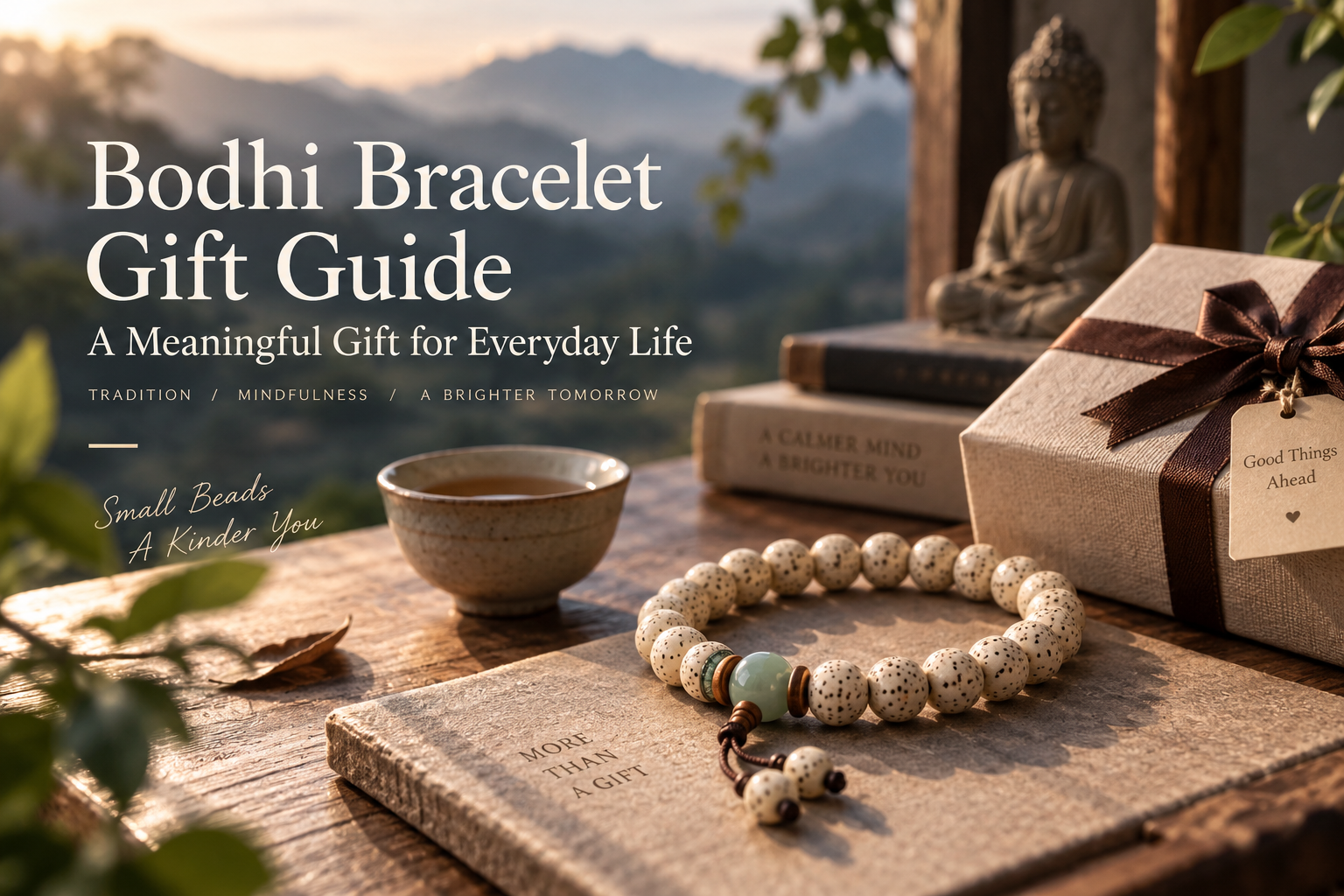
Some gifts are beautiful the moment you open the box. Others become more meaningful after months, or even years, of being used.
A Bodhi bracelet can be both.
At first, it may simply look like a strand of warm, natural beads. But as it is worn, the surface can gradually become smoother and develop a deeper tone. For many people, that slow change is part of the charm. The bracelet doesn't stay exactly as it was on the day it was given. In a small way, it grows with the person wearing it.
That is one reason I think a Bodhi bracelet makes such an interesting gift. It isn't overly formal, and it doesn't need to carry a dramatic spiritual promise. It can simply be a thoughtful object with a story behind it.
Why Give a Bodhi Bracelet as a Gift?
The word "Bodhi" is closely associated with awakening and understanding in Buddhist traditions. The historical Buddha is traditionally said to have attained enlightenment while meditating beneath the Bodhi tree in India.
Over time, Bodhi seeds and other natural beads associated with this tradition became popular materials for prayer beads, meditation beads, and personal bracelets across different parts of Asia.
In China, bead bracelets are often handled almost absentmindedly during quiet moments. Some people rotate the beads while thinking, walking, drinking tea, or sitting at a desk. Traditionally, beads may have had religious or contemplative purposes, but today many people also wear them simply because they appreciate natural materials and the feeling of something tactile in the hand.
This makes a Bodhi bracelet surprisingly easy to give. The recipient doesn't have to follow a particular spiritual practice to appreciate it.
The Beauty of a Bracelet That Changes With Time
One of my favorite things about Bodhi beads is that they don't necessarily remain pristine.
Natural beads can slowly change through contact with the skin, natural oils, air, and everyday handling. Depending on the material, they may become slightly darker, smoother, or more polished.
In Chinese collecting culture, people sometimes talk about the pleasure of "raising" or caring for an object through use. The idea isn't that an old object becomes worse. Sometimes the signs of time are exactly what make it personal.
A new Bodhi bracelet might look pale and simple. A bracelet worn regularly for several years may tell a completely different story.
As a gift, I find that idea rather lovely.
Who Is a Bodhi Bracelet Good For?
A Bodhi bracelet works especially well when you want to give something meaningful without making the gift feel too serious.
It can be a thoughtful choice for a friend beginning a new chapter, someone interested in meditation or Eastern culture, a family member who prefers natural jewelry, or a partner who enjoys simple, understated accessories.
It can also work as a graduation, birthday, travel, or "just because" gift.
Many people believe Bodhi beads symbolize mindfulness, growth, patience, and inner awareness. I prefer to think of these meanings as invitations rather than promises. A bracelet won't create calm or wisdom by itself, but it can become a small reminder of the intention behind the gift.
Choosing the Right Bodhi Bracelet
When choosing one as a gift, I would pay more attention to the recipient's personality than to complicated rules.
For someone who loves minimal jewelry, a simple strand of natural Bodhi beads is usually the safest choice. White or light-colored Bodhi beads tend to feel clean, soft, and contemporary, while darker beads often have a warmer, more traditional character.
For someone who likes symbolic jewelry, you might choose a bracelet paired with jade, red cord, sandalwood, or a small meaningful charm.
In Chinese culture, jade has traditionally been associated with virtues such as beauty, refinement, and moral character. Red, meanwhile, has long been connected with celebration and good fortune. Combining these elements with Bodhi beads can make the bracelet feel more culturally layered without becoming overly ornate.
The most important thing is that it still looks like something the person would actually wear.
A Bodhi Bracelet for Someone Who Meditates
If the recipient practices meditation, yoga, or another contemplative routine, a simpler design may be especially appropriate.
In both China and Japan, beads have long appeared in Buddhist practice, although their forms, materials, and religious meanings vary considerably between traditions.
A modern Bodhi bracelet shouldn't automatically be treated as a formal Buddhist object. Still, many people enjoy using the beads as a tactile focus during breathing exercises or quiet reflection.
Sometimes running a thumb over one bead at a time is enough to create a small pause in an otherwise busy day.
Should You Explain the Meaning When Giving It?
I would.
Not with a long lecture, though.
A short note can make the gift much more personal. You might mention that Bodhi is traditionally associated with awakening and awareness, or that natural Bodhi beads can gradually change with use.
Something as simple as, "I chose this because I liked the idea of something that becomes more personal the longer you keep it," can mean more than an elaborate explanation about luck or energy.
It also gives the recipient room to create their own relationship with the bracelet.
What About "Spiritual Benefits"?
You'll often see Bodhi bracelets described online using words such as protection, healing, luck, or positive energy.
These ideas are meaningful to some people, and many people believe natural beads can carry symbolic or spiritual significance. Traditionally, beads have certainly played important roles in religious and contemplative practices.
But I wouldn't choose a Bodhi bracelet because it supposedly guarantees a particular result.
For me, its value is quieter.
It can remind someone to slow down. It can mark a new beginning. It can carry the memory of the person who gave it. And, after years of wear, it may become one of those small possessions that feels strangely difficult to replace.
A Gift That Doesn't Need to Be Perfect
There is something refreshing about giving an object that is expected to change.
A Bodhi bracelet may pick up tiny marks. Its color may deepen. The beads may become smoother from being touched thousands of times.
In a culture where we're often encouraged to keep everything looking brand new, that feels almost rebellious.
Traditionally, many handmade and natural objects in East Asian cultures have been appreciated not only for perfection, but also for the traces of time and use they accumulate.
A Bodhi bracelet fits beautifully into that way of thinking.
You give someone the bracelet when it is new.
What it becomes afterward belongs to them.
And perhaps that is what makes it such a meaningful gift.


Comments (0)
No comments yet. Be the first to comment!
Leave a Comment
Please note, comments must be approved before they are published.