
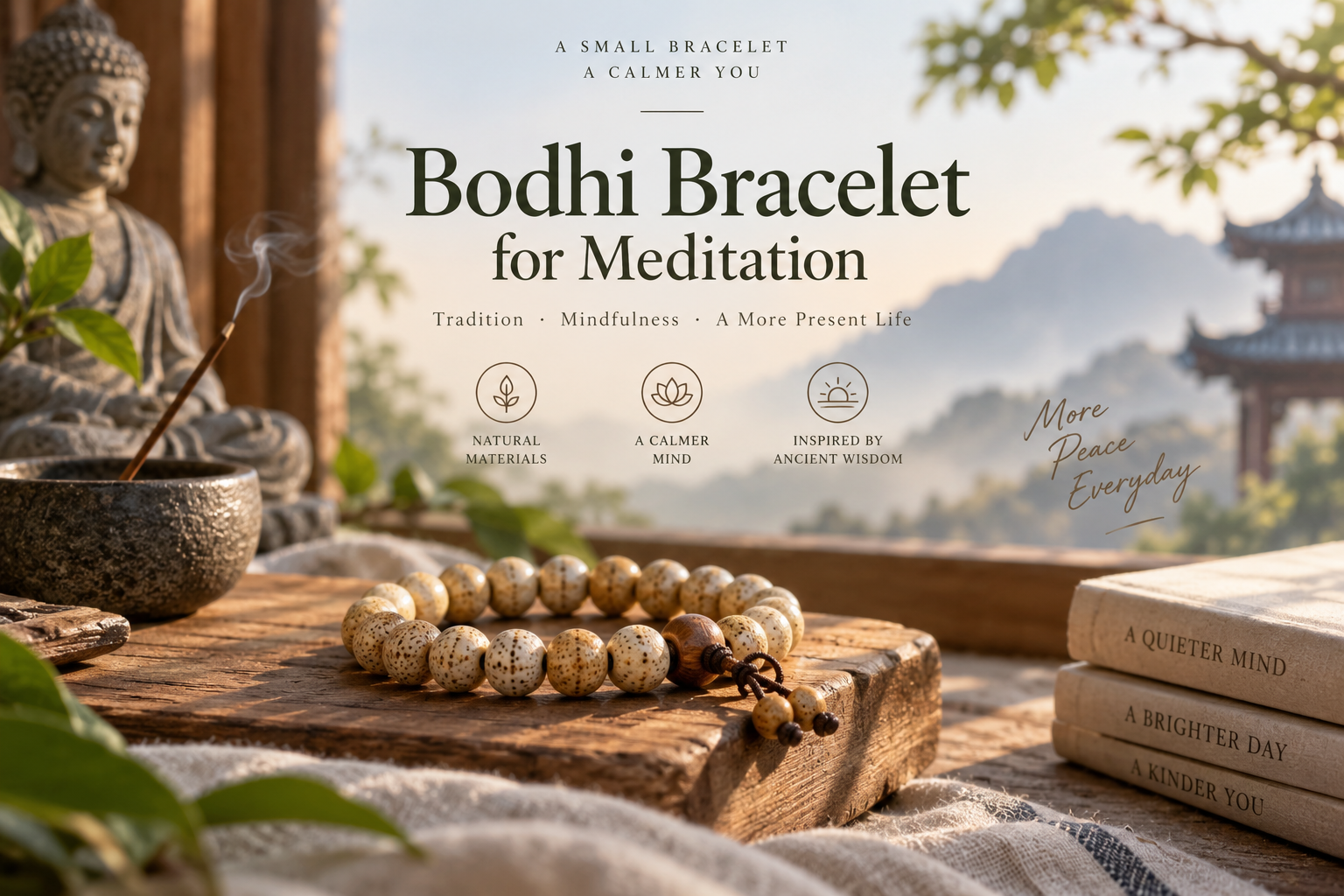
Meditation does not always begin with a perfectly quiet room, a cushion, and thirty uninterrupted minutes.
Sometimes, it begins on a train.
Sometimes, it begins at your desk between two meetings.
And sometimes, it begins with something as simple as touching a small wooden or seed bead around your wrist.
That is one reason I find Bodhi bracelets interesting. They are not complicated objects, and they do not need to be. Traditionally, Bodhi beads have been connected with Buddhist practice, reflection, and the idea of becoming more aware of the present moment.
For modern life, a Bodhi bracelet can be less about "achieving enlightenment" and more about having a small reminder to slow down.
What Is a Bodhi Bracelet?
Despite the name, "Bodhi" does not always refer to one specific type of seed.
In the jewelry and meditation world, the term is often used for different natural seeds and beads associated with Buddhist traditions. You may see white Bodhi beads, lotus seed-style beads, or other varieties used in bracelets and malas.
The word "Bodhi" itself comes from a Sanskrit word associated with awakening or enlightenment. According to Buddhist tradition, Siddhartha Gautama attained enlightenment while meditating beneath the Bodhi tree.
Because of this story, Bodhi gradually became much more than the name of a tree. For many people, it represents awareness, patience, and the long process of understanding oneself.
A bracelet made with Bodhi beads carries a little of that symbolism into everyday life.
Why Use a Bodhi Bracelet for Meditation?
When people first try meditation, one of the biggest surprises is how difficult it can be to simply sit still.
Your mind starts making lists.
You remember an email you forgot to send.
You suddenly wonder what you are having for dinner.
This is completely normal.
A physical object can sometimes give your attention somewhere gentle to return to. You can hold one bead between your fingers, breathe slowly, then move to the next bead.
There does not have to be a complicated ritual.
Many people believe the repetitive movement of touching beads helps create a natural rhythm during meditation. I personally think the value is often much simpler: the beads give your hands something quiet to do while reminding your mind why you sat down in the first place.
A Tradition Older Than the Modern "Wellness" Trend
Meditation beads existed long before meditation became part of modern wellness culture.
In Chinese Buddhist traditions, prayer beads are commonly known as "fo zhu," or Buddhist beads. Traditionally, monks and lay practitioners may use strings of beads while reciting the Buddha's name, mantras, or other devotional phrases.
In Japan, Buddhist prayer beads are generally known as "juzu" or "nenju." Their designs vary between Buddhist schools, and they can be used during prayer, ceremonies, and personal practice.
Of course, wearing a small Bodhi bracelet today is not the same thing as carrying a traditional Buddhist mala or juzu.
That distinction matters.
You do not need to pretend you are participating in a religious practice if you are simply interested in meditation. Instead, I think it is more respectful to understand where the inspiration comes from and use the bracelet in your own quiet, thoughtful way.
A Simple Way to Meditate With Bodhi Beads
You do not need incense, special music, or a complicated setup.
Sit somewhere comfortable and place your phone out of reach if possible.
Hold one bead gently between your thumb and finger.
Take one slow breath.
Notice the texture of the bead. Is it smooth, slightly uneven, warm, or cool?
Move to the next bead and breathe again.
If your thoughts wander, simply return your attention to the bead in your fingers.
Some people repeat a short phrase with each bead. Traditionally, beads may be used for mantra or prayer recitation. For a non-religious practice, you might use a simple phrase such as "be here," "slow down," or "one breath at a time."
Five minutes is enough.
The point is not to force your mind to become completely empty. It is simply to notice when your attention wanders and gently bring it back.
Why Natural Bodhi Beads Feel Different Over Time
One of my favorite things about natural Bodhi beads is that they rarely stay exactly the same.
With regular handling, some Bodhi beads gradually become smoother, warmer in tone, or slightly darker. Natural oils from your hands, friction, moisture, and time can all influence their appearance.
In Chinese collecting culture, there is a familiar pleasure in this process. People sometimes spend years handling natural seed beads, watching their surface slowly develop character and patina.
Many people believe this aging gives the beads a more personal meaning.
I would not describe it as the bracelet "absorbing your energy" as a scientific fact. But there is something genuinely satisfying about an object changing because you have carried and touched it for months or years.
It becomes a quiet record of use.
Do Bodhi Bracelets Have Spiritual Powers?
This depends very much on personal belief.
Traditionally, Bodhi-related objects can carry deep Buddhist symbolism. Some people believe wearing or using Bodhi beads encourages calmness, mindfulness, protection, or spiritual awareness.
Others simply appreciate their natural texture and cultural history.
I think both approaches can coexist.
A Bodhi bracelet does not need to promise a miraculous transformation to be meaningful. Sometimes its purpose is simply to interrupt an automatic habit.
You reach for your phone, notice the bracelet, and take a breath instead.
That tiny moment may be enough.
Choosing a Bodhi Bracelet for Meditation
For meditation, I would prioritize comfort over decoration.
Look for beads that feel pleasant between your fingers and a bracelet that is not painfully tight around your wrist. Natural variations, small marks, and differences in color are normal with many seed-based beads and can actually make the bracelet feel more individual.
If you plan to use the beads regularly, simpler designs are often easier to handle than bracelets covered with large metal charms.
Most importantly, choose one you actually want to wear.
A meditation bracelet hidden permanently inside a drawer is not much of a reminder.
A Small Ritual for an Ordinary Day
There is a temptation to make meditation feel like another task we need to perform correctly.
I prefer thinking about Bodhi beads differently.
Traditionally, they are connected to practices that value repetition, patience, and awareness. In modern daily life, a bracelet can carry a much smaller version of that idea.
Touch a bead.
Take a breath.
Notice where you are.
Then continue with your day.
Many people believe meaningful objects become meaningful because of the intention we give them. Whether you see a Bodhi bracelet as a spiritual symbol, a meditation tool, or simply a beautiful natural object, perhaps its most useful message is also the simplest:
You are here now.
Comments
Leave a comment
Please note, comments must be approved before they are published.