
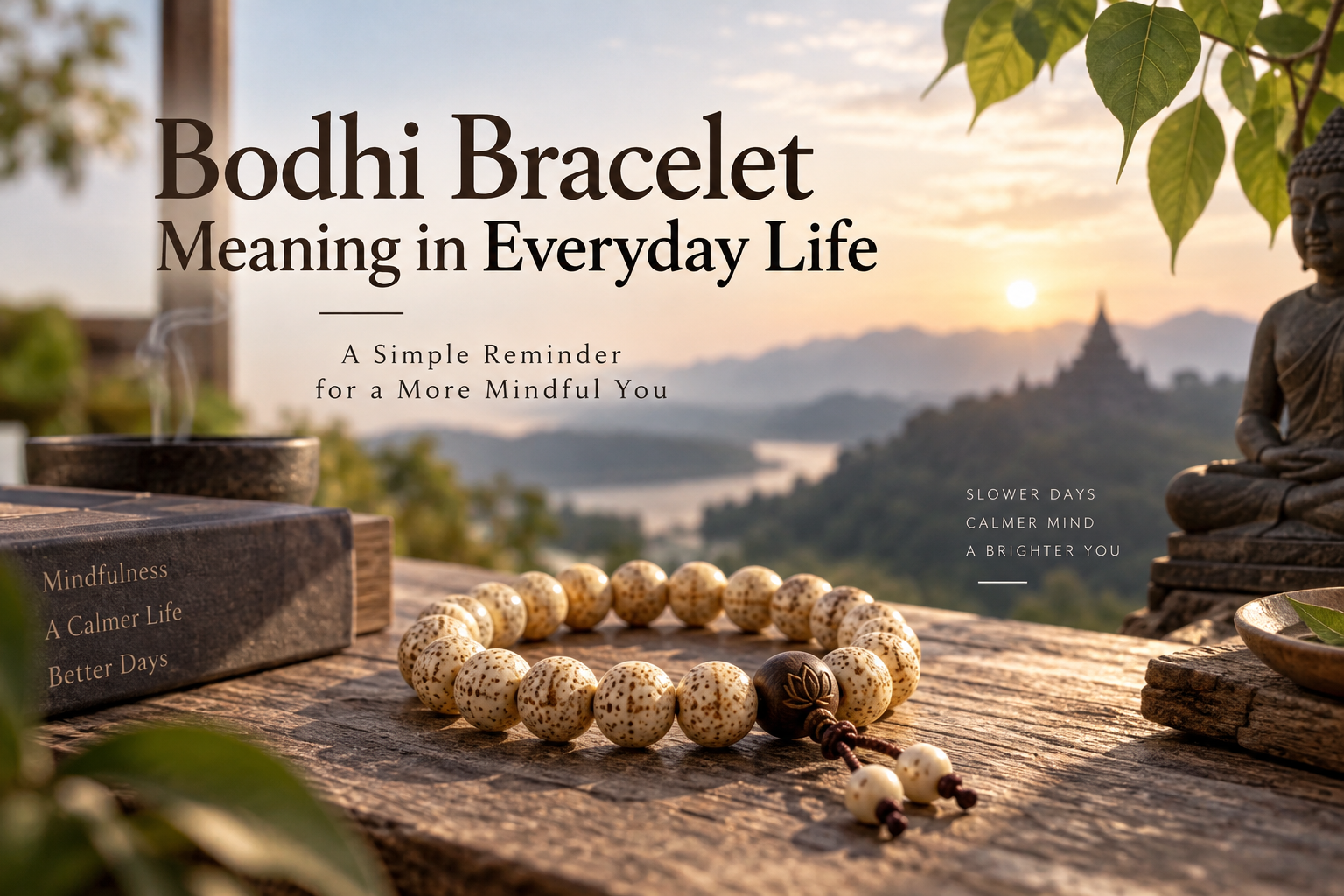
A Bodhi bracelet can look surprisingly simple: a circle of natural beads, often in soft ivory, warm brown, or earthy tones. There is no screen, no notification, and nothing particularly complicated about it.
Maybe that is exactly why people still like wearing one.
Traditionally, Bodhi beads have been connected with Buddhist practice, meditation, and the idea of awakening. Today, however, you do not need to be a monk, a serious meditator, or even a Buddhist to appreciate them. For many people, a Bodhi bracelet has become something much more personal: a small reminder to slow down, stay present, and carry a little intention into ordinary life.
What Does "Bodhi" Actually Mean?
The word "Bodhi" is commonly translated as "awakening" or "enlightenment."
In Buddhist tradition, the Bodhi tree is especially meaningful because Siddhartha Gautama is traditionally said to have attained enlightenment while meditating beneath a Bodhi tree in India.
Over time, the idea of Bodhi became associated not only with religious awakening, but also with awareness, wisdom, and seeing life more clearly.
This does not mean that wearing a Bodhi bracelet automatically gives someone wisdom or spiritual insight. Rather, many people believe the bracelet can serve as a physical reminder of those ideas.
And sometimes, a reminder is enough.
A Small Pause in a Busy Day
One thing I find interesting about bead bracelets is how often you notice them without trying.
You see the beads while typing. You feel them move when picking up your phone. Your fingers may touch them while waiting for coffee or sitting on a train.
Those tiny moments can become little pauses.
In traditional meditation practices, beads are sometimes used for counting recitations, breaths, or mantras. In everyday life, people often use Bodhi bracelets much more casually.
You might touch one bead and take a slow breath before opening another email.
You might notice the bracelet during a stressful commute and remind yourself not to rush mentally just because everything around you is moving quickly.
It is a very simple habit, but that simplicity is part of the appeal.
Why Bodhi Beads Change With You
Natural Bodhi beads are especially interesting because they do not always stay exactly the same.
With regular handling and wear, some beads gradually become smoother, darker, or warmer in tone. Natural oils from the skin, friction, sunlight, and everyday use can all contribute to these changes.
In China, the practice of handling and appreciating natural beads and objects over time is sometimes connected with the broader culture of "pan" (盘), meaning to repeatedly handle and care for an object until its surface develops a richer character.
For some people, this aging process is not considered a flaw.
It is the point.
A brand-new bracelet may look clean and untouched. A bracelet worn for years can quietly record something about the person who wore it.
Traditionally, many people appreciate this gradual transformation because it reflects patience. You cannot really rush it.
Bodhi Bracelets in Modern Life
In China and other parts of Asia, bead bracelets can appear in many different settings. You might see them worn during meditation, but you might just as easily see them with a T-shirt, office clothes, or a watch.
That is one reason Bodhi bracelets translate surprisingly well into modern wardrobes.
They do not have to announce themselves as "spiritual jewelry."
For some people, they represent mindfulness. For others, they are connected with Buddhist culture. Some simply enjoy the texture and natural appearance of the beads.
And some wear one because it was given to them by someone important.
All of those meanings can coexist.
A Personal Reminder, Not a Promise
It is easy for spiritual jewelry to be surrounded by big claims: protection, luck, healing, transformation.
I prefer a quieter way of looking at Bodhi bracelets.
Traditionally, Buddhist practice places great importance on what happens within the mind and through one's actions. An object may have symbolic meaning, but it does not replace patience, compassion, awareness, or personal effort.
So instead of thinking, "This bracelet will make me calm," you might think:
"When I notice this bracelet, I will remember to slow down."
That small difference makes the meaning feel much more grounded.
Wearing Bodhi Beads Without Being Buddhist
A common question is whether someone needs to be Buddhist to wear a Bodhi bracelet.
Generally, no.
Many people wear Bodhi-inspired jewelry because they appreciate its cultural background, natural materials, or connection with mindfulness. You do not have to adopt a belief system simply because you find meaning in an object.
What matters more is approaching the tradition with respect.
Learning where the symbolism comes from, avoiding exaggerated claims, and treating religious imagery thoughtfully can make the experience much more meaningful.
Giving a Bodhi Bracelet as a Gift
Bodhi bracelets can also make thoughtful gifts precisely because their meaning is fairly gentle.
Instead of saying, "This will bring you good luck," you could give one with a simpler intention:
"I hope this reminds you to take care of yourself."
Or:
"Keep this with you when life gets busy."
In many Asian traditions, meaningful objects become especially valuable when they are connected with relationships and memories. The emotional meaning often comes less from the material itself and more from who gave it, when it was given, and why.
Let the Meaning Grow Naturally
Perhaps the nicest thing about a Bodhi bracelet is that you do not need to decide exactly what it means on the first day.
Wear it.
Let the beads change gradually. Notice how they feel in your hand. Use them during meditation if you want, or simply let them sit quietly on your wrist while you go through your day.
Over time, the bracelet may become associated with a certain period of your life, a person, a journey, or a habit you are trying to build.
Many people believe meaningful objects become meaningful through use, not just through symbolism.
A Bodhi bracelet may begin as a simple strand of beads.
After enough ordinary days, it can become something much more personal.


Comments (0)
No comments yet. Be the first to comment!
Leave a Comment
Please note, comments must be approved before they are published.