
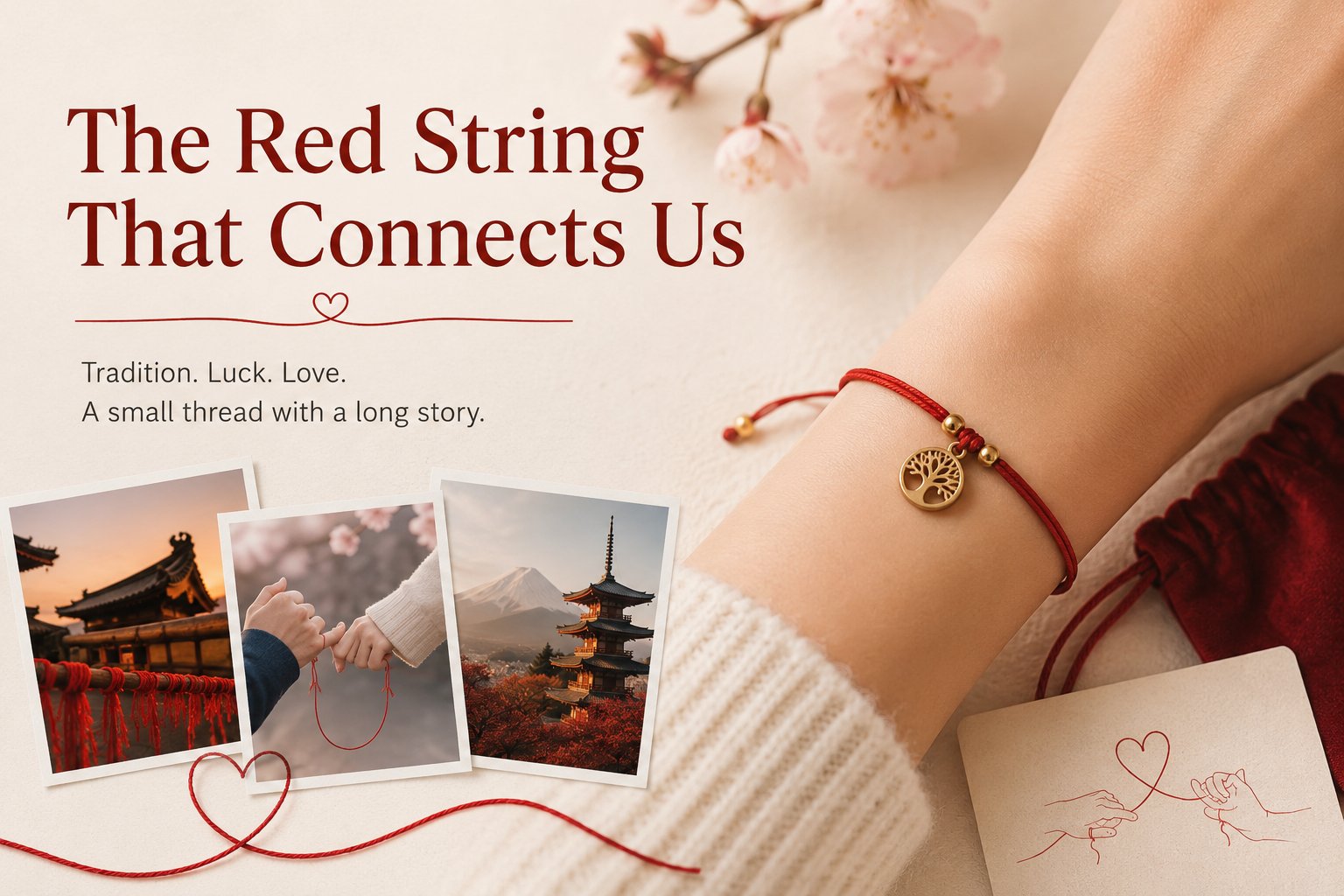
Walk through a night market in Taipei, browse a small jewelry shop in Tokyo, or scroll through fashion posts online, and you will probably see it somewhere: a simple red string tied around the wrist.
It is not flashy. It does not need diamonds, complicated charms, or a luxury logo. Sometimes it is literally just a piece of red cord.
And yet, the red string bracelet has survived centuries of changing fashion.
So why are people still wearing it today?
The answer probably has less to do with trends than we think. For many people, a red string bracelet sits somewhere between jewelry, tradition, memory, and a small personal ritual.
Red Has Never Been "Just a Color"
In Chinese culture, red has traditionally carried strong associations with happiness, celebration, good fortune, and protection.
You see it everywhere during important moments: red envelopes at Lunar New Year, red decorations at weddings, red lanterns during festivals, and red details on gifts.
Traditionally, red was also used in folk customs as a protective color. Parents might tie red thread around a child's wrist, or people might wear red during their zodiac birth year, known as ben ming nian.
Of course, not everyone wearing a red bracelet today follows these traditions literally. But the cultural memory remains.
Many people believe that wearing red can represent good luck or offer a symbolic sense of protection. Others simply like what the color reminds them of: warmth, family, celebration, and home.
The Red Thread of Fate
There is another reason the red string feels unusually romantic.
In Chinese folklore, there is a famous idea known as the "red thread of fate."
Traditionally, the story is associated with Yue Lao, the Old Man Under the Moon, a deity connected with marriage and relationships. According to folklore, people who are destined to meet are connected by an invisible red thread.
The thread may stretch. It may become tangled. Life may send two people in completely different directions.
But eventually, they are meant to meet.
A similar idea exists in Japanese popular culture, where akai ito, or "red thread," is often used as a symbol of destined relationships.
This story has helped give the red string bracelet a meaning that goes far beyond fashion.
Couples sometimes wear matching red strings. Friends give them to each other. A parent may give one to a child before a long journey. Some people simply wear one as a reminder of someone important.
It does not have to mean, "Destiny guarantees we will stay together."
Sometimes it simply means, "This connection matters to me."
It Fits Modern Life Surprisingly Well
One reason the red string bracelet has remained popular is actually very practical: it is incredibly easy to wear.
Modern jewelry often competes for attention. Large gemstones, thick chains, statement pieces, and elaborate designs can look beautiful, but they do not always fit everyday life.
A red string bracelet is different.
It is lightweight, understated, and easy to combine with a watch, crystal bracelet, jade piece, or other jewelry. It can work with a T-shirt and jeans just as easily as with something more formal.
There is also something appealing about jewelry that does not try too hard.
In a world full of highly polished accessories, a slightly worn red cord can feel strangely personal.
People Want Meaning From the Things They Wear
Jewelry has always been about more than decoration.
A wedding ring is technically a small circle of metal, but nobody thinks of it that way. Its importance comes from the story attached to it.
The same principle helps explain the lasting appeal of red string bracelets.
Many people believe certain bracelets represent luck, love, protection, or positive energy. Whether someone interprets those ideas spiritually, culturally, or simply symbolically is very personal.
For one person, a red string may be connected with Feng Shui traditions.
For another, it might remind them of a trip to China or Japan.
Someone else may wear it because their grandmother tied one around their wrist years ago.
And another person may simply think it looks good.
All of those reasons can exist at the same time.
It Also Makes an Easy, Meaningful Gift
There is something nice about giving jewelry without making the gift feel overly expensive or formal.
A red string bracelet can quietly say:
"I hope things go well for you."
"I want you to stay safe."
"I am thinking about you."
Or simply, "This reminded me of you."
Traditionally, symbolic objects often become more meaningful when they are given by another person. That idea still feels relevant today, especially when so many modern gifts are quickly bought, used, and forgotten.
A simple bracelet with a story behind it can feel much more personal.
Tradition Without Too Many Rules
Perhaps this is the biggest reason the red string bracelet continues to survive.
You do not need to understand every Chinese folk belief before wearing one.
You do not need to believe that a bracelet can magically change your future.
And you certainly do not need to follow every rule you might find online.
Many people today wear traditional symbols in a much more personal way. They may respect the cultural story while giving the object their own meaning.
For some, the red string represents luck. For others, love. For others, protection, friendship, family, or simply a reminder to stay grounded.
That flexibility is probably part of its longevity.
A Small Thread With a Long Story
Fashion changes incredibly quickly. Something can be everywhere one year and disappear the next.
The red string bracelet has somehow avoided that cycle.
Maybe that is because it was never really just a fashion trend.
It carries centuries of stories about luck, protection, relationships, and human connection. At the same time, it is simple enough to become whatever the person wearing it wants it to be.
And perhaps that is why, after all these years, people are still tying a little red thread around their wrists.
Not because everyone believes exactly the same thing.
But because sometimes the smallest objects carry the stories we want to keep close.
Comments
Leave a comment
Please note, comments must be approved before they are published.