
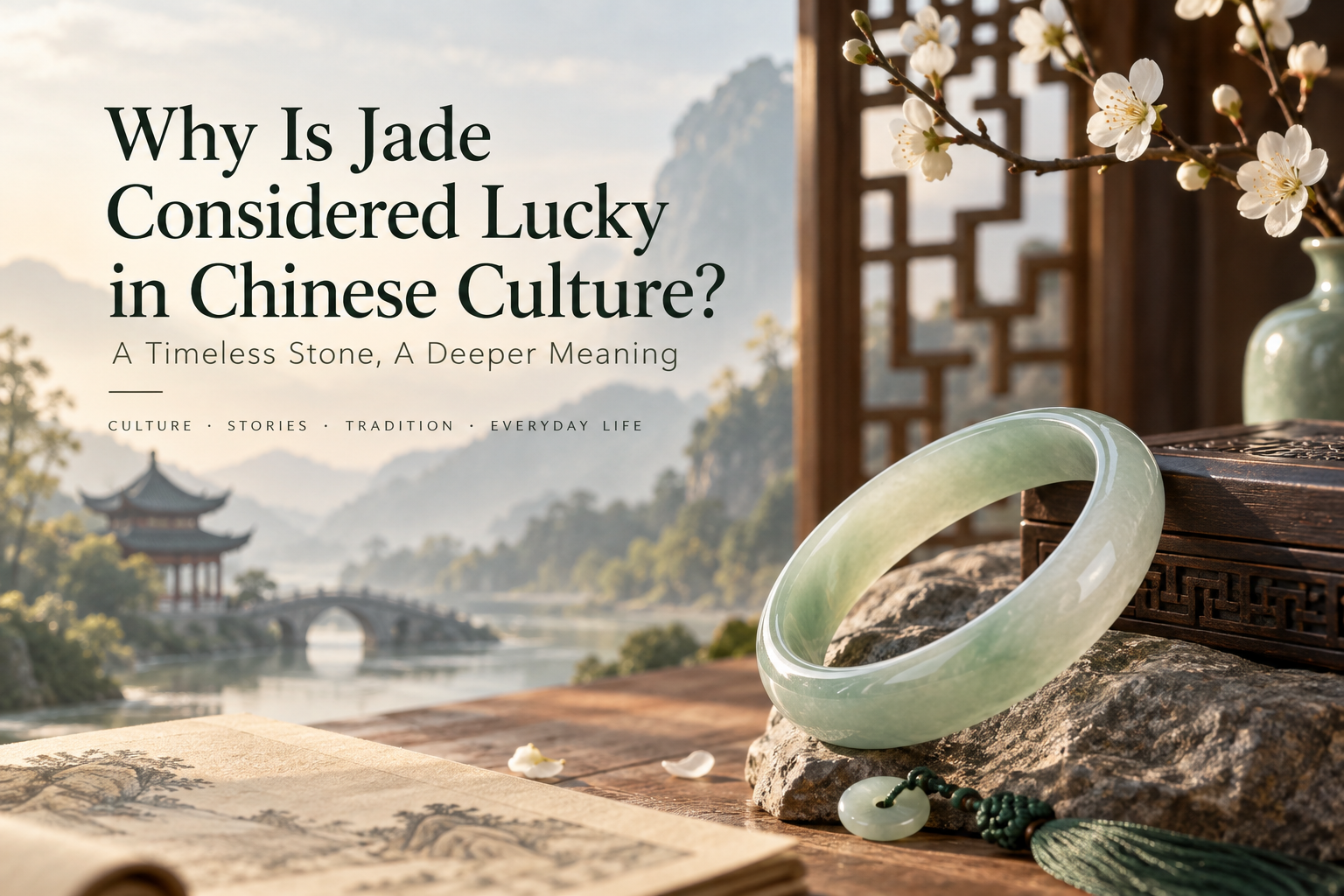
Walk into an old Chinese jewelry shop, open a grandmother's jewelry box, or look closely at the wrist of someone wearing a simple jade bangle, and you may notice something interesting: jade is rarely treated as "just a pretty stone."
In Chinese culture, jade has been connected with good fortune, protection, virtue, family, and long life for thousands of years. Traditionally, people gave jade to children, wore it during important moments in life, and passed treasured pieces from one generation to the next.
But why did jade become such a powerful symbol of luck?
The answer has less to do with magic and more to do with history, symbolism, and the way Chinese families have lived with jade for generations.
Jade Was Precious Long Before Modern Jewelry
Jade has an exceptionally long history in China.
In ancient China, jade was used for ceremonial objects, ornaments, carvings, and personal accessories. Because working jade required considerable time and craftsmanship, beautifully carved pieces could represent status and importance.
Over time, jade also became associated with qualities people admired.
Traditionally, jade was connected with ideas such as kindness, wisdom, courage, honesty, and moral character. The philosopher Confucius famously discussed jade through the virtues people saw reflected in the material.
Its beauty mattered, but so did what it represented.
That is one reason jade still feels different from ordinary jewelry to many Chinese families today.
So, Why Is Jade Considered Lucky?
There isn't one single reason.
Instead, the idea of "lucky jade" grew from several traditions.
Many people believe jade represents harmony, protection, prosperity, and a peaceful life. In Chinese culture, giving someone jade can therefore express a simple wish:
"May good things accompany you."
This does not necessarily mean the wearer expects jade to magically change their fortune. Often, the meaning is much more personal.
A jade bracelet received from a mother, grandmother, partner, or close friend can become a reminder that someone wishes you safety and happiness.
Sometimes, that emotional meaning is the real "luck."
Jade and the Tradition of Protection
One of the most familiar traditional beliefs surrounding jade is protection.
You may hear stories about a jade bangle cracking after its owner experiences an accident or difficult moment. In folk tradition, some people interpret this as the jade having "taken the misfortune" for its wearer.
There is no scientific evidence that jade can absorb danger, of course.
Still, the story has remained popular because it reflects something deeper in Chinese culture: jewelry can carry wishes, memories, and emotional protection.
Traditionally, parents or grandparents may give younger family members jade pendants or bracelets as symbols of safety.
The message behind the gift is often more important than the stone itself:
"Come home safely."
The Color of Jade Matters Too
When many Western shoppers hear "jade," they immediately imagine green.
But jade appears in many shades, including white, pale green, deep green, yellow, lavender, and darker tones.
Green jade is often associated with vitality, growth, harmony, and prosperity. Because green naturally reminds people of spring and new life, many people believe it carries an especially positive feeling.
White jade has a different personality.
In Chinese tradition, white jade is often associated with purity, calmness, elegance, and inner peace. Hetian jade, particularly its creamy white varieties, has been highly appreciated in Chinese culture for centuries.
Neither color is automatically "luckier" than the other.
The meaning often depends on the person wearing it and the reason it was chosen.
A Jade Bracelet Can Become a Family Story
This is probably my favorite part of jade culture.
A new bracelet may simply look beautiful. But after years of wearing it, the piece can become connected to birthdays, weddings, journeys, family gatherings, and ordinary everyday memories.
In many families, jade is passed from an older generation to a younger one.
Imagine receiving a jade bangle that your grandmother wore for decades.
Its monetary value may matter, but its emotional value is something completely different. You are not simply wearing a gemstone. You are carrying a small piece of family history.
That is why traditional jade gifts are often chosen for meaningful occasions such as birthdays, weddings, anniversaries, and major life changes.
The gift quietly says, "I hope your life goes well."
Jade, Luck, and Everyday Life
Today, you don't need to follow every traditional belief to appreciate jade.
Some people wear jade because they believe in its symbolism. Others simply love its smooth texture, natural color, and understated beauty. And some wear a bracelet because it reminds them of their family or cultural roots.
All of those reasons are valid.
Many people believe the best jade is not necessarily the most expensive piece, but the one you actually enjoy living with.
A simple jade bracelet can sit beside a watch, a red string bracelet, or modern gold jewelry without feeling out of place. In that sense, jade has managed to do something remarkable: it has remained culturally meaningful while becoming part of modern everyday style.
Is Jade Really Lucky?
That depends on what "lucky" means to you.
There is no scientific reason to expect a jade bracelet to suddenly bring wealth, prevent accidents, or change your future.
But cultural symbols do not always need to work that way.
Traditionally, jade represents wishes for protection, harmony, good fortune, and a long, peaceful life. When someone gives you jade with those intentions, the object can carry that meaning every time you wear it.
And perhaps that explains why jade has survived thousands of years of changing fashion.
For many people, jade is lucky not because it promises that nothing bad will happen, but because it represents the hope that something good will.
Final Thoughts
Jade's connection with luck in Chinese culture comes from thousands of years of history, symbolism, family traditions, and personal stories.
It has represented virtue in ancient philosophy, protection in folk tradition, prosperity in popular culture, and love within families.
Today, a jade bracelet can be all of those things, or simply a beautiful piece of jewelry.
If you choose to wear one, you don't need to believe that jade can control your destiny. Sometimes, wearing a small symbol of peace, protection, and good wishes is meaningful enough.
And in Chinese culture, that may be the most enduring kind of luck.
Comments (0)
No comments yet. Be the first to comment!
Leave a Comment
Please note, comments must be approved before they are published.