
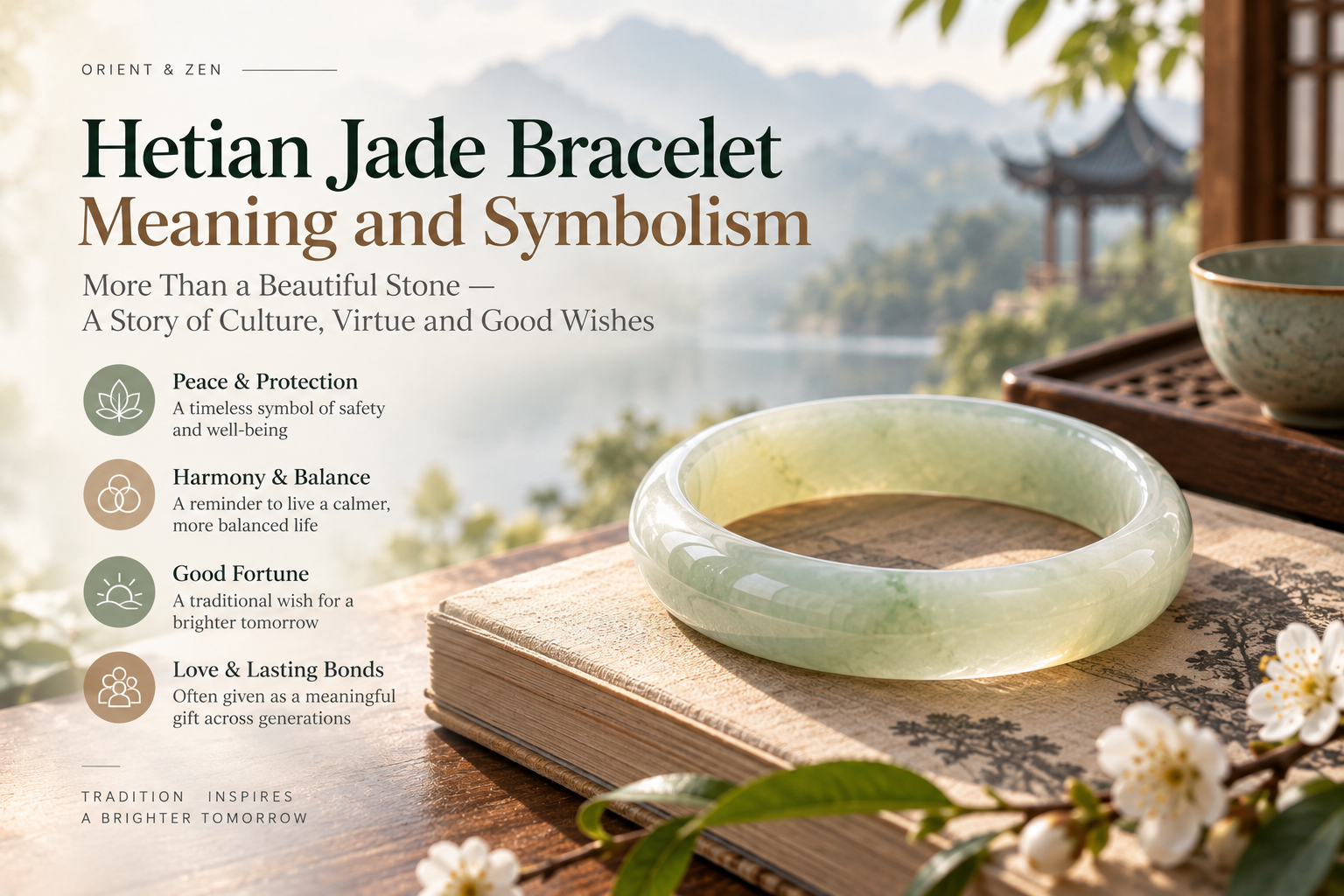
The words “Hetian jade” can invite an image of a particular place and a long cultural history. On a modern listing, however, the name alone does not prove where the material was mined. Ask what the seller means by the term before deciding what part of its story you are paying for.
Separate the name from the evidence
GIA’s 2015 article The Nephrite Jade Road discusses the Hetian association and records use of that name for material from other sources. It is a historical market account, not a current inventory of every seller, but it clearly shows why a label should not substitute for geographic evidence.
Ask whether “Hetian” is being used as a trade description, an asserted source or both. If a place-of-origin claim is important, request its basis in writing rather than assuming a familiar name settles it.
Material identity is another question
GIA’s jade description distinguishes nephrite and jadeite, with some green omphacite also included under specified conditions. A decorative name, pale color or creamy appearance is not a complete identification.
Our jade authenticity guide explains how to distinguish identity, treatment and origin questions. A document answering one of them should not silently be treated as proof of all three.
Read laboratory scope carefully
GIA describes colored-stone identification reports that name material and list detectable treatments, with origin reporting as a separate service for specified materials. Ask a laboratory what it can establish for your actual piece rather than assuming every report proves a mine.
Compare the report’s description and identifying details with the bracelet being offered. If the origin remains unverified, describe it that way. Uncertainty is preferable to turning a seller’s story into a confirmed fact.
Keep cultural meaning distinct
A buyer may be interested in jade as a symbol, a material or a connection with a particular person. Those reasons do not depend on inventing a specific extraction history. Our Chinese jade meaning article explores documented associations with room for personal interpretation.
Neither a source name nor a poetic description establishes that a bracelet changes character, offers healing or attracts good fortune. It can still be an object you value.
Choose the finished piece too
Check dimensions, construction, condition and return terms with the same care you give the name. Our everyday selection guide considers those practical details, and our white versus green comparison explains why color is not a shortcut to identity.
A meaningful purchase can rest on what is clearly known about the object. Let any uncertain geographic claim remain visible, and choose whether the disclosed piece itself is one you want to wear.
Is Hetian jade the same as jadeite?
Hetian or Hotan is associated with nephrite, while jadeite is a different jade material. A geographic name and a mineral identification answer separate questions. A comparison with a bracelet described as Burmese jade also needs the seller’s specific material identification and evidence for any geographic claim; a name alone does not establish either.
GIA’s account of the nephrite trade records that the Hetian name has been used beyond the place. For more terminology context, read Hetian, Hotan and nephrite on our sister site OrientLore.
Comments
Leave a comment
Please note, comments must be approved before they are published.