
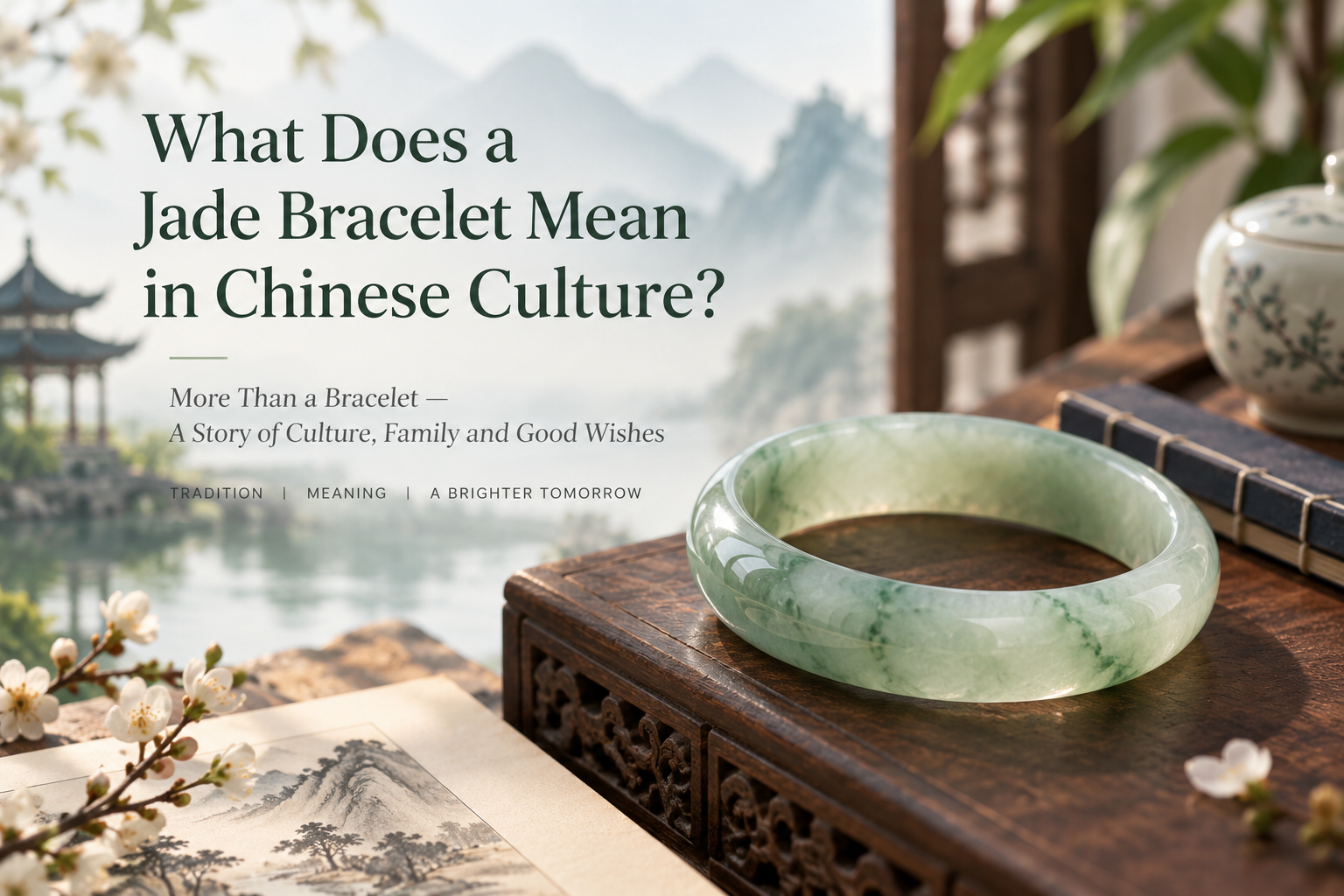
If you have ever visited a Chinese jewelry shop, wandered through a traditional market, or looked through an older relative's jewelry box, you may have noticed something: jade is everywhere.
Among all jade jewelry, the jade bracelet, especially the classic jade bangle, holds a particularly meaningful place in Chinese culture. It can be beautiful, of course, but traditionally, it has represented much more than decoration.
For many Chinese families, a jade bracelet can carry ideas of protection, peace, family connection, good fortune, and even a person's hopes for the future.
Jade Has Been Treasured in China for Thousands of Years
Jade has been valued in China for thousands of years, long before modern jewelry became part of everyday fashion.
In traditional Chinese culture, jade was admired not simply because it was rare or beautiful. Its smooth surface, strength, and natural luster became associated with qualities such as integrity, wisdom, kindness, and dignity.
Confucius famously used jade as a metaphor for human virtue. That idea influenced how generations of Chinese people viewed the stone: something beautiful on the outside, but meaningful because of the qualities it represented.
This is one reason jade jewelry often feels different from ordinary accessories. A bracelet may be purchased because it looks beautiful, but the cultural meaning behind it can make it feel surprisingly personal.
A Symbol of Peace and Protection
One of the meanings most commonly associated with jade bracelets is protection.
Traditionally, many people believe jade can help guard the wearer from misfortune and encourage a peaceful, balanced life. You may even hear an old belief that if a jade bracelet suddenly breaks, it has "protected" its owner by taking the impact of bad luck.
Of course, this is a cultural belief rather than something that can be scientifically proven. A bracelet can break for very ordinary reasons, including impact, internal fractures, or changes in temperature.
Still, the story tells us something important about the relationship Chinese culture has with jade. Jade is often treated less like a magical object and more like a companion carrying someone's wishes for safety.
That is why parents and grandparents sometimes give jade jewelry with a simple hope behind it: "May you be safe."
Jade Bracelets and Family Connections
This is probably my favorite part of jade culture.
In many Chinese families, jade jewelry is passed from one generation to another. A mother may give a jade bracelet to her daughter, or a grandmother may save one for a granddaughter.
The monetary value is not always the important part.
An older bracelet may have tiny scratches, a color that isn't perfectly even, or a style that looks old-fashioned. But because someone in the family wore it for years, those imperfections can become part of its story.
In this sense, a jade bracelet can work almost like a family letter that doesn't use words.
Traditionally, jade bracelets are also given during important moments in life, such as birthdays, weddings, graduations, or the beginning of a new chapter. The gift may quietly express wishes for health, peace, happiness, and a steady future.
Why Are Jade Bracelets Often Worn on the Left Hand?
You may notice that many people prefer wearing a jade bracelet on the left wrist.
There are several explanations for this.
In some traditional beliefs, the left side is considered more receptive, so people associate it with receiving positive energy or good fortune. There is also a much simpler explanation: because many people are right-handed, wearing valuable jade on the less active hand may reduce accidental knocks and scratches.
Personally, I think this is a good example of how Chinese jewelry traditions often mix symbolism with everyday practicality.
There is no universal rule saying that jade must be worn on the left. Comfort and lifestyle matter too.
Does the Color of Jade Have Meaning?
When people outside China imagine jade, they often picture bright green stone. But jade can appear in many shades, including white, pale green, deep green, lavender, yellow, and combinations of different colors.
In Chinese culture, green jade is commonly associated with vitality, harmony, and growth, while white jade has traditionally been admired for its understated beauty and associations with purity and calmness.
But color isn't everything.
Experienced jade lovers often pay attention to texture, translucency, craftsmanship, and how the piece feels in person. Sometimes a quiet, slightly imperfect bracelet has far more character than a flawless-looking one.
Is a Jade Bracelet Considered Lucky?
Many people believe so, although "lucky" may be too simple a word.
Traditionally, jade is connected with auspicious wishes, protection, harmony, and well-being. Wearing jade can therefore be seen as carrying those wishes with you.
But in everyday Chinese culture, jade doesn't necessarily mean, "Wear this and something amazing will happen."
It can mean something softer:
Remember where you came from. Stay peaceful. Take care of yourself. Carry your family's good wishes with you.
That is a much more interesting meaning, in my opinion.
Jade in Modern Life
Today, jade bracelets are no longer limited to older generations or traditional clothing.
You can see younger people pairing simple jade bangles with watches, silver jewelry, linen dresses, T-shirts, or even office clothes. Some wear jade because of family tradition, some because they enjoy Chinese culture, and others simply love the natural appearance of the stone.
In Japan, jade also has an ancient history, particularly with jade ornaments associated with prehistoric cultures such as the Jomon period. The traditions developed differently from those in China, but across East Asia, jade has long been more than an ordinary decorative material.
Perhaps that helps explain why it still feels timeless.
Final Thoughts
So, what does a jade bracelet mean in Chinese culture?
There isn't just one answer.
It can represent peace, protection, good fortune, virtue, family connection, and the hope for a long and balanced life. For one person, it may be a spiritual symbol. For another, it may simply remind them of their grandmother.
And for someone discovering jade for the first time, it may just be a beautiful bracelet with a story worth knowing.
Traditionally, jade has never been valued only for how it looks. Its deeper appeal comes from what people choose to place into it: memories, wishes, relationships, and meaning.
Maybe that is why a simple circle of jade can feel like much more than jewelry.


Comments (0)
No comments yet. Be the first to comment!
Leave a Comment
Please note, comments must be approved before they are published.