
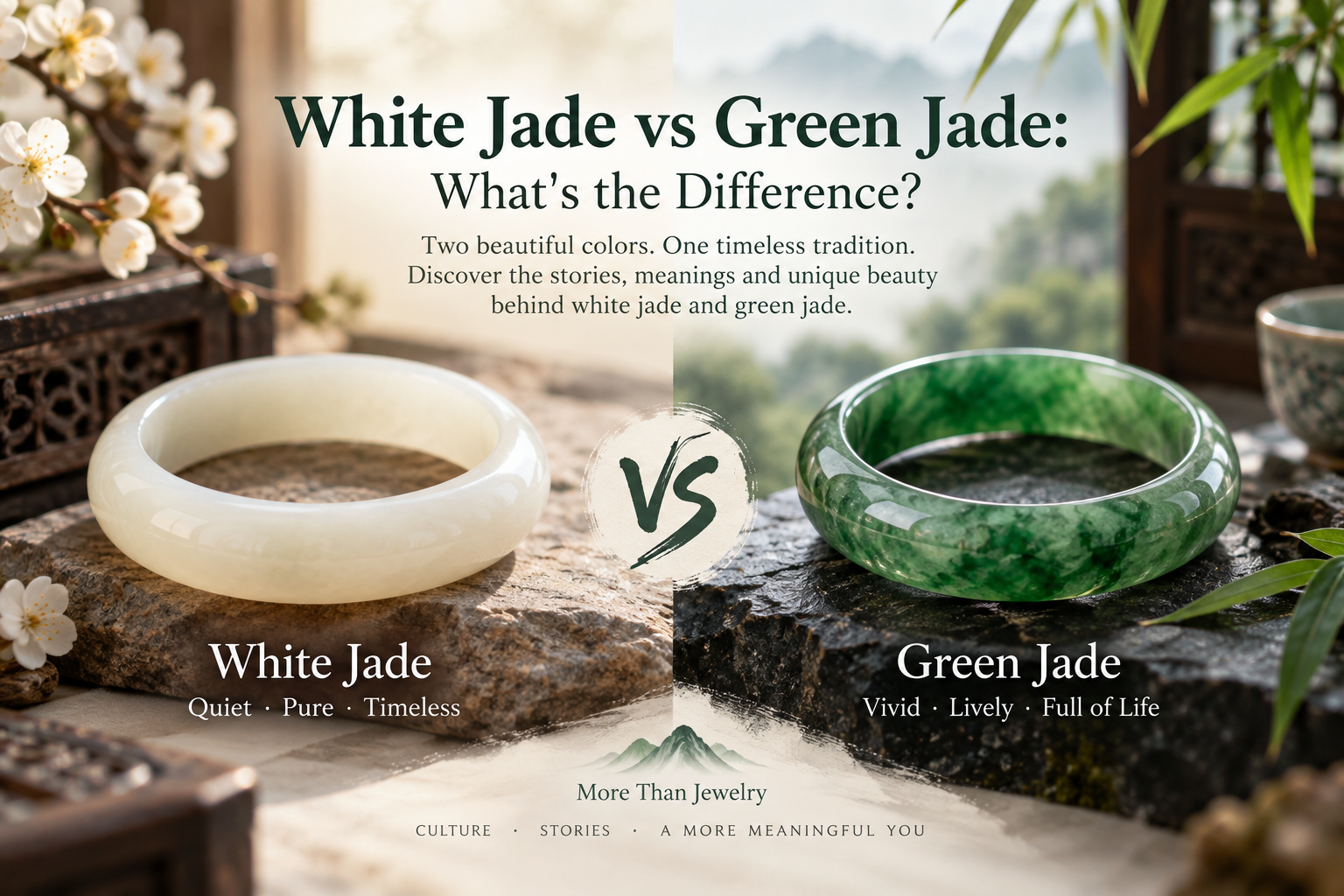
If you have ever shopped for jade jewelry, you have probably noticed something confusing: jade is not always green.
Some bracelets are creamy white, almost like warm ivory. Others come in pale celadon, apple green, moss green, or deep emerald tones. And despite what many first-time buyers assume, darker or greener jade is not automatically "better" than white jade.
In Chinese culture, both white jade and green jade have long been admired, but they can feel surprisingly different when worn.
So, what is actually different about them?
First, "Jade" Is Not Just One Stone
One useful thing to know is that the word "jade" can refer to two different minerals: nephrite and jadeite.
Traditional Chinese jade culture was historically built largely around nephrite. Hetian jade, one of China's most famous jade traditions, is especially known for its soft white, creamy, and slightly warm appearance.
Jadeite became especially fashionable in China much later, particularly during the Qing Dynasty. Some of the most famous jadeite pieces are known for their vivid green color.
This means that comparing white jade with green jade is not always simply comparing two colors of exactly the same material.
A white Hetian jade bracelet and a bright green jadeite bracelet, for example, can differ in mineral composition, texture, translucency, origin, and value.
White Jade: Quiet, Warm, and Understated
White jade has a very different personality from bright green jade.
Good-quality white nephrite often has a smooth, almost waxy luster rather than a glassy shine. Some pieces are pure-looking white, while others have cream, beige, or very pale green undertones.
Traditionally, white jade has been associated with purity, virtue, calmness, and refinement in Chinese culture.
There is an old Chinese idea that jade reflects the qualities of a good person. Confucius famously connected jade with virtues such as wisdom, benevolence, and integrity. Because of this history, jade was never appreciated only because it looked expensive. Its character mattered too.
That is one reason white jade can feel especially traditional.
Many people believe its gentle appearance represents a quieter kind of strength — something you carry rather than display.
For everyday jewelry, I personally find white jade especially easy to wear. It works with red string, silver, sandalwood, Bodhi beads, and simple neutral clothing without demanding too much attention.
Green Jade: Fresh, Vivid, and Full of Life
Green is probably the color most Western shoppers imagine when they hear the word "jade."
But green jade comes in an enormous range.
It can be almost white with a faint green tint, soft celadon, gray-green, spinach green, or an intense emerald shade.
In Chinese culture, green is naturally connected with ideas of growth, spring, vitality, and renewal. Because of this, many people believe green jade carries a feeling of flourishing and positive movement.
Bright green jadeite also became closely associated with elegant jewelry and personal status, especially in later periods of Chinese history.
Still, color alone should not determine quality.
A beautiful jade piece is usually appreciated through several characteristics together, including color, texture, translucency, craftsmanship, and natural imperfections.
White Jade vs Green Jade at a Glance
The easiest way I explain the difference is through mood.
White jade feels quiet. Green jade feels lively.
White jade tends to suit people who like subtle, traditional jewelry. It can feel peaceful, minimal, and slightly more understated.
Green jade usually creates a stronger visual presence. Depending on the shade, it can look fresh and casual or exceptionally luxurious.
Neither is universally better.
In fact, someone who loves a creamy Hetian jade bracelet may have very little interest in an intensely green jadeite bangle, while another person may feel exactly the opposite.
Jade is surprisingly personal that way.
Does White Jade Have a Different Meaning?
Traditionally, different colors can inspire different symbolic interpretations, but these meanings are not fixed rules.
Many people believe white jade represents purity, peace, clarity, and protection, while green jade is often associated with harmony, growth, prosperity, and vitality.
I prefer to think of these meanings as cultural layers rather than promises.
A jade bracelet is not going to magically change your life because it happens to be white or green. But wearing something connected to a particular idea — calmness, family, good fortune, or personal growth — can make the jewelry more meaningful.
That distinction matters.
Which One Should You Choose?
If you are choosing your first jade bracelet, start with the piece you genuinely want to wear.
Choose white jade if you prefer soft colors, understated jewelry, traditional Chinese aesthetics, or pieces that are easy to combine with other bracelets.
Choose green jade if you enjoy stronger color, want jade to stand out more clearly, or simply love the fresh appearance of green stone.
And if you are buying jade as a gift, personality often matters more than symbolism.
Someone with a minimalist wardrobe may naturally prefer creamy white jade. Someone who loves colorful jewelry may be much happier receiving green jade.
A Small Cultural Detail I Love
In China, jade jewelry is often more than decoration.
Traditionally, jade pieces could be passed between generations, given by parents to children, or worn for years until they became closely connected with a person's memories.
There is even a popular belief that "people nourish jade, and jade nourishes people."
It does not need to be understood literally. To me, the more interesting idea is that jade changes through contact, time, and care, while the person wearing it also builds memories around the object.
That is perhaps why choosing jade only by asking "Which color is more valuable?" misses part of the experience.
Sometimes the right jade is simply the one you keep reaching for every morning.
Final Thoughts
White jade and green jade belong to the same broad jade tradition, but they can create very different impressions.
White jade is often softer, quieter, and closely connected with the classical beauty of nephrite and Hetian jade. Green jade can feel fresher and more vivid, and brilliant green jadeite has its own important place in Chinese jewelry history.
Traditionally, both have accumulated layers of cultural symbolism, but there is no universal rule saying one color brings more luck or is more meaningful than another.
If you are deciding between them, look beyond color. Consider the type of jade, texture, craftsmanship, how it feels against your skin, and — perhaps most importantly — whether you actually enjoy wearing it.
After all, the most meaningful jade is usually not the one sitting safely in a box.
It is the one that becomes part of your everyday life.


Comments (0)
No comments yet. Be the first to comment!
Leave a Comment
Please note, comments must be approved before they are published.