
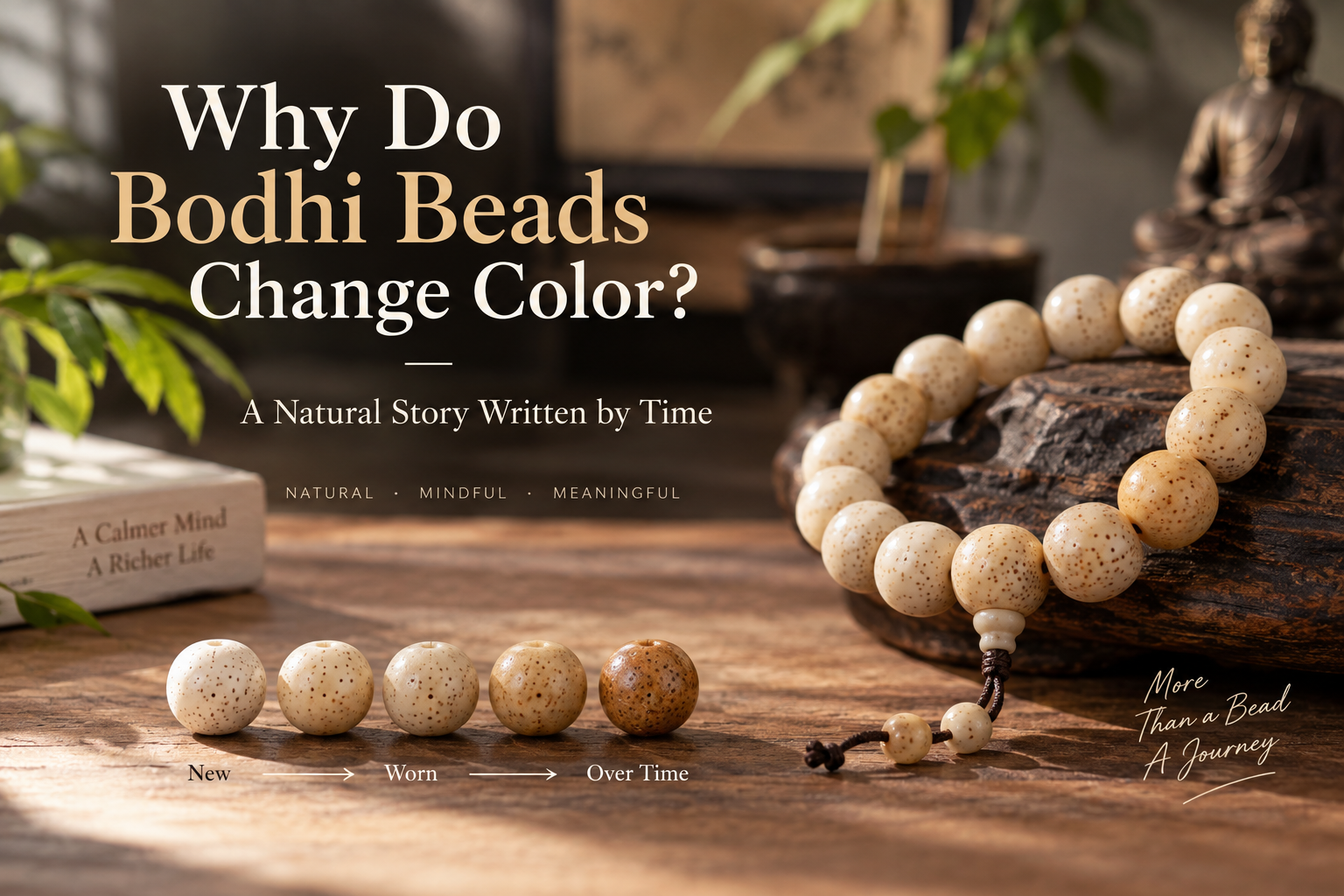
If you have worn a Bodhi bracelet for a few months, you may notice something interesting: the beads no longer look exactly the way they did when they were new.
White Bodhi beads may gradually become warmer, creamier, or slightly golden. Other Bodhi beads can develop a deeper, richer tone. Their surface may also become smoother and more polished.
For some people, this is surprising. For others, it is one of the most beautiful parts of owning Bodhi beads.
So, why do Bodhi beads change color?
The simple answer is that natural materials respond to touch, oils, moisture, air, and time. But traditionally, many people believe there is also a more personal story behind this slow transformation.
Bodhi Beads Are Natural Materials
Despite their stone-like appearance, many beads sold as "Bodhi beads" are made from plant seeds or seed-like natural materials rather than gemstones.
Because they are organic, they do not remain perfectly unchanged.
When you wear a Bodhi bracelet regularly, the beads come into contact with the natural oils and moisture on your skin. Over time, these substances can be absorbed into the surface. Friction from your wrist, clothing, and fingers can also gradually polish the beads.
The result is usually subtle.
A pale bead may become warmer in color. A matte surface may develop a soft sheen. Tiny differences between individual beads may become more noticeable.
This is normal aging rather than a flaw.
Your Hands Slowly Polish the Beads
In China, people sometimes talk about "playing" with beads, but the English word does not quite capture the meaning.
The Chinese practice often called pan wan involves slowly handling beads, walnuts, wood, jade, or other small objects in the hands. The movement is repetitive and calming: turning, rubbing, and touching the object over a long period of time.
Traditionally, this was not necessarily about making something look new. In fact, the opposite was often appreciated.
A well-handled object could develop a smooth surface and a richer appearance that showed it had been used and cared for.
Bodhi beads can change in a similar way.
Your fingers naturally polish the surface each time you touch them. After months or years, a bracelet may develop a character that cannot easily be reproduced when it is brand new.
Skin Oils Can Deepen the Color
Natural skin oils are one of the main reasons Bodhi beads gradually darken.
Think about an unfinished piece of wood. Once it is handled repeatedly, its surface often becomes slightly darker and smoother. Bodhi beads can respond in a similar way.
This does not mean you should deliberately cover your bracelet with oil.
In fact, too much oil, lotion, perfume, or moisture may cause uneven coloring or make the beads dirty. Natural, gradual contact is usually enough.
If you enjoy the aged appearance of Bodhi beads, patience tends to produce a more natural result than trying to speed up the process.
Why Does One Bracelet Change Faster Than Another?
There is no universal timeline.
One person's Bodhi bracelet might begin changing noticeably after a few months, while another may look almost the same for much longer.
Several things can influence the process, including:
- How often the bracelet is worn
- How frequently the beads are handled
- Natural oils and moisture from the skin
- Climate and humidity
- Exposure to sunlight
- The type and quality of the Bodhi material
- How the bracelet is cleaned and stored
This is why two seemingly identical bracelets can eventually look quite different.
Natural variation is part of the charm.
In Chinese Tradition, Aging Can Add Character
There is an interesting idea in traditional Chinese collecting culture: some objects become more appealing through interaction with their owner.
A wooden piece, seed bracelet, or hand-held object may slowly develop what collectors sometimes describe as a warm, polished patina.
Rather than seeing every mark of age as damage, people may appreciate the surface as evidence of time and use.
Many people believe Bodhi beads become more "personal" in this way.
That does not necessarily mean the beads literally absorb someone's energy. A more practical way to understand it is that your habits leave physical traces on the material.
You wore the bracelet while traveling.
You touched it while waiting for a train.
You rolled the beads between your fingers during a difficult afternoon.
Years later, those ordinary moments are invisible, but the smoother, darker beads remain.
What About Buddhist Tradition?
Bodhi beads are often associated with Buddhist imagery because the word "Bodhi" relates to awakening or enlightenment.
Traditionally, prayer beads have been used in different Buddhist cultures to support mantra recitation, meditation, and mindful repetition. In China and Japan, beads can also carry cultural meanings connected with Buddhist practice, although styles and customs vary widely.
Because prayer beads may be handled repeatedly, older beads naturally show signs of use.
Some people find meaning in this transformation. They see the changing surface as a quiet reminder that nothing stays exactly the same.
It is a beautiful interpretation, but it is better understood as a personal or cultural perspective rather than a scientific rule.
Does Darker Mean the Bodhi Bracelet Is "Working"?
Not necessarily.
You may occasionally hear claims that Bodhi beads darken because they are absorbing negative energy or reacting to your spiritual state.
These ideas exist in modern spiritual communities, and many people enjoy them as symbolic interpretations. However, there is a much simpler physical explanation: natural materials change through contact with skin oils, moisture, friction, air, and environmental conditions.
A darker bracelet is not proof that it has absorbed bad energy.
Likewise, a bracelet that changes very slowly does not mean something is wrong.
Should You Try to Make Bodhi Beads Change Color Faster?
I wouldn't.
Part of the appeal of Bodhi beads is watching them change naturally.
Avoid soaking them in oils or using aggressive polishing methods just to create an aged appearance. Artificially accelerating the process can produce uneven colors, sticky surfaces, or even damage.
Wear them. Handle them occasionally. Keep them reasonably clean. Let time do the rest.
That is usually enough.
A Bracelet That Grows Older With You
When a new Bodhi bracelet arrives, every bead may look pale, clean, and almost identical.
A year later, it might look completely different.
Perhaps the color is warmer. Perhaps the surface has developed a quiet shine. Perhaps one bead is slightly darker because your thumb touches it more often.
Those small imperfections are often what make an older Bodhi bracelet interesting.
Traditionally, many people believe objects become meaningful through the time we spend with them. Whether or not you attach any spiritual meaning to Bodhi beads, their changing color offers a very tangible reminder of that idea.
They do not stay frozen in the moment you bought them.
They age, slowly and naturally, alongside you.
Comments
Leave a comment
Please note, comments must be approved before they are published.