
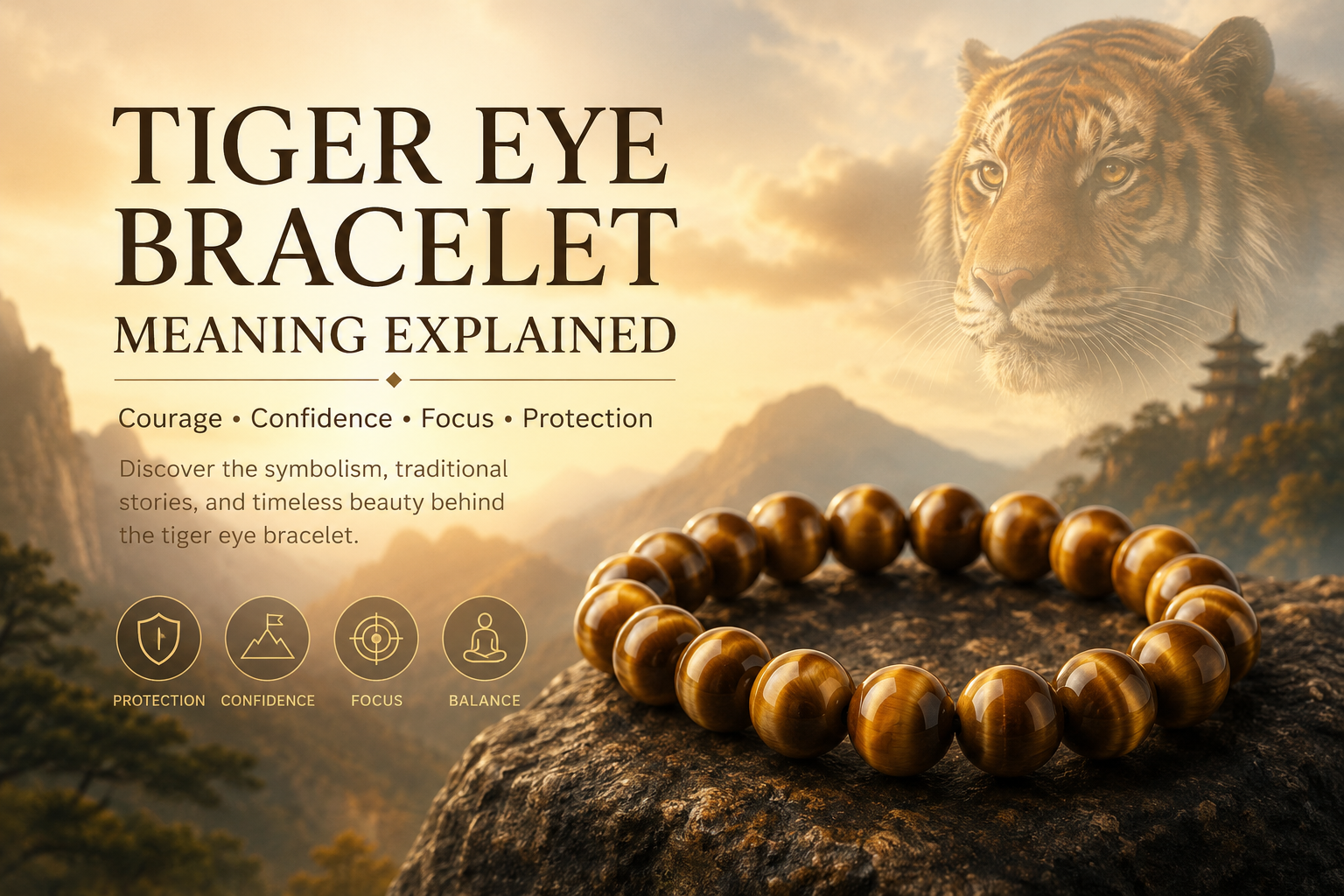
A tiger’s eye bracelet is recognizable for its patterned, silky reflection. You may choose it for that appearance or attach a personal meaning such as courage or steadiness. Those are different reasons for wearing it, and neither requires a claim that the beads produce confidence or control events.
The moving light is an optical feature
GIA’s tiger’s-eye quartz exhibit describes its chatoyancy and explains how reflected light produces the silky appearance. The material is used for beads and cabochons. As a polished piece moves relative to a light source, its highlighted area can appear to shift.
This gives you something specific to appreciate and compare. Ask for ordinary-light photographs or a short video rather than relying entirely on a highly edited image. The appearance should not be described as visible spiritual energy.
For the blue variety, our blue tiger’s-eye and hawk’s-eye guide explains color, chatoyancy and the questions to ask about a particular bracelet.
The name and a personal meaning
The resemblance suggested by “tiger’s eye” can invite an association with courage. You might welcome that idea when marking a new project, or choose the bracelet simply because the patterned reflection catches your eye. Neither reason needs to describe everyone who wears it.
You can make the association specific: perhaps the bracelet marks a course you started or a decision you made carefully. Keeping that explanation personal leaves other wearers free to find a different meaning in the same design.
Make a chosen meaning concrete
You could choose the bracelet to mark a new project and use it as a reminder to prepare. Perhaps your intention is to check details before a meeting or finish one planned task. The bracelet represents that intention; it does not complete the work.
There is no need to judge its strength by whether a day goes well. Changes in confidence, mood or opportunity can occur for many reasons and do not establish a causal effect from the stone.
Ask material questions before buying
The FTC’s Jewelry Guides emphasize accurate descriptions of materials, treatments and manufacture. As a buyer, ask what the beads and fittings contain and what is known about treatments. An evocative story should not obscure the actual product.
Our obsidian and tiger’s-eye comparison considers a practical alternative if you are deciding between dark beads and a golden-brown pattern. If you are considering a Pixiu design, assess that motif separately from the tiger’s-eye beads.
Choose for your wrist and wardrobe
Anyone who likes the design can consider it; a bold pattern does not establish a gender restriction. Check circumference, bead diameter and the closure. Our selection guide helps connect fit with personal meaning. Let the bracelet be an object you understand and enjoy rather than a test of your courage.
What does a tiger’s eye bracelet mean?
A wearer may choose tiger’s eye for its golden-brown appearance or as a personal reminder of courage or focus. These are individual or modern symbolic interpretations, rather than evidence that a bracelet improves health or changes decisions.
Does tiger’s eye have different benefits for men and women?
The symbolic interpretations discussed here do not establish different effects for men and women. Anyone who likes the design can choose it for appearance or personal meaning. Compare the actual fit, bead size, weight and closure rather than assuming a gender label tells you how a bracelet will feel or what it will do.
GIA’s tiger’s-eye exhibit describes the moving sheen known as chatoyancy in a particular quartz specimen. It does not identify an individual bead or prescribe a meaning. Ask the seller about the named material, treatments and fit.
What does a black tiger’s eye bracelet mean?
If a listing says “black tiger’s eye,” start by asking what the seller means by the name. Does it describe the claimed material, a color, a mixed strand or a treated appearance? Ask which beads the description covers and whether coloring or other treatments are disclosed or unknown.
The GIA exhibit cited here explains chatoyancy in a particular tiger’s-eye quartz specimen. It does not identify a dark bead in another seller’s photograph. Likewise, a dark color does not establish a separate historical meaning or stronger protective effect.
The FTC’s Jewelry Guides emphasize accurate descriptions, including material, color and treatment. A useful comparison keeps those disclosures alongside bead size, wrist fit and the complete price, rather than ranking bracelets by a promised effect.
Comments
Leave a comment
Please note, comments must be approved before they are published.