
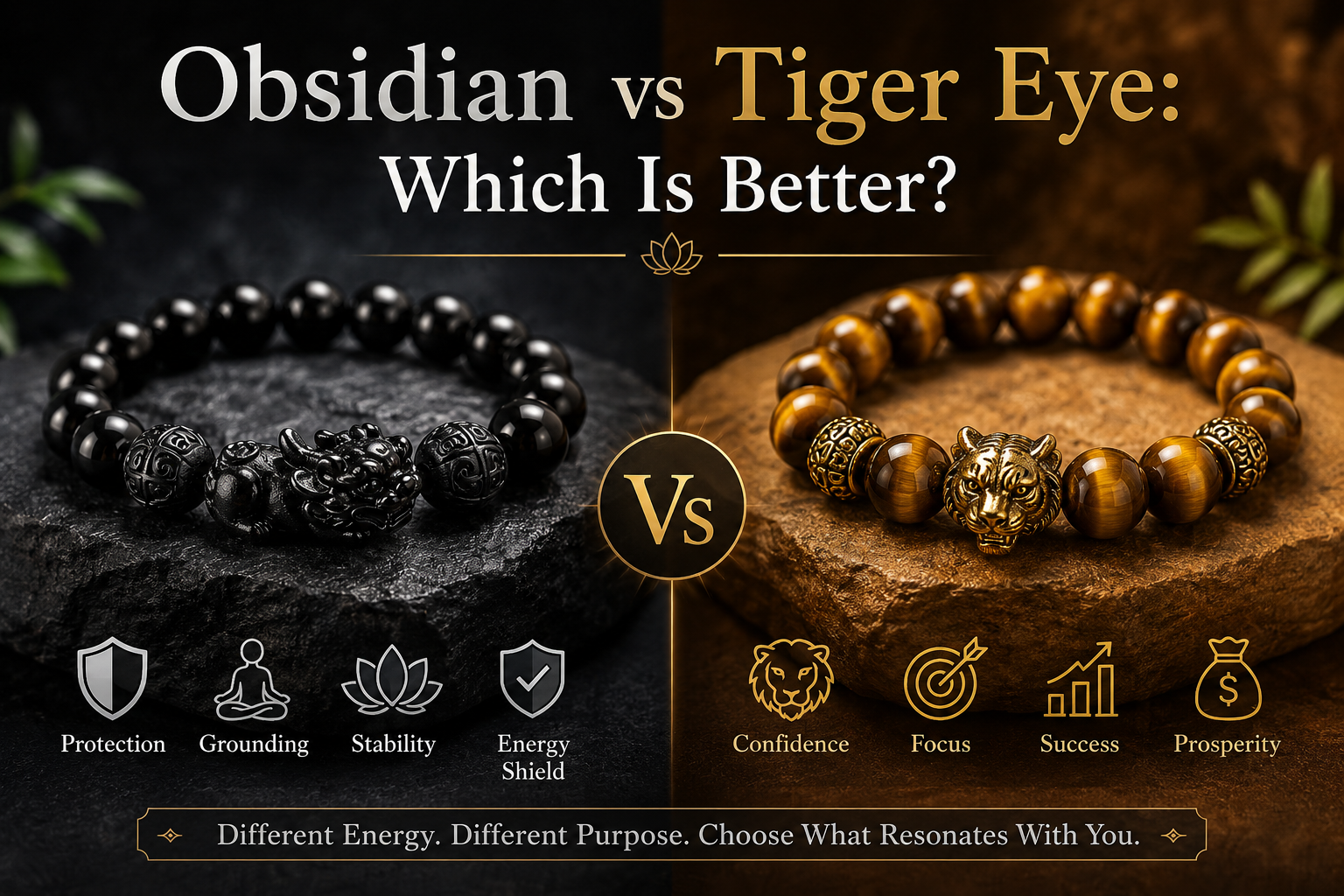
Neither obsidian nor tiger’s eye is universally the better bracelet material. The useful comparison concerns what they are, how they look and how a particular bracelet is made. There is no established energy ranking that makes one better for protecting you or bringing business success.
Obsidian: a glassy volcanic material
The National Park Service describes obsidian as a glassy rock formed when volcanic lava cools rapidly. It is brittle and can form sharp edges when chipped. A polished black bead gives a different visual effect from a striped, reflective material, but polish does not remove the need for careful handling.
If you prefer a restrained look, compare actual photographs in ordinary light. “Black obsidian” on a listing is still a material claim, not proof that every dark bead has been correctly identified.
Tiger’s eye: moving light and warm bands
GIA describes tiger’s-eye quartz and its silky chatoyancy, an optical appearance produced by reflected light. It is used in beads and cabochons. As the piece moves relative to a light source, the highlighted area can appear to shift.
That makes tiger’s eye worth considering if you enjoy visible pattern and changing reflection. Ask for a short video of the actual bracelet where possible. A moving highlight is an appearance to appreciate, not evidence of courage or motivation stored in the material.
Compare the finished bracelets
Match bead diameter, wearable circumference, closure and focal-charm size before comparing price. A large bead strand can feel and sit differently from a smaller one even when the material name is the same.
Consider whether you want a single-color accessory or a more visible patterned accent. You can also combine designs if you like the result; there is no need to prove that their “energies” are compatible.
Check what the listing includes
Ask for the identity of the beads and fittings and any known treatments. Our Hetian jade article illustrates why material names deserve focused attention. If a bracelet includes a Pixiu charm, assess its substance and design separately from the beads.
GIA’s care guidance emphasizes that materials and treatments affect maintenance. Do not assume that the same soaking or cleaning method suits every bracelet simply because both are sold as crystal jewelry.
Choose a preference you can explain
Our selection guide helps connect design with fit and meaning. Choose obsidian if you prefer the actual obsidian piece offered, or tiger’s eye if its pattern appeals more. Neither choice has to carry a promise about wealth, health or emotional protection to be worthwhile.
Comments
Leave a comment
Please note, comments must be approved before they are published.