
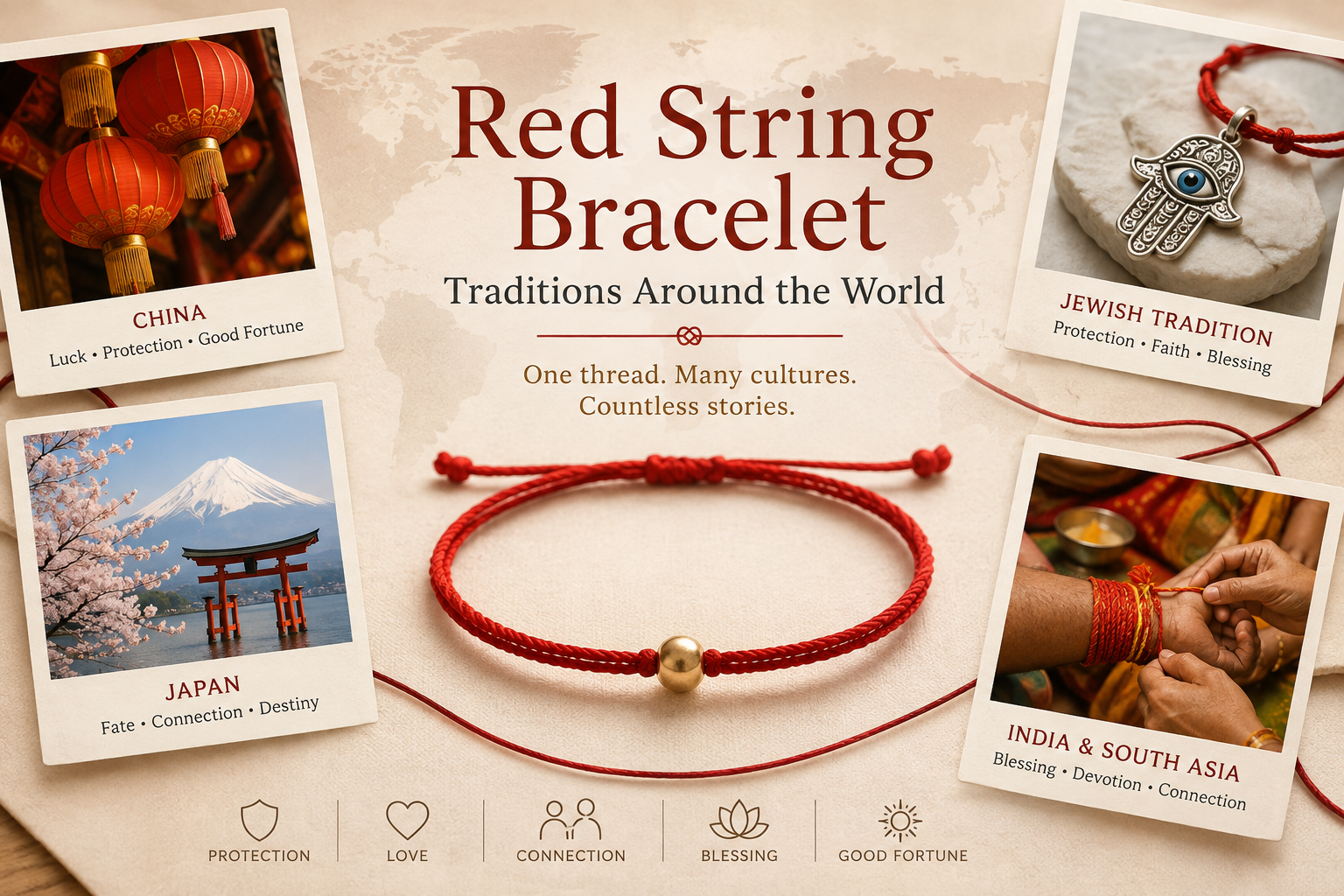
A red string bracelet looks almost too simple to carry much meaning. It is just a piece of thread tied around the wrist, sometimes with a small knot, bead, or charm.
Yet travel across different cultures, and you will find versions of the red thread appearing again and again.
In China, it may be connected with luck and protection. In Japan, red thread is often associated with fate and human connection. In Jewish tradition, some people wear a red string as a protective symbol. Across parts of South Asia, sacred threads may be tied during religious ceremonies and blessings.
The traditions are not all the same, and they should not be treated as if they came from one universal belief. But that is exactly what makes the red string so interesting.
Different cultures gave the same simple object their own stories.
China: Red as a Color of Luck and Protection
In Chinese culture, red has traditionally been one of the most meaningful colors.
You see it during Lunar New Year, weddings, birthdays, and other celebrations. Red envelopes are given as gifts, red decorations appear around homes, and traditionally, many people believe the color represents happiness, vitality, prosperity, and good fortune.
That symbolism naturally found its way into jewelry.
Red string bracelets are often worn as small everyday symbols of good luck or protection. Some include jade, Pixiu, zodiac charms, or other traditional motifs, while others are nothing more than a simple knotted cord.
There is also an old Chinese idea that red can help ward off misfortune. This is especially noticeable during a person's zodiac year, known as ben ming nian. Traditionally, some people wear red clothing, belts, socks, or bracelets during that year.
Whether someone takes the belief literally or simply enjoys the tradition, the red string becomes a quiet reminder: carry a little good fortune with you.
Japan: The Red Thread of Fate
Japan gives the red thread a more romantic meaning.
Many people know the story of the "red thread of fate," or akai ito. According to popular East Asian folklore, two people who are destined to meet are connected by an invisible red thread.
The thread may stretch. It may become tangled. The two people may live far apart or meet much later than expected.
But traditionally, the story suggests that the connection remains.
Versions of this legend also exist in Chinese folklore, where the deity Yue Lao is associated with marriage and destined relationships. In one famous tradition, Yue Lao connects people who are meant to become partners with a red cord.
In Japan, the idea eventually became especially associated with romantic destiny. It appears in novels, anime, films, jewelry, and even everyday conversations about relationships.
This is one reason red string bracelets are sometimes exchanged between couples or given to someone deeply important.
Not necessarily because the bracelet can "create" destiny, but because it gives an invisible relationship something you can actually see and touch.
Jewish Red String Traditions
Red string also appears in some Jewish folk and Kabbalistic traditions.
One well-known custom involves wearing a red string, often on the left wrist, as a symbol associated with protection from the "evil eye."
The evil eye is an ancient idea found in many cultures around the Mediterranean and Middle East. Traditionally, people believed that envy or harmful attention could bring misfortune.
Some modern red-string customs are associated with Rachel, a biblical matriarch, although practices and interpretations vary considerably between communities.
For some wearers, the bracelet carries spiritual meaning. For others, it may simply represent family tradition, heritage, or a personal reminder to approach life with positive intentions.
India and South Asia: Sacred Threads and Blessings
In India and neighboring regions, red or red-and-yellow threads are commonly seen in religious ceremonies.
Depending on the region and tradition, a sacred thread may be called kalava, mauli, or by another local name. It can be tied around the wrist during Hindu rituals, prayers, temple visits, or important ceremonies.
Traditionally, the thread may represent blessing, protection, devotion, or participation in a sacred ritual.
There is also Raksha Bandhan, a festival in which sisters traditionally tie a rakhi around their brothers' wrists. Modern celebrations can be broader and more flexible, but the thread remains a powerful symbol of affection, responsibility, and family connection.
Again, the meaning is different from a Chinese luck bracelet or the Japanese red thread of fate.
The material may look similar. The story behind it is not.
Why Does Red Appear So Often?
This is the part I find most fascinating.
These traditions developed in different places, religions, and historical contexts, yet red repeatedly became connected with life, protection, love, courage, and important transitions.
Perhaps the color itself helps explain why.
Red is difficult to ignore. It is the color of blood and fire, but also celebration, warmth, passion, and vitality. In many societies, it naturally became a color reserved for moments that mattered.
And thread has its own quiet symbolism.
A thread connects two things. It can be tied, passed from one person to another, or worn close to the body. It is inexpensive enough for almost anyone to use, yet personal enough to carry a story.
Put those two ideas together, and the enduring appeal of the red string begins to make sense.
A Small Bracelet With a Very Long Story
Today, someone might wear a red string bracelet because of family tradition, cultural curiosity, spirituality, fashion, love, or simply because they like how it looks.
There does not have to be one "correct" reason.
What matters is understanding that these bracelets are more than a single trend. Similar red threads have appeared across cultures, but each tradition has its own history and meaning.
Personally, I think that makes the bracelet more interesting, not less.
A red string does not need to promise miracles to feel meaningful. Sometimes it is enough for a small object to remind us of someone we love, a tradition we grew up with, a journey we have taken, or simply the kind of luck we hope to carry into tomorrow.
One thread, many cultures, many stories.
Comments
Leave a comment
Please note, comments must be approved before they are published.