
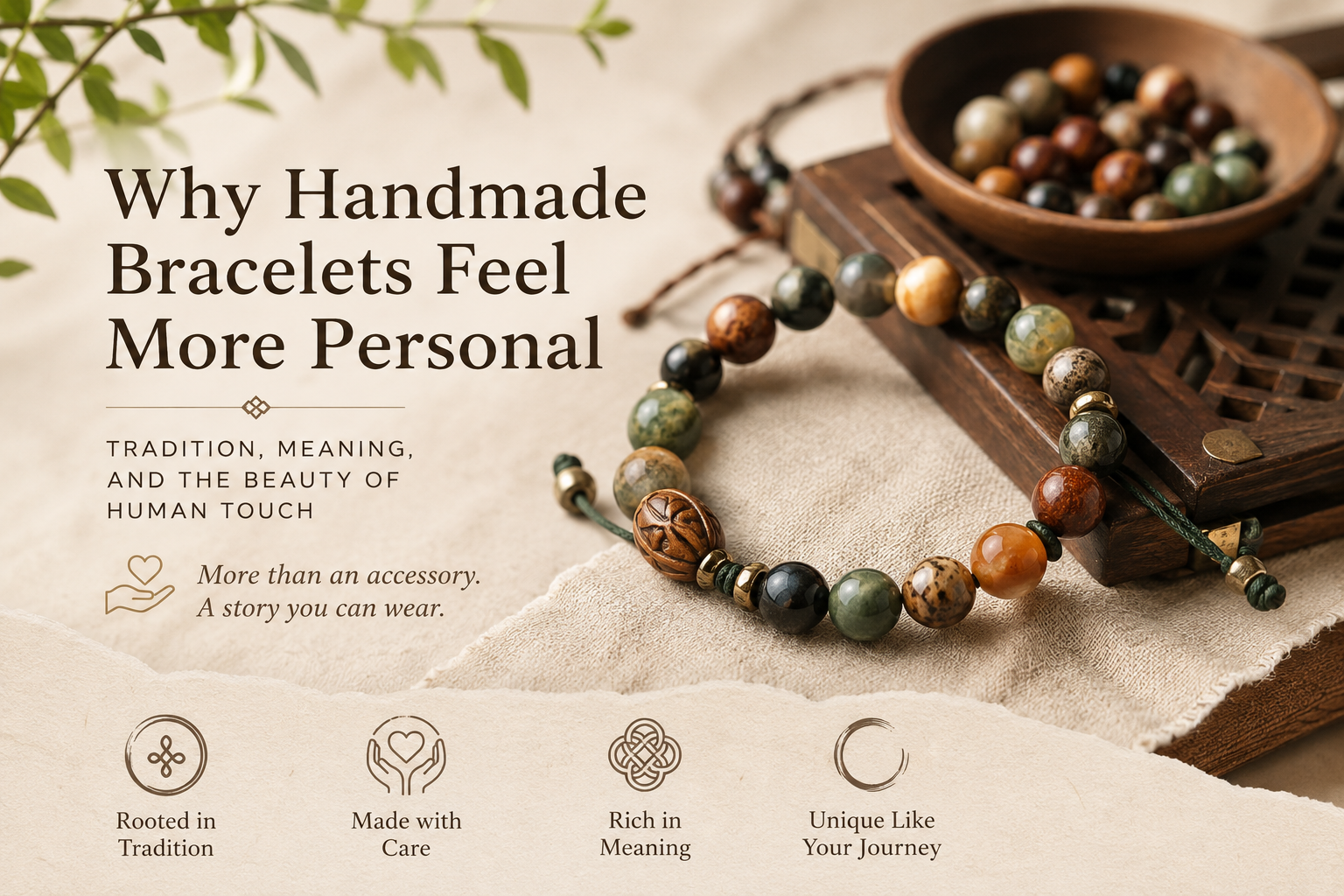
A handmade bracelet may feel personal because you discussed its design with the maker, chose a meaningful combination or received it from someone you know. Those connections can matter. They do not mean every handmade piece is unique, better made or more meaningful than every factory-produced bracelet.
Ask which work was done by hand
“Handmade” can leave important questions unanswered. Were the beads carved by the maker, bought ready-made, assembled into a strand or finished in another way? Request an explanation of the relevant steps rather than imagining a workshop from a photograph.
The FTC’s Jewelry Guides emphasize accurate representations about manufacture and other product characteristics. For a buyer, a clear process description is more useful than a general promise of authenticity. A maker should be able to describe their contribution without needing to claim they personally created every component.
Customization is one concrete source of connection
Choosing length, bead size, a clasp or a particular sequence can make an accessory suit your use. Confirm which choices are available and whether a custom order can be adjusted. Written measurements help both sides understand what is being made.
Our bracelet selection guide helps turn a personal preference into practical dimensions. Customization is valuable when it serves you, not merely when a listing calls it special.
Imperfections do not prove handwork
An uneven knot or irregular bead could reflect many things. It is not proof of a particular maker, a natural material or careful craftsmanship. Equally, precise work does not prove machine production. Judge the stated process and evidence independently of whether the piece looks perfectly symmetrical.
Check comfortable edges, secure fittings and the seller’s approach to repairs. A flaw should not be excused as charming if it interferes with wearing the bracelet.
Give the gift an honest story
Explain the design choice that connects the gift with its recipient. Our Pixiu introduction provides background for a creature motif, while our bracelet gift guide helps you connect the design with a shared memory. Keep the maker’s process description with the gift if handwork is part of what you chose.
A message about the recipient, a shared occasion or a choice you made together can supply a personal story that is already true.
Plan for an object that will be used
Ask for component details and care instructions. GIA’s care guidance emphasizes that different materials and treatments need appropriate handling. Hand assembly does not make cord, coatings or stones immune to wear. A bracelet’s connection can deepen through ownership, while its physical condition still deserves ordinary attention.
Comments
Leave a comment
Comments are reviewed before publication.