
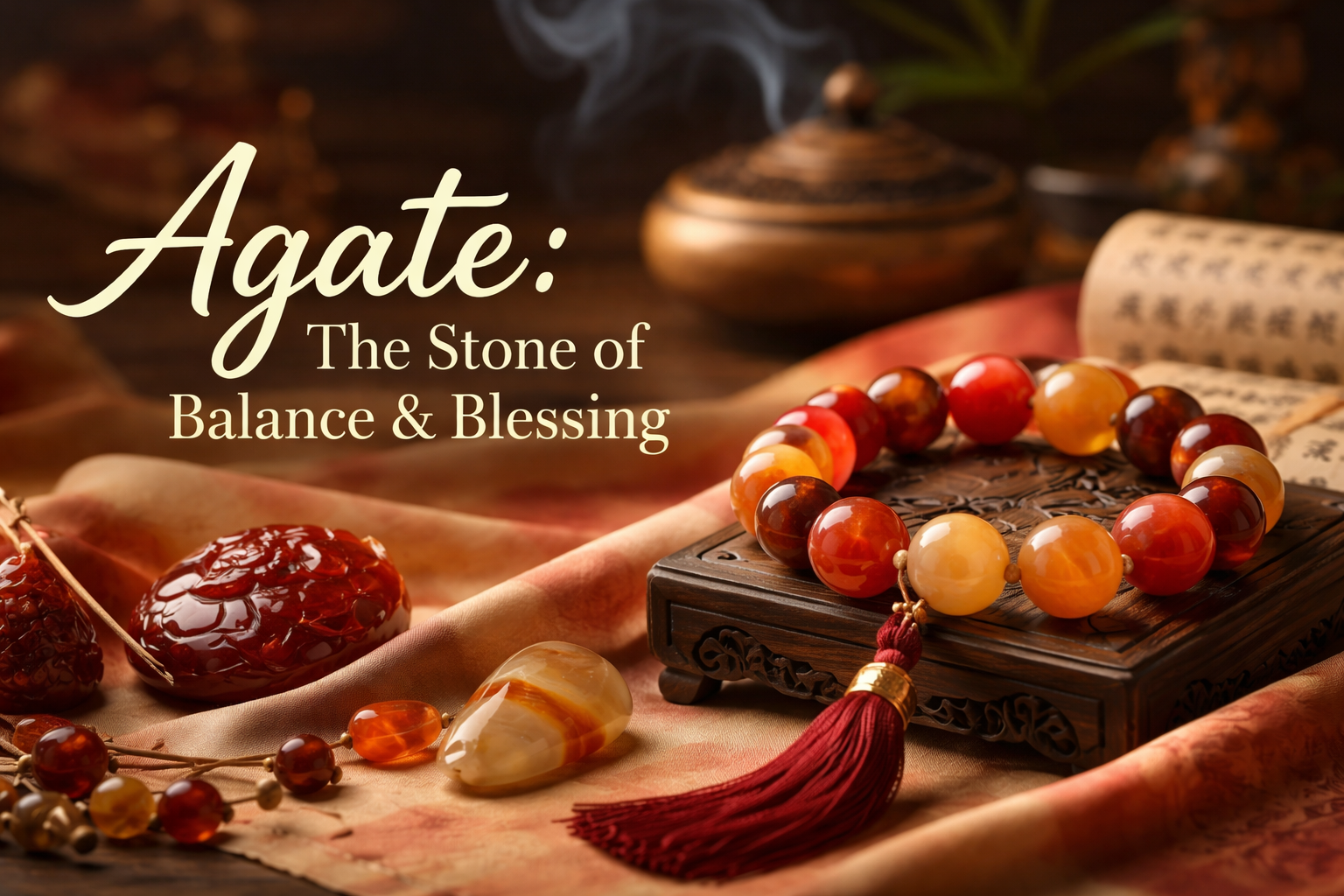
Agate rewards a closer look. A pale band curves around a darker one; a polished bead catches the light at its edge. Its appeal can be quiet, giving the eye something to return to rather than asking for attention all at once.
That layered appearance also makes agate an inviting material for personal symbolism. Someone might choose it as a reminder of patience or steadiness. Understanding the stone itself helps keep that meaning grounded in an object you can actually see and enjoy.
What Is Agate?
The British Geological Survey classifies agate as a banded form of variegated chalcedony, made from quartz crystals too small to distinguish with the naked eye. Those bands are a useful starting point for appreciating its appearance.
In a bracelet, cutting and polishing determine which parts of a pattern remain visible. One bead may show a narrow stripe while another presents a broader field of color. Look at photographs of the actual piece where available, rather than expecting every bead to resemble a dramatic sliced specimen.
Color and Treatment Deserve Separate Questions
A beautiful color does not, by itself, tell you whether a bead is untreated. GIA's introduction to gem treatments explains that chalcedony can be dyed to change its color.
Ask what material is stated, whether treatments are disclosed, and what care is recommended for the complete bracelet. A trade name, vivid photograph, or word such as “natural” is not a substitute for clear information about the particular item.
This distinction applies to other stones too. Our introduction to Hetian jade and its material identity explores how a stone's cultural story and its identification answer different questions.
What Can Agate Mean?
“Balance,” “courage,” and “protection” appear in contemporary gemstone descriptions. They can express a wearer's intention, but they should not be presented as physical effects of agate or as a single, documented belief shared throughout Chinese history.
A bracelet chosen before a new chapter might stand for taking things steadily. A gift between friends might recall a place, a shared color, or a promise to stay in touch. Those meanings become more specific when they come from your own experience.
Color and form can add further layers. Our article on red cord and good wishes considers the meaning of the cord separately from the beads. The same principle helps when looking at agate: distinguish the material, the design, and the message you give it.
Choosing a Shape You Will Enjoy Wearing
Round beads make the pattern repeat around the wrist. A larger focal piece gives a single area more space. If you prefer a simple circular design, our guide to the peace buckle and its meaning looks at another way an understated form can carry a wish.
Compare bead size, bracelet fit, fastening, and the weight you find comfortable. The most meaningful piece still needs to suit the way you live.
Keeping the Beauty in View
For dyed material, GIA notes that solvents such as alcohol or acetone can affect some dyes, while prolonged sunlight can fade some treated colors. Follow care instructions for the whole piece, including its cord, metal, and any other beads.
Agate does not need an extravagant legend to be interesting. Its bands already offer a reason to pause and look. A personal story can grow around that beauty without asking the stone to promise more than it can provide.
Comments
Leave a comment
Please note, comments must be approved before they are published.