
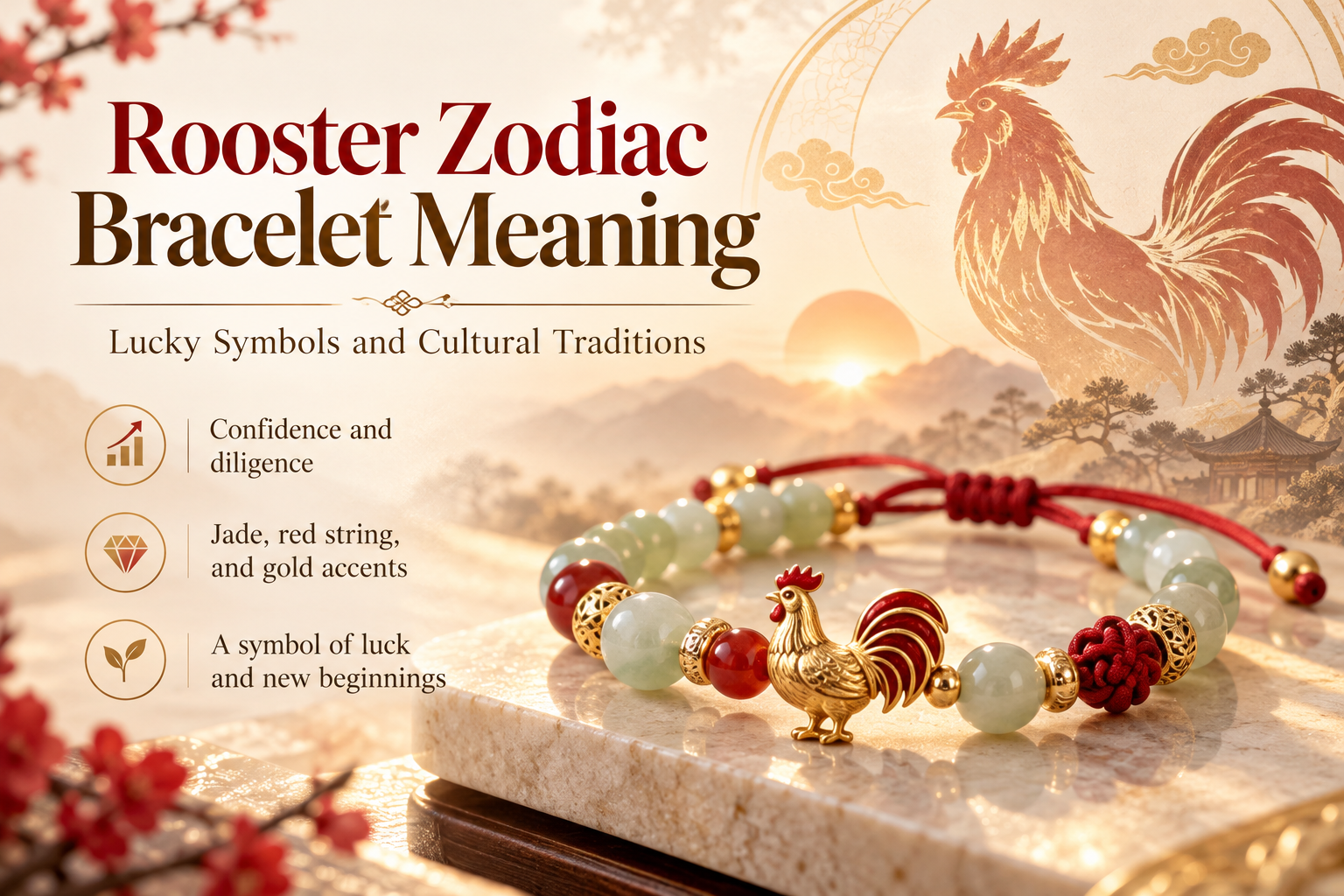
There is something appealing about a rooster greeting the morning. Its alert posture and familiar call suggest a fresh start: another day to pay attention, make an effort, and begin again.
A Rooster zodiac bracelet turns that image into something personal. For someone born in a Rooster year, a small charm can recall their place in a family’s calendar traditions. For another wearer, it may simply be a piece of jewelry whose story they enjoy.
The meaning comes from a combination of zodiac identity, cultural imagery, and personal intention. It does not require a promise that the bracelet will change anyone’s luck.
What does the Rooster symbolize?
The Rooster is the tenth animal in the twelve-animal sequence listed by the Hong Kong Observatory, following the Monkey and preceding the Dog. Our introduction to the Chinese zodiac tradition explains the wider cycle.
In its Year of the Rooster exhibition overview, The Metropolitan Museum of Art connects the rooster’s early rising with the traditional description of Rooster-born people as diligent and industrious. These are cultural character associations, not a way to determine an individual’s personality.
The museum also discusses the rooster as an auspicious figure whose crowing is associated with sunlight overcoming darkness. A bracelet can draw on that image as a wish for courage or a hopeful beginning, without suggesting that its wearer receives literal protection.
A documented story behind the motif
Chinese art offers more than one way to read a rooster. The Met’s Vessel in the Form of a Heavenly Rooster is a nineteenth-century bronze example. Its catalogue explains that the name refers to a legendary bird whose call awakens the world.
This is a story attached to a recorded artistic motif. It should be distinguished from the familiar zodiac race, which is a folktale with different retellings rather than a historical account of how the calendar was established.
For a modern bracelet, the morning image is enough to carry a meaningful intention: stay attentive, meet the day with energy, and make room for another attempt.
Which years are Rooster years?
Recent and upcoming examples include the following Gregorian year labels. Each link opens the Hong Kong Observatory’s corresponding calendar, whose heading identifies it as a Rooster year.
These labels do not mean that everyone born between January 1 and December 31 has that sign. This guide uses Lunar New Year as the boundary for a zodiac-year gift. Someone born in January or February should check the exact birthday in the Gregorian–Lunar Calendar Conversion Table; for example, the first lunar month of 2017 began on January 28.
Some astrology traditions use the solar term Beginning of Spring for their year boundary. If the recipient follows a particular system, ask which convention they use rather than treating one birth-year shortcut as universal. The traditional Chinese calendar is lunisolar, so “not January 1” is more accurate than calling it a purely lunar calendar.
Materials and symbols that can accompany a Rooster charm
Jade: a wish expressed through a material
Jade has a rich cultural vocabulary beyond zodiac jewelry. The National Palace Museum’s The Virtue of Jade explains how Confucian interpretations connected its qualities with virtues such as integrity and benevolence.
A jade-and-rooster design can bring that background together with the wearer’s zodiac identity. It is a design choice, not evidence that jade is uniquely lucky for the Rooster. Our guide to Hetian jade’s material and cultural meaning looks more closely at that distinction.
Also check the actual material description. White Jade Bodhi is a trade name for a different bead material; a similar-sounding name does not make it mineral jade.
Red cord: a familiar carrier of good wishes
Red decorations have a prominent place in Lunar New Year celebrations, as discussed in the Victoria and Albert Museum’s Lunar New Year resource. A red cord with a rooster charm can use that festive association in a simple, wearable form.
Our article on red string and Chinese traditions explores its connections with relationships and personal wishes. Those meanings extend beyond one zodiac sign; not every red bracelet has received a temple blessing.
Gold tones, tiger eye, and Pixiu
Warm gold-colored details or the brown-and-gold appearance of tiger eye may suit a rooster design visually. That makes them possible styling choices, rather than required “lucky materials” for everyone born in a Rooster year. A gold-colored accent should also be described separately from its actual metal content.
Some designs combine a zodiac charm with Pixiu, a mythical figure associated with prosperity. That combination brings two stories together. It does not establish an exclusive historical bond between Pixiu and the Rooster or guarantee a financial result.
Are there fixed lucky colors or matching zodiac partners?
Advice about colors, elements, and compatible animals varies between interpretive traditions. The animal sign alone is not a universal instruction to wear white, silver, or gold, and a bracelet does not need a second animal to become meaningful.
If you enjoy such associations, treat them as part of a particular cultural interpretation and explain that context. If you are choosing a gift, the recipient’s taste is a more useful starting point than assuming their birth year tells you everything about them.
Choosing a thoughtful Rooster zodiac gift
Start by checking the birth date and asking whether the recipient enjoys zodiac symbolism. Then consider how they dress, whether they prefer a soft cord or beads, and the bracelet’s stated size and materials.
A quiet jade design, a bright red cord, or a warm-toned bead bracelet can each work for different people. The thoughtful part is the fit between the object and the person, rather than finding one supposedly correct bracelet for every Rooster-born wearer.
You can make the intention explicit with a short message: “For your next beginning,” or “A reminder of the care you bring to what you do.” That leaves the wearer free to enjoy the symbol without asking them to adopt a belief.
Perhaps the rooster’s most approachable meaning is also its simplest: the day begins again. A small charm can hold that thought while remaining what it is—a piece of jewelry chosen with attention.
Comments
Leave a comment
Please note, comments must be approved before they are published.