
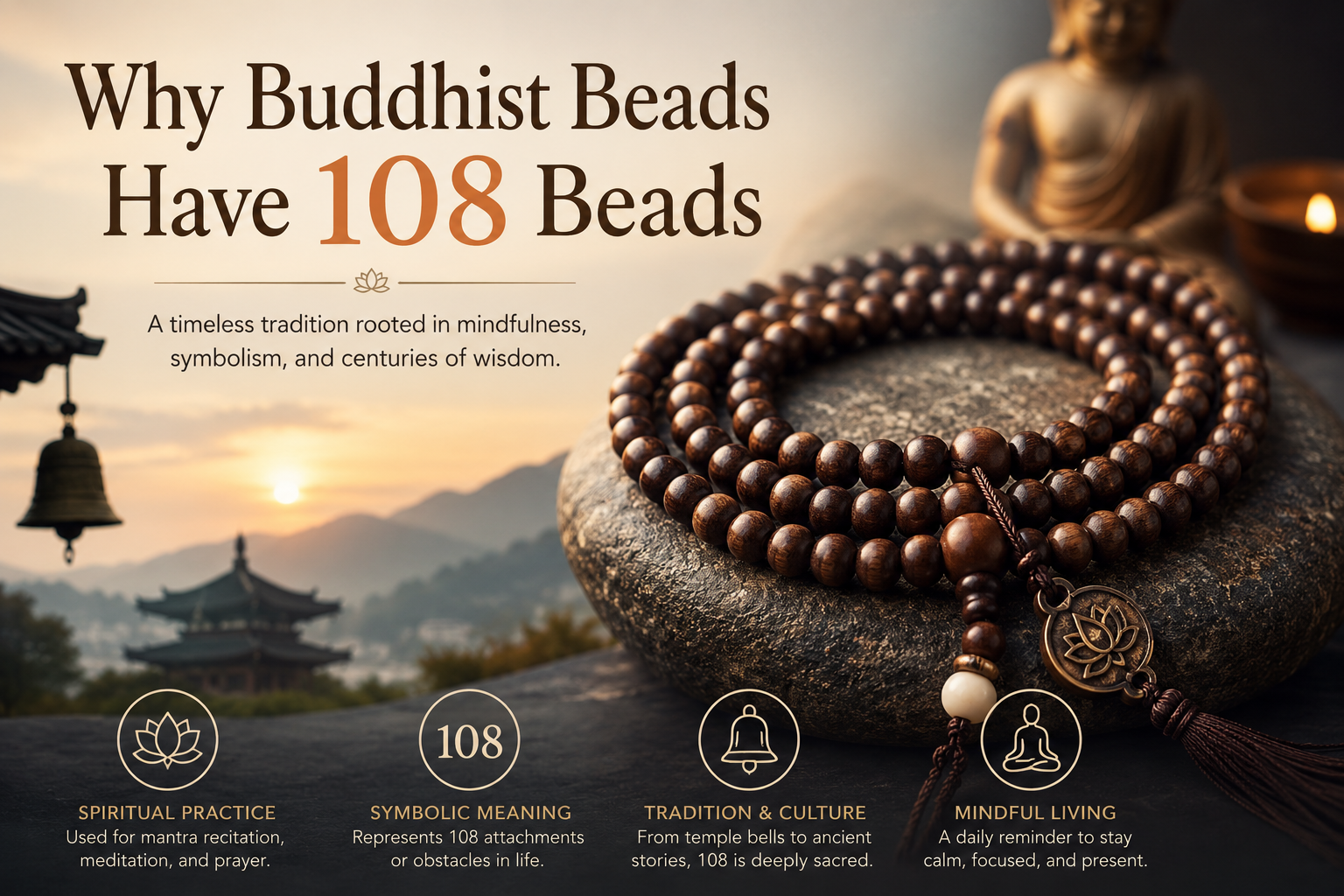
If you've ever held a traditional Buddhist bracelet or mala necklace, you may have noticed something curious: many of them contain exactly 108 beads.
The first time I learned this, I assumed it was just a design choice. But the more I explored Buddhist culture and Chinese traditions, the more I realized that the number 108 carries a deep symbolic meaning that has fascinated people for centuries.
Today, whether someone wears Buddhist beads for meditation, spiritual practice, or simply as a meaningful piece of jewelry, the number 108 remains one of the most recognizable symbols in Buddhism.
But why 108? And where did this tradition come from?
A Number Rooted in Ancient Buddhist Tradition
Traditionally, Buddhist prayer beads, often called a mala, contain 108 beads. Practitioners use them while chanting mantras, reciting prayers, or meditating.
Many people believe that counting beads helps focus the mind and prevents distractions. Instead of worrying about numbers, the practitioner can concentrate on breathing, prayer, or mindfulness.
In Buddhist practice, completing a cycle of 108 recitations is often seen as a symbolic journey toward greater awareness and inner clarity.
The exact origin of the number is difficult to trace, but stories and interpretations have been passed down through generations across India, China, Tibet, Japan, and other parts of Asia.
The Meaning of 108 Human Attachments
One of the most common explanations comes from Buddhist teachings about human desires and attachments.
Many people believe that humans experience 108 different forms of attachment, temptation, or emotional obstacles that can prevent them from seeing life clearly.
These may include emotions such as:
- Greed
- Anger
- Jealousy
- Pride
- Fear
- Ignorance
The idea is not that people must eliminate every emotion, but rather learn to understand and manage them.
Traditionally, each bead represents one of these worldly attachments. As practitioners move through all 108 beads, they symbolically work through these obstacles and return to a calmer state of mind.
Whether taken literally or symbolically, many people find this interpretation meaningful because it reflects the everyday challenges we all experience.
The Chinese New Year Connection
In China, the number 108 also appears in cultural traditions beyond Buddhism.
One interesting example happens on Chinese New Year's Eve in some Buddhist temples.
Traditionally, temple bells may be struck 108 times to welcome the new year.
Many people believe that these 108 bell strikes symbolize letting go of the worries, mistakes, and negative thoughts accumulated during the previous year.
The sound of the bell is believed to mark a fresh beginning.
Even today, thousands of visitors gather at famous temples to participate in these ceremonies, enjoying the atmosphere of reflection and renewal.
A Famous Story from Chinese Literature
The number 108 is also deeply woven into Chinese storytelling.
In the classic Chinese novel Water Margin, one of the Four Great Classical Novels of China, there are 108 legendary heroes who gather together to fight corruption and injustice.
While this story is not directly connected to Buddhist prayer beads, many scholars believe the popularity of the number helped strengthen its symbolic importance in Chinese culture.
In traditional Chinese thinking, numbers often carry meanings beyond mathematics. They become symbols of balance, destiny, or spiritual ideas.
Because of this cultural background, the number 108 feels familiar and meaningful to many people throughout East Asia.
Why Modern People Still Wear 108-Bead Malas
Not everyone who wears Buddhist beads today is a practicing Buddhist.
Some people use them during meditation.
Others wear them as a reminder to stay calm and mindful throughout the day.
Some simply appreciate their cultural significance and craftsmanship.
In recent years, 108-bead malas made from sandalwood, bodhi seeds, jade, obsidian, and other natural materials have become popular around the world.
Many people believe that carrying a mala creates a small daily ritual. Touching the beads during stressful moments can serve as a reminder to slow down, breathe, and focus on the present moment.
Whether or not someone follows Buddhist teachings, the beads often represent mindfulness rather than superstition.
More Than Just a Number
What I find most interesting about the number 108 is that there isn't just one explanation.
In different Buddhist traditions, different stories exist. Some focus on human desires. Others connect the number to ancient astronomy, sacred mathematics, or spiritual symbolism.
Yet all of these interpretations point toward a similar idea: the journey of self-reflection.
Traditionally, Buddhist beads were never meant to be ordinary jewelry. They were tools for mindfulness, patience, and personal growth.
That is why, after hundreds of years, the number 108 continues to appear on malas, temple bells, and spiritual practices across Asia.
The next time you see a 108-bead mala, you'll know that it represents far more than a collection of beads. It carries centuries of stories, traditions, and beliefs—each bead serving as a small reminder to return to awareness, one step at a time.
Comments (0)
No comments yet. Be the first to comment!
Leave a Comment
Please note, comments must be approved before they are published.