
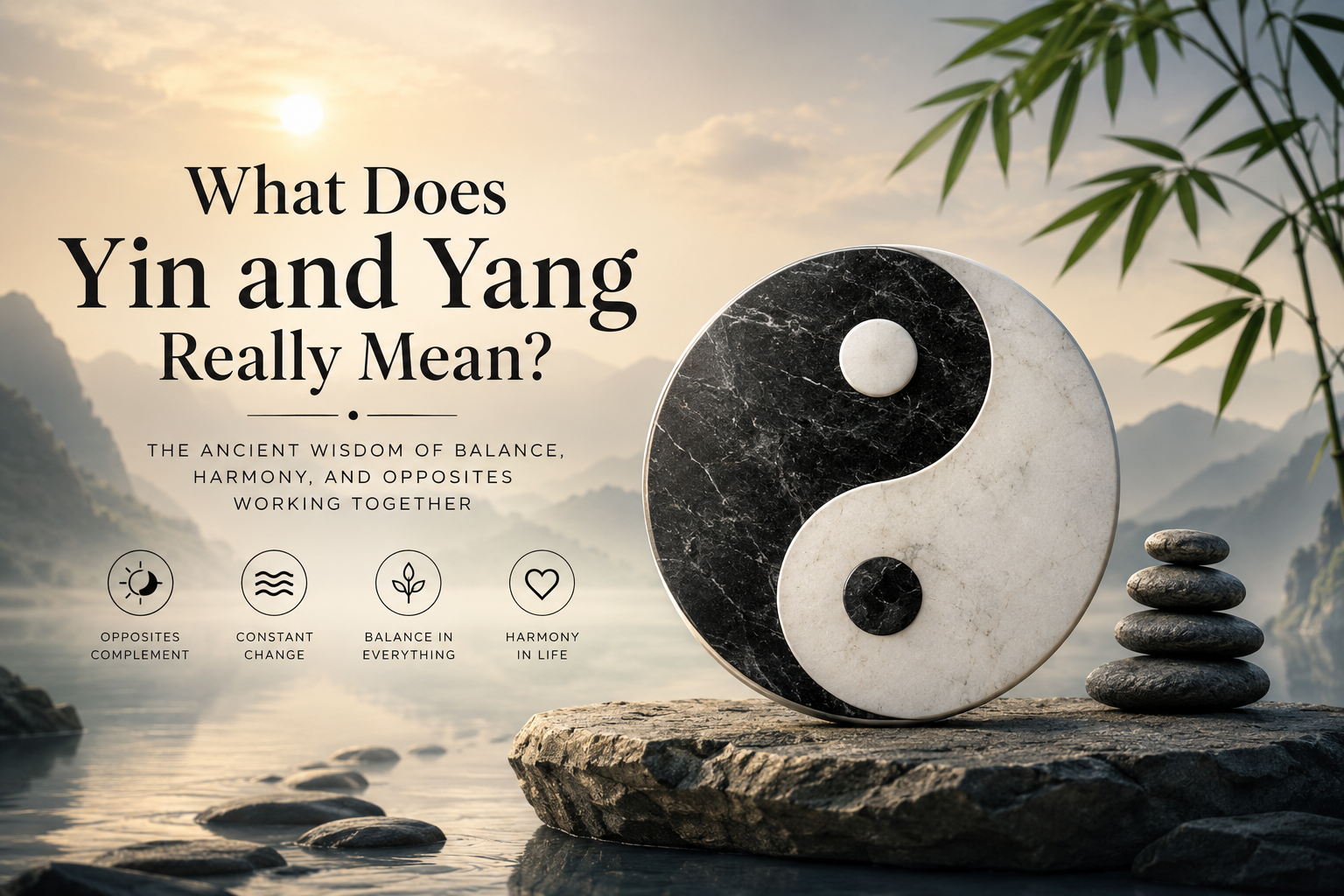
Yin and yang are related concepts in Chinese philosophy used to understand contrasting yet interconnected aspects of the world. Calling them “balance” is a starting point, but it can miss the relationship between the two. They are not simply competing teams, and the familiar black-and-white design is not a chart of good and evil.
Think in relationships
The University of Hong Kong’s University Museum and Art Gallery describes yin and yang through opposites coexisting in nature. Its art explanation points to contrasts such as light and shadow, color and shape. The important feature is their connection within a larger composition.
As a simple illustration, a shaded area is understood in relation to light around it. That example helps explain the idea without turning it into a claim about invisible substances stored in objects. “Opposite” does not need to mean hostile.
What does the circular symbol show?
The Rubin Museum calls the diagram taijitu, the “Image of the Great Ultimate.” Its explanation describes the two interlocking colors and places the symbol in Daoist and cosmological Confucian contexts. This is more specific than treating it as an anonymous decorative logo.
The flowing composition can prompt a viewer to think about relationship and change. Avoid claiming that every small feature has one timeless explanation unless the source actually gives that account. A familiar design can invite interpretation without settling every question about its history.
Do not turn associations into restrictions
Historical explanations associate yin and yang with pairs including dark and light, female and male, or passive and active. Describing those associations is different from telling a person what they are allowed to do because of their gender. A philosophical category should not become a jewelry eligibility test.
Nor does a pale or dark bead establish the condition of your body. Choosing an accessory by color is not a method of diagnosing health or prescribing a treatment.
What can it mean in jewelry?
You may wear the motif because its interlocking design interests you or because you associate it with considering different perspectives. Say that this is your own interpretation. A seller cannot establish that a bracelet balances your life simply by printing the symbol on a charm.
Our bracelet selection guide helps separate a personal preference from a claim about effects. For comparison with a different Chinese motif, read what a Pixiu bracelet means; sharing a cultural setting does not make two symbols interchangeable.
Keep the particular tradition visible
If a piece combines the diagram with a cord or another image, ask what each element is meant to express. Our introduction to red string traditions shows why a combined design should not automatically be assigned one origin.
Understanding yin and yang begins with connected contrasts and a documented philosophical context. You can appreciate that idea without turning it into a promise about health, relationships or a supposedly perfect state of permanent balance.
Comments
Leave a comment
Please note, comments must be approved before they are published.