
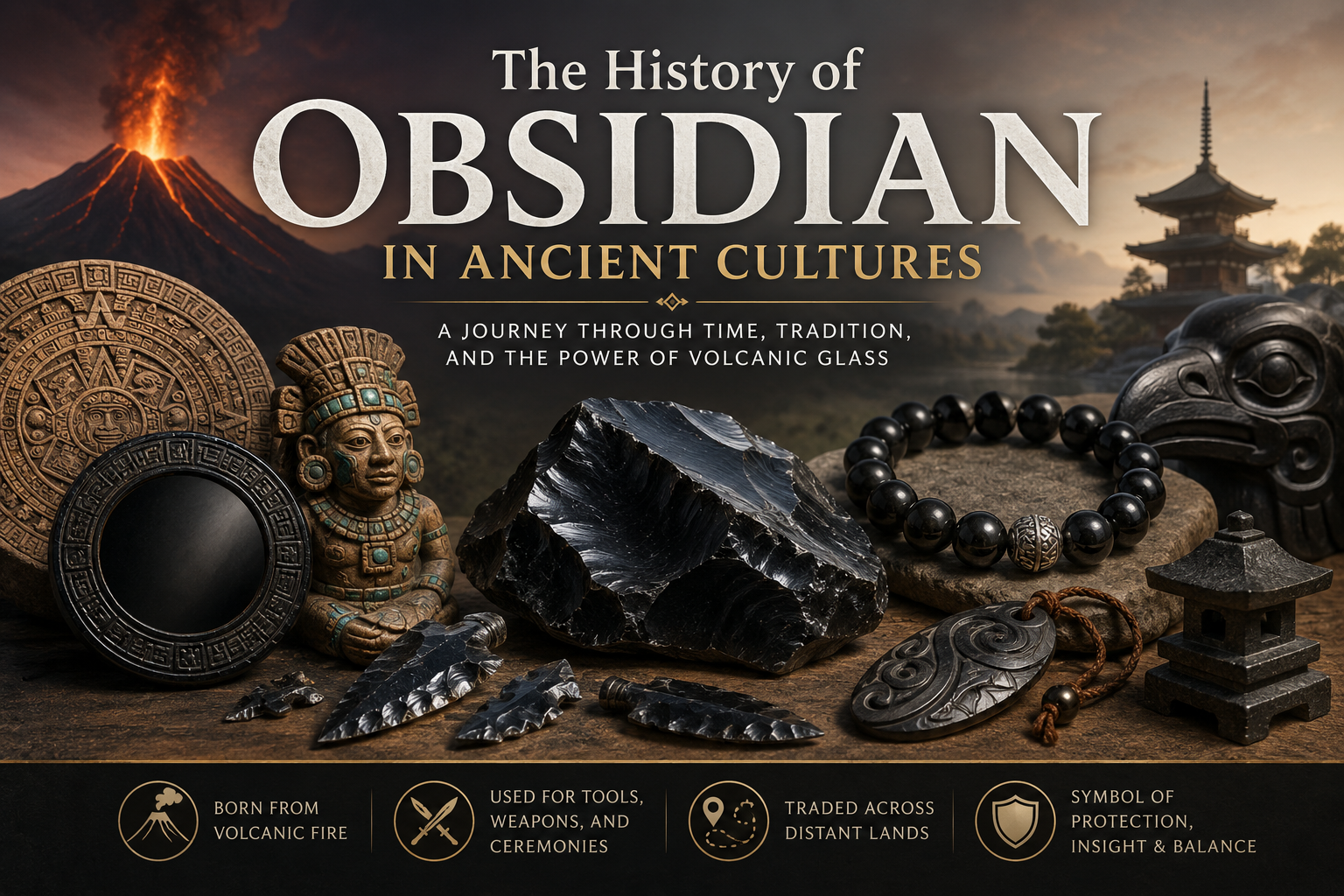
If you've ever held a piece of obsidian in your hand, you probably noticed something unusual about it. Its surface is dark, smooth, and reflective, almost like a natural mirror. Long before obsidian became a popular material for bracelets and spiritual jewelry, it played an important role in many ancient civilizations around the world.
What fascinates me most about obsidian is that nearly every culture that discovered it seemed to assign special meaning to it. Some used it as a practical tool. Others believed it carried spiritual power. While the details differed from place to place, the sense of mystery surrounding obsidian has remained surprisingly consistent throughout history.
A Stone Born From Fire
Obsidian is a form of volcanic glass created when lava cools rapidly. Unlike many crystals and minerals that form over thousands of years, obsidian can develop relatively quickly after volcanic eruptions.
Because of its sharp edges and glass-like texture, ancient people quickly realized it could be shaped into useful tools. Archaeologists have found obsidian blades, arrowheads, and ceremonial objects dating back thousands of years.
In many regions, obsidian became so valuable that it was traded across vast distances. Some ancient trade routes existed partly because communities wanted access to high-quality obsidian deposits.
Obsidian in Ancient China
Although jade often receives most of the attention when discussing traditional Chinese culture, obsidian also has a long history in China.
Archaeological discoveries suggest that obsidian tools were used in parts of ancient China during the Neolithic period. Traditionally, stones formed by natural forces were respected because they were believed to embody the energy of heaven and earth.
In some regions, black stones were associated with protection and grounding. Many people believe that dark-colored materials could help ward off unwanted influences and maintain balance in daily life.
One traditional Chinese belief that continues today is the importance of maintaining harmony between opposing forces. In the philosophy of Yin and Yang, black is often connected with Yin energy, representing depth, stillness, and reflection. Because of its deep black appearance, obsidian naturally became linked with these symbolic ideas.
While historical records vary, many people believe obsidian was sometimes carried as a protective talisman during travel or periods of uncertainty.
The Aztecs and the "Smoking Mirror"
One of the most famous obsidian traditions comes from ancient Mesoamerica.
The Aztecs valued obsidian so highly that it became part of both daily life and religious practice. They crafted weapons, tools, ornaments, and ceremonial objects from it.
A particularly fascinating story involves the deity Tezcatlipoca, whose name is often translated as "Smoking Mirror." Traditionally, polished obsidian mirrors were associated with this powerful figure.
Ancient priests sometimes used obsidian mirrors during rituals and acts of divination. Many people believe these mirrors symbolized self-reflection and the ability to see beyond ordinary appearances.
Even today, when people speak about obsidian's spiritual symbolism, the image of the obsidian mirror frequently appears.
Obsidian in Ancient Japan
In Japan, obsidian has been used since prehistoric times. Archaeological sites have revealed obsidian tools dating back more than 20,000 years.
What is remarkable is how far obsidian was traded. Researchers have discovered that communities transported volcanic glass across considerable distances, suggesting it was highly valued.
Traditionally, Japanese craftsmanship emphasized both practicality and beauty. Obsidian fit perfectly into that philosophy. Its sharpness made it useful, while its polished appearance gave it aesthetic appeal.
Many people believe that objects formed by nature's powerful forces, such as volcanoes, carry a unique presence. This idea can still be found in modern appreciation of natural stones throughout Japan.
The Protective Symbolism of Black Stones
Across many cultures, black stones often carried symbolic meaning beyond their practical uses.
In China, black was associated with depth and wisdom.
In parts of Central America, obsidian was linked with spiritual insight.
In some indigenous traditions, volcanic stones were respected because they emerged directly from the earth's inner fire.
Although these beliefs developed independently, they share a common theme: the idea that natural materials can remind people of their connection to the world around them.
This may explain why obsidian continues to attract interest today.
Why Obsidian Still Matters
When I first learned about obsidian, I assumed it was simply another decorative stone. The more I explored its history, however, the more interesting it became.
Few materials have traveled through so many cultures while maintaining such a strong sense of mystery. From ancient Chinese traditions to Aztec ceremonies and Japanese craftsmanship, obsidian has repeatedly appeared wherever people sought both practical tools and meaningful symbols.
Today, many people wear obsidian bracelets not because they expect miracles, but because they appreciate the stories, traditions, and symbolism connected to the stone.
Traditionally, obsidian has been associated with protection, reflection, and personal awareness. Whether viewed as a historical artifact, a beautiful natural material, or a meaningful piece of jewelry, its appeal has endured for thousands of years.
Perhaps that is the most remarkable part of obsidian's story. A stone born from volcanic fire continues to inspire curiosity, reflection, and cultural traditions long after the lava has cooled.
Comments (0)
No comments yet. Be the first to comment!
Leave a Comment
Please note, comments must be approved before they are published.