
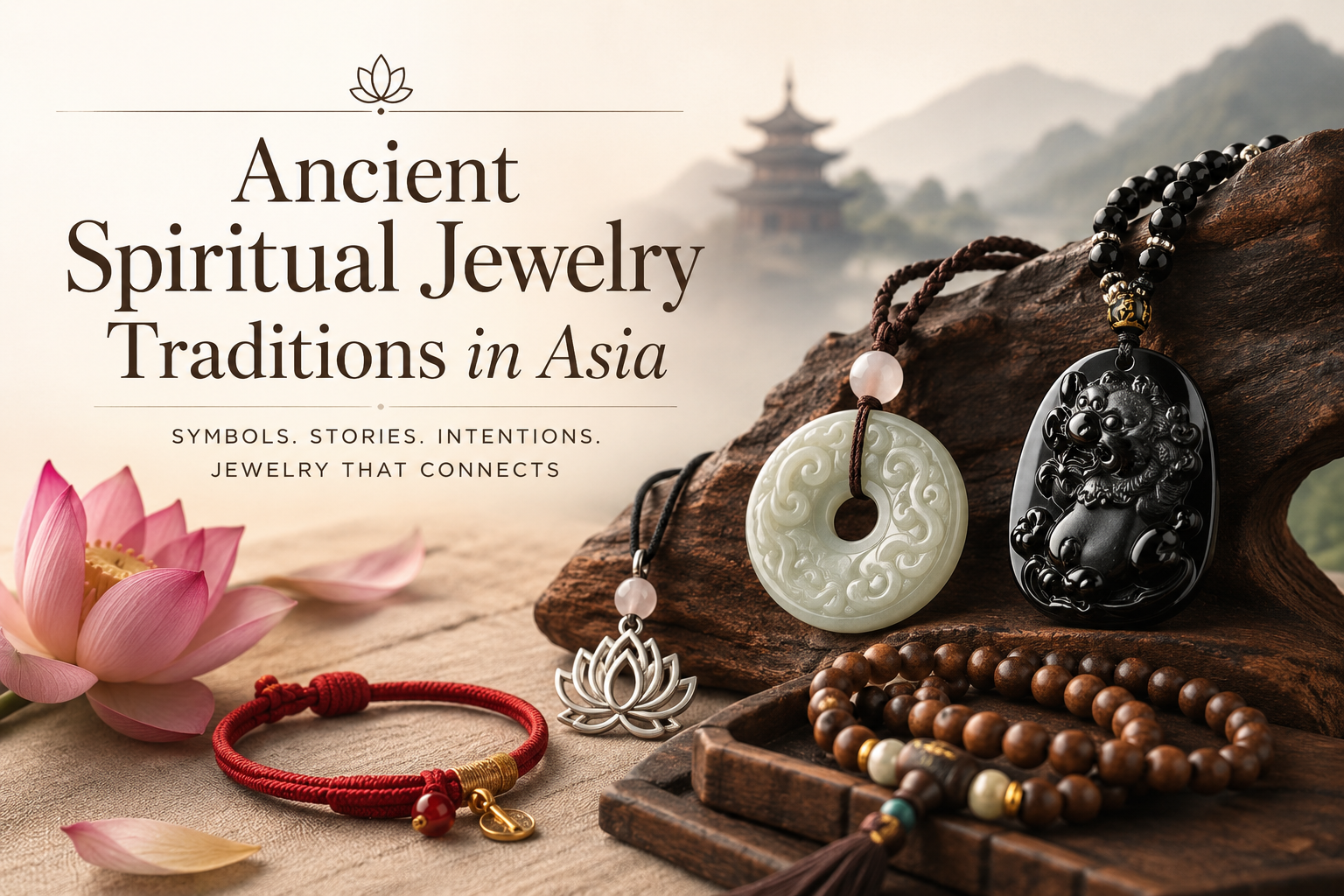
ewelry has never been just decoration.
Long before bracelets, pendants, and beads became fashion accessories, many people in Asia wore them as quiet symbols of protection, blessing, memory, and personal intention. A small string around the wrist, a carved jade pendant near the heart, or a row of prayer beads in the hand could carry a meaning far deeper than its size.
Traditionally, in many Asian cultures, spiritual jewelry was not about showing wealth first. It was often about connection: connection to family, nature, ancestors, faith, and the unseen rhythm of daily life.
Of course, not everyone today wears these pieces for religious reasons. Some people simply love their beauty. Others feel comforted by the stories behind them. Many people believe that when jewelry carries meaning, it becomes more personal. It turns into something you do not just wear, but return to.
Jade in Chinese Culture: A Stone of Character
In China, jade has been treasured for thousands of years. Traditionally, jade was associated with purity, wisdom, harmony, and moral strength. There is an old saying often repeated in Chinese culture: "Gold has a price, but jade is priceless." The idea is not only about money. It means jade carries a kind of inner value.
In ancient China, jade pendants were worn by scholars, nobles, and families who saw the stone as a symbol of refined character. Many people believe jade has a calm, grounding feeling, perhaps because it has been connected for so long with balance and gentle protection.
There is also a beautiful tradition of giving jade to children or loved ones. A small jade pendant, especially one shaped like a peace buckle or protective symbol, was often seen as a blessing: stay safe, stay well, and walk through life with good fortune.
Even today, when someone wears jade close to the skin, it can feel like carrying a piece of family history. It is not loud. It does not need to be. Jade has always spoken softly.
Red String Bracelets: A Simple Thread With Deep Meaning
A red string bracelet may look simple, but in many Asian traditions, red is a powerful color. In China, red is connected with joy, luck, celebration, and protection. Traditionally, red decorations appear during weddings, Lunar New Year, and important family events because the color is believed to invite good energy and keep misfortune away.
Many people believe a red string worn on the wrist can serve as a small reminder of blessing and intention. Some wear it for love, some for luck, and others for emotional comfort during a new chapter in life.
In Chinese folklore, there is also the famous idea of the "red thread of fate." According to the story, an invisible red thread connects people who are meant to meet. It may stretch or tangle, but it does not break. This story is often linked with romance, but I have always liked reading it more widely: some connections in life arrive at the right time, even if we do not understand them immediately.
That is probably why red string jewelry still feels meaningful today. It is humble, almost weightless, but it carries a story people remember.
Prayer Beads Across Asia
In Buddhist traditions across China, Tibet, Japan, Korea, India, and Southeast Asia, prayer beads have long been used for meditation, chanting, and mindfulness. These beads are often called mala beads, and many traditional strands have 108 beads.
The number 108 has many interpretations. In some Buddhist teachings, it is connected with human desires, distractions, or inner obstacles. Traditionally, moving through each bead while repeating a mantra helps the mind slow down and return to the present moment.
Today, not everyone uses bead bracelets or necklaces in a formal spiritual practice. Still, many people believe the physical act of touching beads can bring a sense of calm. In a busy world, that small repeated motion can feel surprisingly grounding.
This is one reason bead bracelets remain popular far beyond temples. They are wearable reminders to breathe, pause, and come back to yourself.
Obsidian and Protective Stones
In different parts of Asia, dark stones have often been associated with protection and grounding. Black obsidian, formed from volcanic glass, is especially loved today in spiritual jewelry. Many people believe it carries a strong, protective energy, although this should be understood as a cultural and personal belief rather than a guaranteed effect.
In modern Chinese-inspired jewelry, obsidian is often paired with symbols like Pixiu, a mythical creature believed to attract wealth and guard fortune. Traditionally, Pixiu is seen as a powerful guardian, especially in feng shui culture. Some wear Pixiu bracelets for prosperity, while others simply enjoy the bold look and the story behind the creature.
What makes obsidian interesting is its contrast. It looks quiet, dark, and polished, but the symbolism around it feels strong. For people who like meaningful jewelry, that contrast can be part of the attraction.
Lotus Jewelry: Beauty Rising From Mud
The lotus is one of the most beloved symbols across Asia. In Buddhism, it often represents purity, awakening, and spiritual growth. The flower grows from muddy water, yet rises clean and beautiful above the surface.
This image has touched many cultures because it feels so human. Life is rarely perfect. People go through confusion, grief, stress, change, and still try to grow toward something lighter.
Traditionally, lotus jewelry can be a reminder that difficult surroundings do not define the soul. In Chinese culture, the lotus is also admired for its elegance and integrity. It stands in the water but remains unstained.
Many people wear lotus pendants or bracelets not because they are making a religious statement, but because the symbol feels encouraging. It says, quietly, "Keep growing."
Why These Traditions Still Matter
Ancient spiritual jewelry traditions in Asia continue to inspire people because they combine beauty with meaning. A bracelet can be stylish, yes, but it can also hold a wish. A pendant can match an outfit, but it can also remind someone of protection, courage, love, or peace.
In the West, more people are becoming interested in jewelry that feels personal rather than mass-produced. They want to know where a symbol comes from. They want a story. They want something that feels connected to intention.
That does not mean every piece must be treated as magical. In fact, the most honest way to appreciate spiritual jewelry may be to see it as a bridge between culture and personal meaning.
Many people believe these pieces support energy, luck, or protection. Others see them as symbolic reminders. Both views can be meaningful. The important thing is to wear them with respect, curiosity, and an open heart.
Ancient jewelry traditions survived because they were never only about appearance. They were about what people hoped for: safety, love, wisdom, peace, prosperity, and a little guidance through uncertainty.
And maybe that is why a simple bracelet can still feel powerful today. Not because it promises to change everything, but because it helps us remember what we are carrying inside.
Comments (0)
No comments yet. Be the first to comment!
Leave a Comment
Please note, comments must be approved before they are published.