
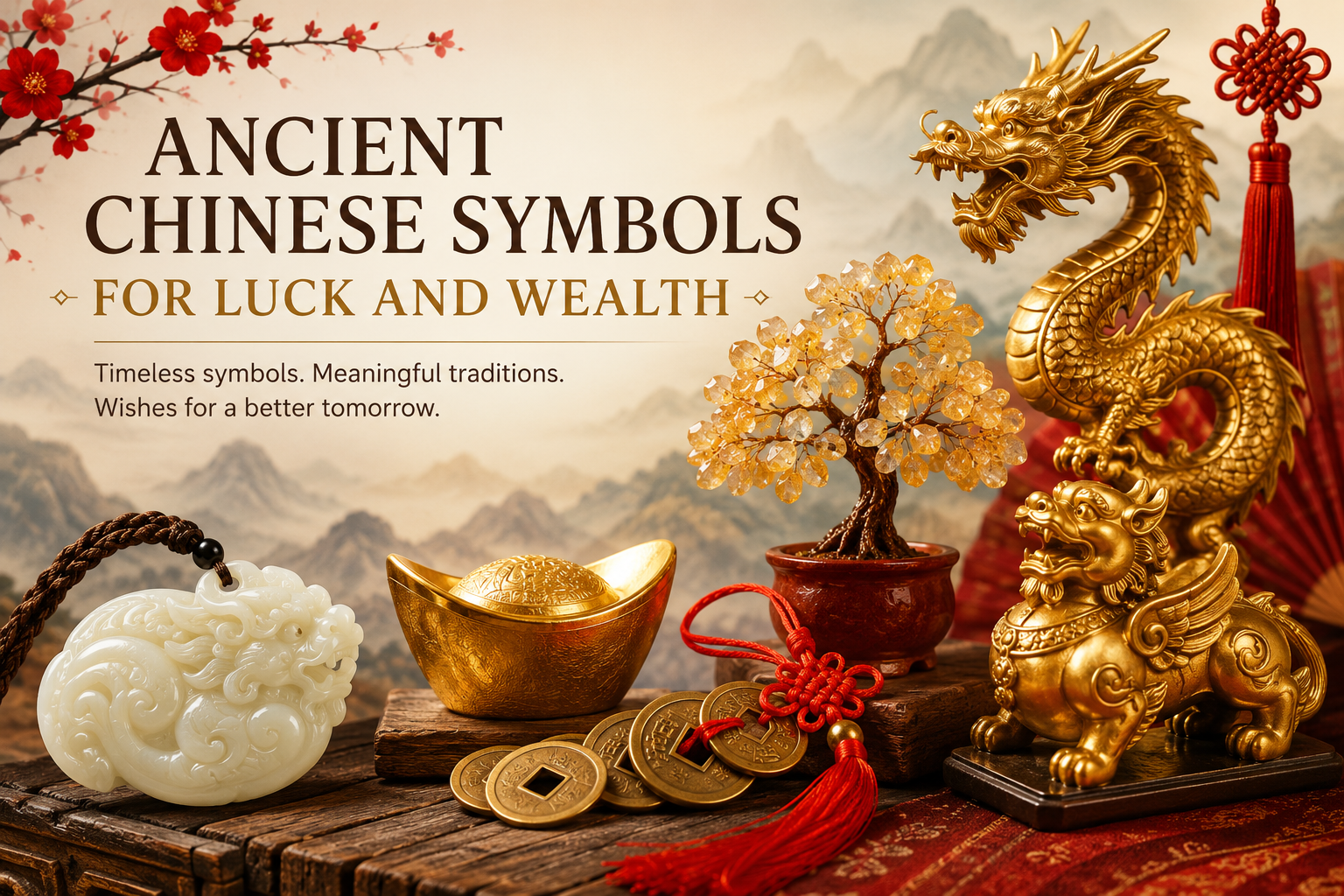
Chinese auspicious motifs communicate wishes, but they do not all mean the same thing. An animal, a character and a scene can express different ideas depending on the object and its setting. Museum descriptions are a useful place to begin because they connect an interpretation with something identifiable.
Pixiu: a wealth-related story
The National Palace Museum’s Southern Branch links Pixiu’s “in but not out” folklore with accumulating wealth. This is a reported symbolic interpretation, not evidence that a charm alters income. Our introduction to Pixiu bracelets explains how the motif appears in jewelry.
Bats: a wish communicated through sound
USC Pacific Asia Museum explains the bat motif through the sound association between fu and good fortune. Its guide also identifies five bats with the Five Blessings. The number and arrangement matter; a decorative bat is not simply a generic sign for money.
This is an example of a rebus: an image communicates through a word or phrase it evokes. To interpret a particular object, look for accompanying characters, other motifs and the museum’s explanation rather than relying on resemblance alone.
Carp and the Dragon Gate: achievement
The Metropolitan Museum of Art describes a fourteenth-century inkstone whose carp-to-dragon decoration evokes success in civil service examinations. A scene of transformation therefore deserves a more specific reading than “this fish brings cash.”
When looking at an unfamiliar design, check whether it actually shows this narrative. A fish by itself does not establish every detail of a larger story. Nor should every fish in a Chinese artwork automatically be called a koi without checking the description.
Phoenix imagery: another kind of auspicious association
The National Palace Museum exhibition discusses phoenix imagery alongside the dragon, including imperial and auspicious associations. This broadens the range of wishes represented in decorative art. Prosperity is one possible theme among many, rather than a single explanation for every mythical animal.
Our guide to Pixiu meaning offers a similar distinction between cultural context and a wearer’s own reading. The specific object remains important even when a motif is familiar.
How to approach a modern piece
- Ask the seller to identify the motif rather than just calling it lucky.
- Look for an object-specific museum reference when a historical claim is made.
- Separate a good wish from a promise of a real-world result.
- Check the actual materials and workmanship independently of the story.
Our guide to Pixiu material claims covers that last step. A meaningful design does not authenticate a gemstone or establish an object’s age.
It is more accurate to name these as Chinese auspicious motifs than to give every modern design one ancient origin. Read the image, its surrounding details and its documented context together; that is where the richer interpretations begin.
Comments
Leave a comment
Please note, comments must be approved before they are published.