
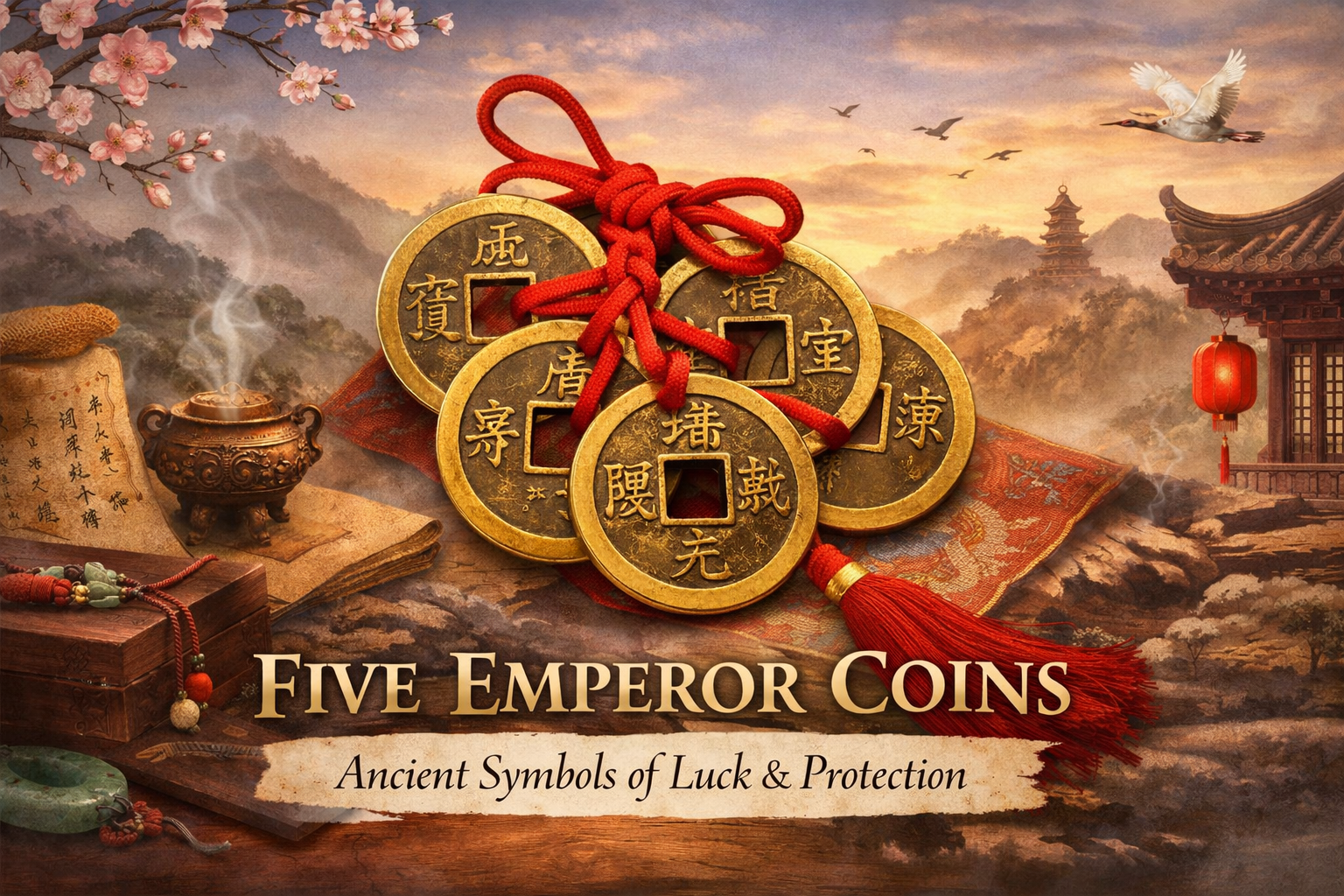
If you ever visit an old Chinese home, temple, or even a small street shop, you might notice a string of ancient-looking coins tied together with a red cord. These are known as “Five Emperor Coins” (五帝钱), and behind their modest appearance lies a rich blend of history, belief, and everyday life that has been passed down for centuries.
At first glance, they may seem like simple antique coins. But for many Chinese families, they are much more than that—they are symbols of protection, prosperity, and a connection to a powerful era in China’s past.
What Are Five Emperor Coins?
The Five Emperor Coins refer to coins minted during the reigns of five powerful emperors of the Qing Dynasty: Kangxi, Yongzheng, Qianlong, Jiaqing, and Daoguang. This period, roughly spanning the 17th to early 19th centuries, is often seen as a time of stability, economic growth, and strong imperial authority.
Each coin carries the name of its emperor, stamped in elegant Chinese calligraphy. When these five coins are gathered together, they are believed to represent the combined strength and fortune of a golden age.
Why Five Coins?
In Chinese culture, numbers often carry symbolic meaning. The number five is associated with balance and harmony—it echoes the concept of the Five Elements (wood, fire, earth, metal, water), which are thought to shape the universe.
By combining five coins from five emperors, people believe they are bringing together different forms of energy into a harmonious whole. It’s not just about wealth; it’s about stability, protection, and good fortune in all aspects of life.
A Story Passed Through Generations
There’s a popular folk story often told by elders. Long ago, a traveling merchant faced constant misfortune—lost goods, bad weather, dishonest partners. One day, he met an old man who gave him five old coins tied with a red string.
“Keep these close,” the old man said. “They carry the strength of great rulers.”
Skeptical but desperate, the merchant kept the coins with him. Slowly, his luck began to change. Deals went smoothly, his journeys were safe, and his business flourished. He later passed the coins to his son, telling him not just about their power, but about the importance of perseverance and faith.
Whether or not you believe the story, it reflects something deeply human—the desire to find meaning and reassurance in uncertain times.
How Are They Used Today?
Even in modern China, Five Emperor Coins are still widely used, especially in feng shui practices. People hang them near doors to “guard” the home, place them in wallets for financial luck, or keep them in cars for safe travels.
They’re also popular as gifts. Giving someone Five Emperor Coins is a way of saying, “I wish you success, safety, and abundance.” It’s a small object with a big message.
Interestingly, their appeal has gone beyond traditional settings. Today, you’ll find them incorporated into jewelry, keychains, and home decor—blending ancient symbolism with contemporary design.
Why Do People Still Believe in Them?
You might wonder: in an age of technology and science, why do these old coins still matter?
Part of the answer lies in culture. The coins are not just about superstition; they are a tangible link to history. Holding them feels like holding a piece of a story that has survived wars, dynasties, and generations.
Another part is emotional. Objects like these provide comfort. They remind people of family traditions, of grandparents who believed in them, of stories told during festivals or quiet evenings.
And sometimes, belief itself has power. When you carry something that symbolizes luck and protection, it can change how you face the world—with a little more confidence, a little more hope.
A Small Object with a Big Story
For international audiences, Five Emperor Coins offer a fascinating glimpse into Chinese culture. They show how history, philosophy, and daily life intertwine in subtle ways.
They are not just relics of the past. They are living symbols—adapted, reimagined, and still meaningful today.
So whether you see them as a cultural artifact, a decorative piece, or a lucky charm, one thing is certain: these coins carry stories. And sometimes, carrying a story is just as valuable as carrying luck itself.
Comments (0)
No comments yet. Be the first to comment!
Leave a Comment
Please note, comments must be approved before they are published.