
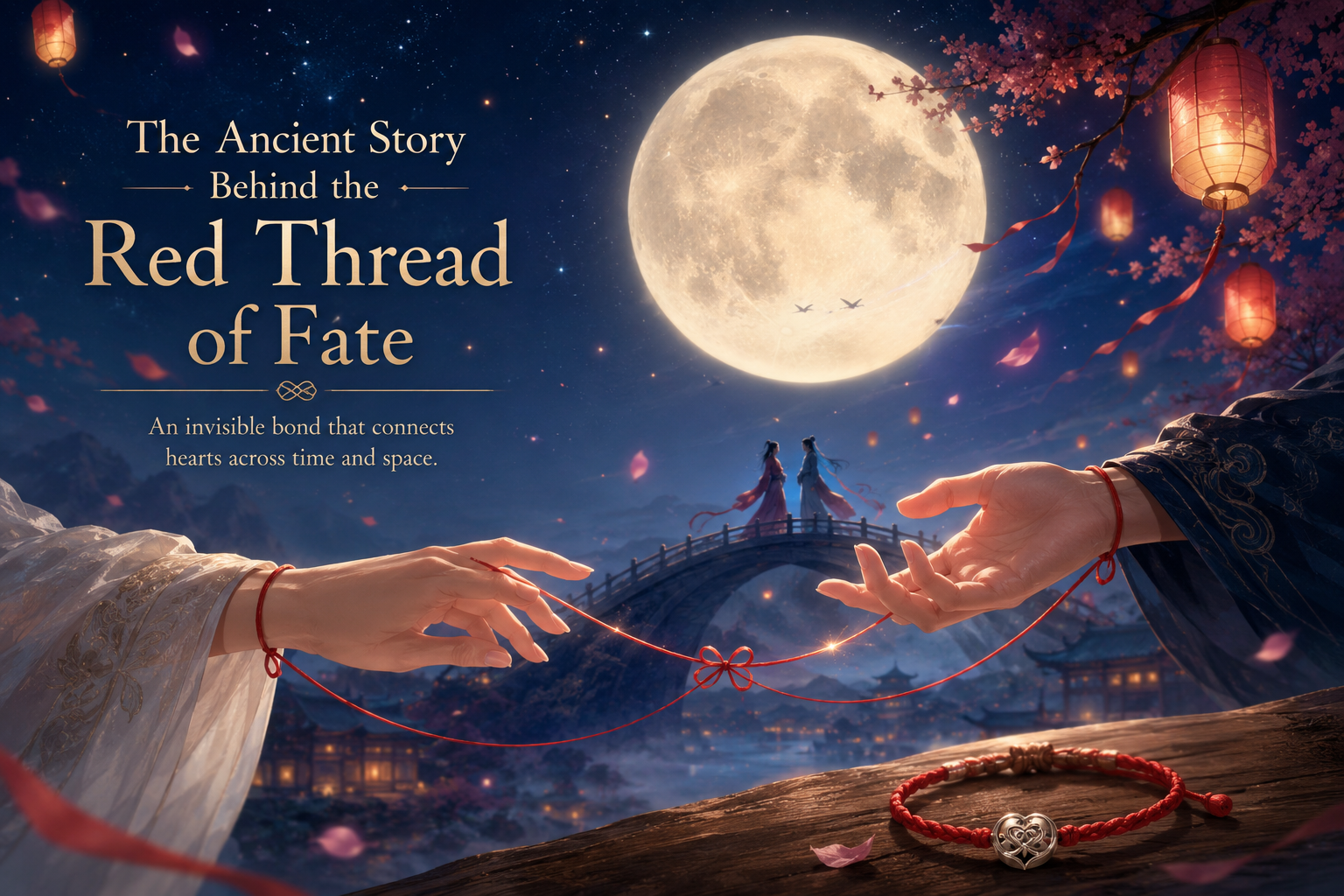
The red thread of fate is often reduced to a reassuring image: two people are connected despite distance. A closer reading of a named account is more interesting, and less tidy. The Chinese Yue Lao and Wei Gu story concerns marriage, destiny, and a man’s attempt to resist a prediction.
The account below follows Singapore’s San Qing Gong Taoist Cultural Centre. It is a temple’s retelling of a legend, not documentary proof that destinies are tied by a physical thread.
The encounter under moonlight
In San Qing Gong’s account, Wei Gu encounters an old man consulting a marriage book beneath the moon. The man carries red strings that join the feet of future spouses. He identifies a young child as Wei Gu’s future wife.
The story then takes a disturbing turn: Wei Gu arranges an attempt to kill the child. Years later, he discovers that the woman he has married is that same girl. Leaving out the attempted violence turns a difficult narrative into a much simpler romance than this account provides.
What belongs to this version
The marriage book, the future spouses’ feet, and Wei Gu’s recognition are specific features of this telling. Lungshan Temple also identifies Yue Lao with marriage matchmaking.
Neither reference establishes that the original story was about every friendship, family relationship, or significant encounter. If a modern writer applies the image to those connections, it is clearer to call that a new interpretation.
A legend is not a relationship instruction
A reader might see the story as a narrative about the limits of control. That is a reading, rather than a rule everyone must accept. The story should not be used to excuse harmful behavior, pressure someone into a relationship, or imply that persistence overrides another person’s refusal.
Appreciating folklore leaves room to question its values and notice what a simplified retelling removes. A meaningful connection in present life still depends on the people involved, rather than a prediction assigned to them.
From story to an object on the wrist
A modern red cord bracelet can refer to the thread image without being the same object described in the tale. The story does not by itself establish a particular wrist, a required knot count, or a historical origin for every red bracelet.
If you are choosing one as a gift, a note explaining your own message is more useful than claiming that the recipient must share a belief in destiny. For wider context, read the red rope’s story in China.
Our related legend guide offers another introduction, while the discussion of bracelets and love considers modern expectations. Keeping the narrative, its interpretation, and the jewelry distinct makes each easier to understand.
Comments
Leave a comment
Comments are reviewed before publication.